
Adaptive vocabulary practice personalizes what you study and schedules review based on how well you know each word, so you spend time on what you’re about to forget instead of what you already know. It works because it combines two proven mechanisms: the spacing effect, which times reviews right before you’d naturally lose a word, and the logic behind computerized adaptive testing, which adjusts difficulty to your actual level in real time. The result is fewer wasted reviews and longer retention, not just more studying.
TL;DR:
- Adaptive vocabulary practice personalizes review timing and difficulty, leading to faster mastery and less time wasted on already known words.
- The system tracks correctness, response time, and exposure across formats, adjusting intervals and progression based on mastery tiers.
- Exercises combining recall, sentence building, and listening reinforce long-term retention more effectively than recognition-only drills.
- Regular, short daily sessions with authentic reading or media improve vocabulary retention better than infrequent practice, especially when involving context-rich exposure.
- Adaptive practice efficiently supports receptive and semi-productive skills but must be complemented with speaking and writing for full language fluency.
Table of Contents
- The Building Blocks Of Adaptive Vocabulary Practice
- How Adaptive Algorithms Personalize Word Selection
- What The Research Says About Adaptive And Spaced Practice
- A Daily Routine That Actually Uses Adaptive Scheduling
- How Educators Can Build Adaptive Practice Into A Course
- How WordByWord Puts These Principles Into Practice
- When Adaptive Practice Should Lead, And When It Supports
- Start Building Vocabulary From What You Already Read
- Sources
- FAQ
The Building Blocks Of Adaptive Vocabulary Practice
An adaptive system tracks three things for every word you touch: whether you got it right, how long it took you to answer, and how many times you’ve seen it before. Those signals feed an algorithm that decides what to show you next and when to show it again.
Spaced repetition is the timing engine underneath this. Instead of cramming fifty words in one sitting, a well-built system spreads review across days and weeks, pushing intervals out as a word gets easier and pulling them back in when you slip. That beats massed practice, where everything gets crammed at once, because spacing and active recall together produce more durable vocabulary learning than repetition alone.
Exercise format matters just as much as timing:
- Multiple choice builds initial recognition fast, but it’s the weakest format for long-term retention.
- Gap-fill and typed answers force actual recall, which sticks longer.
- Sentence building tests whether you can use a word, not just spot it.
- Listening and voiceover modes catch words you’d miss in text alone.
Mastery tracking usually runs on tiers, such as unknown, learning, practiced, and mastered, with error patterns flagging words that keep slipping backward.
How Adaptive Algorithms Personalize Word Selection
Every adaptive engine is running a version of the same question: how likely is this person to get this item right, right now? That’s the idea behind item-response models, and you don’t need the math to use it. The system just needs enough signal to make a decent guess, then it adjusts as you answer.
The signals that actually drive that guess include:
- Correctness on the last few attempts, not just the most recent one.
- Response time, since a five-second answer and a thirty-second guess mean different things even when both are correct.
- Number of prior exposures across all formats, not just flashcards.
- Whether you’ve seen the word in real context, like an article or a video, versus only in isolated drills.
Adaptive systems work best when they blend several of these signals instead of leaning on a single right or wrong flag, because a lucky guess and genuine mastery look identical on one data point alone.
Graduation rules typically promote a word after two or three correct answers spaced days apart, not one lucky streak. Demotion works the other way: one missed answer after a long gap usually resets the interval, sometimes drops the mastery tier too. Format progression follows the same logic, easing you from multiple choice into gap-fill and then into typing or sentence construction as your error rate drops.
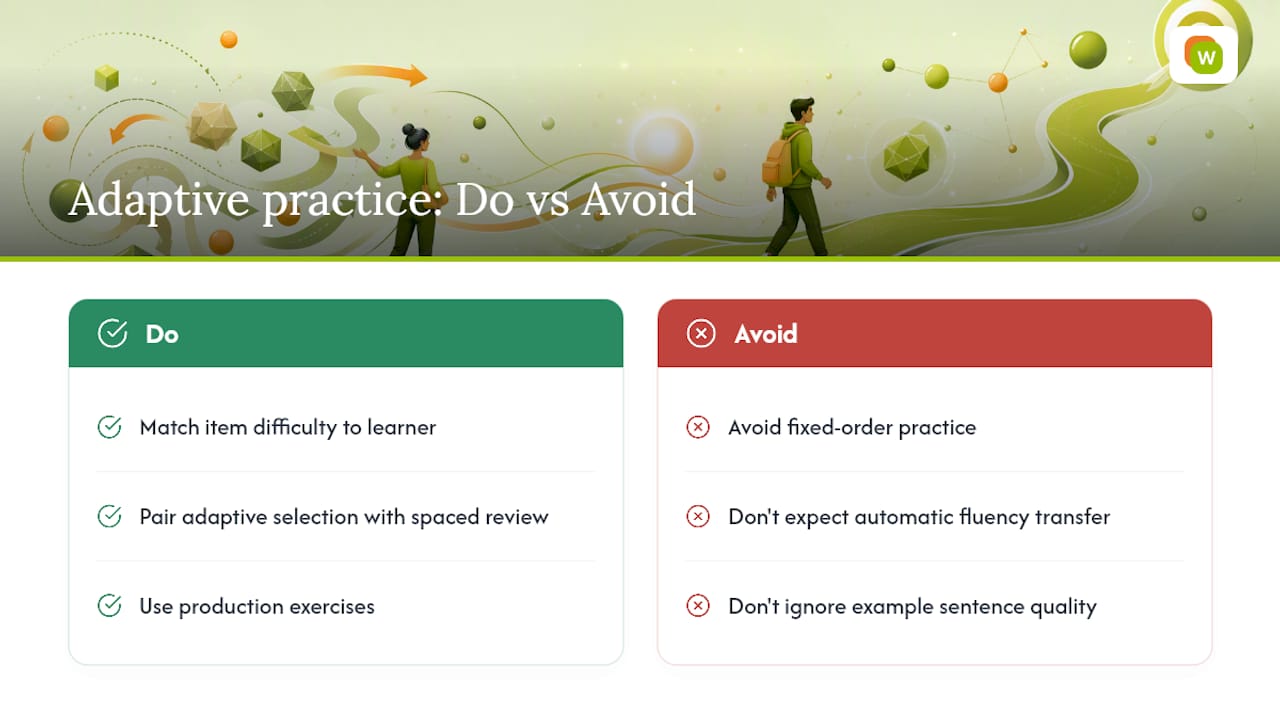
Pro Tip: If a tool lets you skip straight to production formats, use that option once a word feels easy in multiple choice. Recognition success is a weak signal on its own, and forcing a typed answer or a sentence builder exposes gaps that recognition-only practice hides.
What The Research Says About Adaptive And Spaced Practice
The strongest academic backing for this approach comes from work on computerized adaptive testing for vocabulary size, which found that adjusting item difficulty to the test-taker produces reliable estimates of vocabulary knowledge with far fewer items than a fixed test would need. That matters beyond testing: the same difficulty-matching logic is what makes adaptive practice efficient, not just adaptive assessment.
Adaptive selection paired with spaced review consistently outperforms fixed-order practice on long-term retention, largely because both mechanisms target the same failure point: reviewing things too early or too late to matter.
On the practice side, production-focused exercises like gap-fill and sentence building strengthen retention more than recognition-only drills, because retrieving a word yourself builds a stronger memory trace than picking it from a list.
The practical payoff shows up as faster mastery per word, fewer repeated reviews of words you already know, and better recall weeks later. The caveats are real too: adaptive vocabulary drills build receptive and semi-productive knowledge efficiently, but they don’t automatically transfer into fluent speaking or writing, and the quality of example sentences a tool uses affects how well context actually sticks.
A Daily Routine That Actually Uses Adaptive Scheduling
A moderate daily practice session, lasting several minutes and focusing on a moderate number of items, is generally enough to see steady progress without burning out. Here’s a routine that works for most self-study learners:
- Start with review items the system flags as due, not new words. Clearing the backlog first keeps the schedule honest.
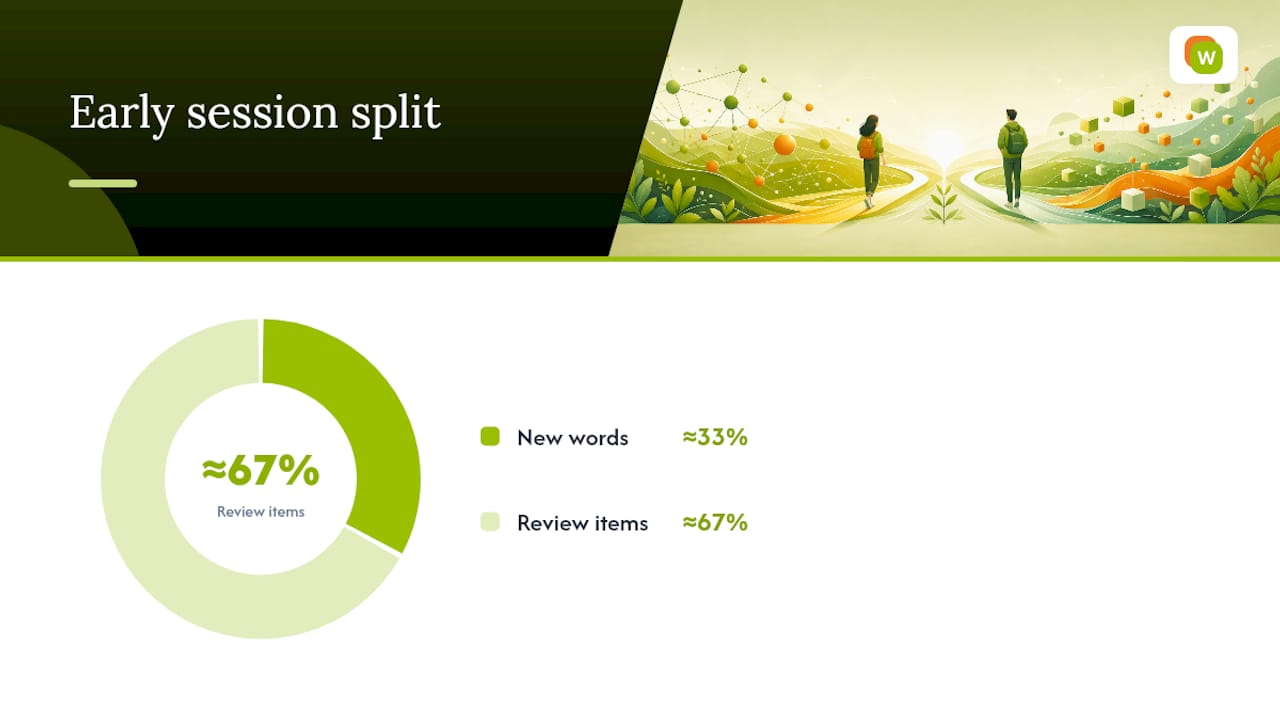
- Cap new words at around one-third of the session early on, then let the ratio drop as your review queue grows.
- Run new words through recognition first, then push them into gap-fill or typed recall within the same week rather than waiting.
- Pull vocabulary from something you’re actually reading or watching, not just a generic list, since context-rich exposure reinforces meaning faster.
- Check your mastery breakdown weekly. If a word’s interval keeps stretching without slips, trust the system and let it push that word further out.
Where the words come from matters more than most learners assume. Authentic reading, YouTube captions, and imported spreadsheets all work, but mixing sources keeps the vocabulary tied to contexts you’ll actually encounter again. Tracking vocabulary while reading is worth doing deliberately rather than passively, since words you notice but don’t capture rarely make it into long-term memory.
Once you’ve got a backlog of words in progress, the adaptive scheduler will naturally shrink that ratio, and fighting it by adding more new words just delays mastery on what you’ve already started.*
How Educators Can Build Adaptive Practice Into A Course
A shared class collection, built once and assigned to everyone, keeps the syllabus consistent while each student’s review schedule still adapts individually. That’s the balance most classrooms need: common vocabulary, personalized timing.
Practical steps that make this work:
- Build or curate one collection per unit, then assign it as homework tied to that week’s lesson.
- Use mastery reports to spot who’s stalled on the same handful of words, and group interventions around those patterns rather than guessing.
- Generate additional practice sentences for spaced review when a class collection needs more context examples than the default set provides.
- Treat adaptive drills as the vocabulary layer underneath communicative classwork, not a replacement for speaking and writing practice.
Mastery breakdowns showing unknown, learning, practiced, and mastered tiers are far more useful for grouping students than a single average score, since two students with the same score can have completely different gaps.
How WordByWord Puts These Principles Into Practice
WordByWord builds adaptive vocabulary practice directly into the reading and watching you’re already doing, rather than asking you to open a separate app. Spotlight mode highlights unfamiliar words on any page by how well you know them, so the words that need attention are visible before you start reading. A comprehension estimate tells you what share of a text’s vocabulary you already know, which helps you judge fit before committing time to it.
Behind that sits the same mechanics covered earlier:
- Collections you build by hand, generate with AI, or import via CSV from tools like Anki or Quizlet.
- Spaced repetition flashcards with voiceover across seven training modes, including typing, sentence building, and a 60-second sprint.
- Statistics showing streaks and how your vocabulary is distributed across learning stages, matching the mastery-tier tracking described above.
The mechanics stay tied to real content instead of a fixed curriculum, which is the core distinction from flashcard-only tools.
When Adaptive Practice Should Lead, And When It Supports
Adaptive drills are the most efficient way to build receptive and semi-productive vocabulary, especially for learners with limited daily time. They shouldn’t stand alone. Pair them with speaking, writing, and real conversation to reach full productive fluency, since recognizing a word and producing it under pressure remain different skills.
— WordByWord Team
Start Building Vocabulary From What You Already Read
The workflows in this guide, capturing words from real content, letting spaced repetition time your reviews, and progressing from recognition to production, are exactly what WordByWord’s Chrome extension does inside the browsing you already do. Instead of switching to a separate app, you click a word on any site, PDF, or YouTube video, and it lands in a collection ready for review.
Install the extension, build your first collection from an article you’re already reading, and let Spotlight mode show you what’s actually unfamiliar before you dive in. The Free Forever plan covers core translation and review features with no time limit, and Premium removes the usage caps for $5.99 a month if you want unlimited collections and full access to every training mode.
Sources
- Measuring English vocabulary size via computerized adaptive testing
- Academic Word List (related learning-science appendix)
- Vocab Quiz Maker: AI Study Tool | FluentFlash
FAQ
What Is Adaptive Vocabulary Practice?
It’s a study method that adjusts word difficulty and review timing to your individual performance, rather than showing everyone the same fixed list in the same order. It draws on spacing and item-difficulty matching from adaptive testing research to keep practice efficient.
How Is Adaptive Practice Different From Regular Flashcards?
Regular flashcards often follow a fixed deck order regardless of how well you know each card. Adaptive systems reorder and reschedule cards based on your correctness, response time, and prior exposures, which cuts down on reviewing words you’ve already mastered.
How Much Daily Practice Is Enough?
Fifteen to twenty items over ten to twenty minutes a day tends to outperform occasional long sessions, largely because distributed daily practice supports better retention than infrequent cramming. Consistency matters more than session length.
Does WordByWord Use Adaptive Vocabulary Practice?
Yes. WordByWord uses Spotlight highlighting, comprehension estimates, and spaced repetition flashcards across seven training modes to adapt review to what you already know from real content you read or watch.
Is Adaptive Practice Enough On Its Own To Reach Fluency?
Adaptive drills build strong receptive and semi-productive vocabulary efficiently, but full fluency also requires speaking, writing, and real conversation. Treat adaptive practice as the vocabulary foundation underneath those communicative skills, not a replacement for them.