
Using context clues during real reading is the most practical way to build durable vocabulary. Not flashcard drills. Not word lists. The moment a reader pauses on an unfamiliar word and uses the surrounding text to figure out its meaning, a memory trace forms that isolated memorization rarely creates. Here is a quick routine to try right now:
- Notice the unknown word. Circle or highlight it mentally. Do not skip it.
- Reread the sentence and the one before it. Look for definition signals, contrasting ideas, or examples nearby.
- Substitute your best guess and check. Does the sentence still make sense? If yes, keep reading.
Say a student hits the word arid in the sentence “The desert was so arid that no plants could survive.” The surrounding words “desert” and “no plants could survive” point directly to “extremely dry.” No dictionary needed. The same logic works for verbs: “She gesticulated wildly, waving her arms and pointing at the door” gives away the meaning through the appositive phrase that follows.
Pro Tip: For a 5-minute in-class warm-up, project one sentence with a challenging word underlined, ask students to write their best guess and the clue they used, then discuss. A quick thumbs-up/thumbs-down check tells you instantly who needs more scaffolding.
Table of Contents
- Why do context clues matter for comprehension?
- What are the six types of context clues?
- How do you infer a word’s meaning step by step?
- Classroom activities that build context-clue skills
- How do you scaffold context-clue instruction over time?
- When should you look up a word instead of inferring it?
- How WordByWord fits into a context-learning workflow
- Key Takeaways
- Why the “just look it up” reflex is holding students back
- Turn every reading session into vocabulary practice with WordByWord
- Useful sources
Why do context clues matter for comprehension?
Context clues are the words, phrases, sentences, and visual elements surrounding an unfamiliar word that help a reader infer its meaning. They are not a trick or a shortcut. They are the natural mechanism through which fluent readers process new vocabulary every day.

Learning vocabulary through context produces stronger long-term retention than isolated rote memorization. When a learner encounters a word inside a sentence they are already processing for meaning, the brain encodes both the word and its semantic neighborhood at once. That dual encoding is what makes the word stick.
Consider two students who encounter the word tenacious. One writes it on a flashcard with the definition “persistent.” The other reads it in a paragraph about a climber who refused to quit despite a broken harness. Weeks later, the second student is far more likely to use the word correctly in writing, because the meaning was never abstract. It was attached to a story.
For teachers, the practical implication is this: the goal of context instruction is to improve reading comprehension first, and vocabulary depth follows from that. Teaching students to infer meaning keeps them inside the text rather than bouncing between the page and a dictionary.
What are the six types of context clues?
Context clues fall into six primary categories, each requiring a slightly different reading move. The table below shows each type with a classroom-ready example and a quick instructional note.
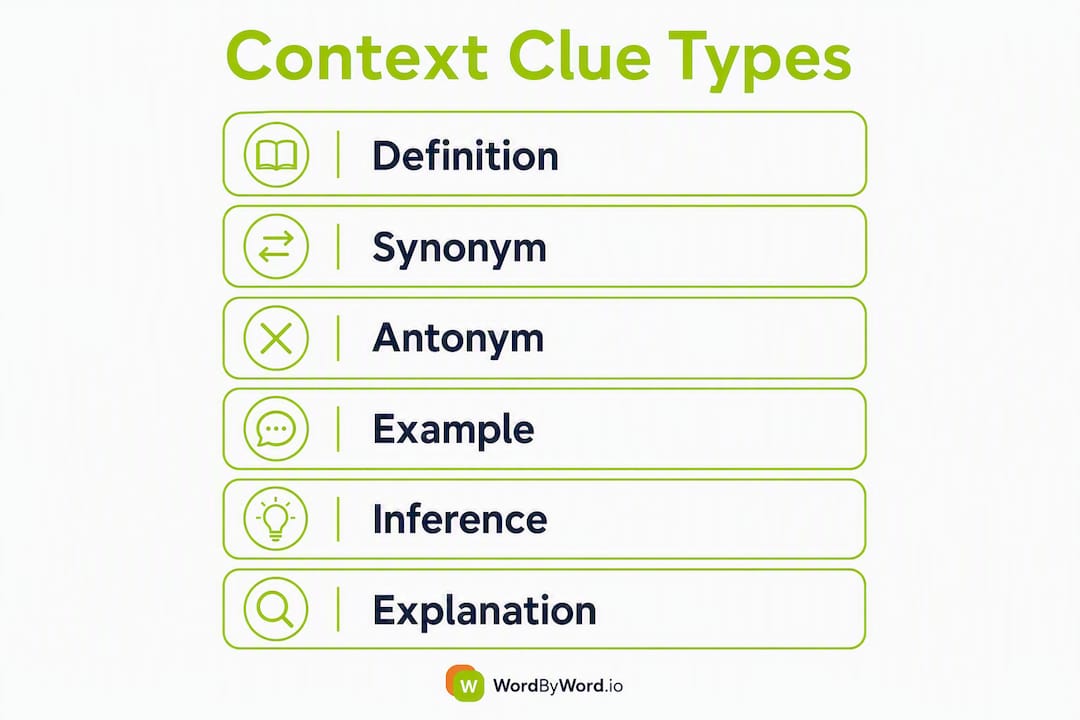
| Clue type | In-text example | What to teach |
|---|---|---|
| Definition | “The protagonist, or main character, faced a difficult choice.” | Look for commas, dashes, or “or” signals that introduce a restatement. |
| Synonym | “She was loquacious, always chatty and full of stories.” | A nearby word with a similar meaning often follows a comma. |
| Antonym/Contrast | “Unlike his frugal brother, Marco spent money freely.” | Signal words: unlike, but, however, in contrast. |
| Example | “Citrus fruits, such as kumquats, are high in vitamin C.” | “Such as,” “for example,” and “including” introduce examples. |
| General knowledge/Logic | “The surgeon sutured the wound before bandaging it.” | Prior knowledge about surgery tells you suturing closes a wound. |
| Word parts (morphology) | “The bilateral agreement required both countries to sign.” | Bi = two; lateral = side. Break the word at its roots. |
Teacher note on visuals and structure: diagrams, captions, and bold text in textbooks function as a seventh clue type. Train students to glance at surrounding images before reading a dense paragraph.
Mini exercise (paste directly into a lesson):
Read the sentence below. Underline the clue word or phrase. Write your inferred meaning. Then write the clue type.
Expected answer: novice = beginner; clue type = example/logic (the phrase “never made bread before” explains the unfamiliarity).
Pro Tip: When planning a reading lesson, scan the text in advance for one word from each clue type. Assign each type to a different student group. Each group finds their word, identifies the clue, and reports back. The whole activity runs in under 10 minutes.
How do you infer a word’s meaning step by step?
Students need a repeatable procedure they can run independently, without prompting. The four-step routine below is short enough to memorize and specific enough to actually work.
- Notice. Flag the unfamiliar word. Do not skip it or guess randomly. Acknowledge that you do not know it yet.
- Reread. Read the sentence again, plus the sentence before and after. Look for definition signals, contrast words, or examples.
- Use morphology and neighboring clues. Break the word into parts (prefix, root, suffix). Check whether a synonym, antonym, or example appears nearby.
- Substitute and check. Plug your best guess into the sentence. Does it make grammatical and logical sense? If yes, continue reading. If no, try a different inference or flag the word for later.
Walkthrough example: A student reads, “The cantankerous old man complained about everything from the weather to the mail.” Step 1: flag cantankerous. Step 2: reread; “complained about everything” is the key phrase. Step 3: no obvious prefix, but “complained about everything” is a strong behavioral example clue. Step 4: substitute “grumpy” — “The grumpy old man complained about everything” — yes, that holds. Inference confirmed.
Student cheat-sheet (one line to memorize or tape inside a notebook): Notice → Reread → Break it down → Substitute and check.

Classroom cue phrase for teachers: “Sense, Scan, Guess, Check.” Post it on the board. When a student raises a hand about an unknown word, point to the poster before answering. Most of the time, they will find the answer themselves.
Techniques that reinforce this routine include using new words immediately in a sentence after inferring them, and learning phrase-level collocations rather than single words in isolation. Both practices strengthen context-based retention by forcing the brain to process meaning in use, not in abstraction.
Classroom activities that build context-clue skills
Explicit instruction and guided practice in context clues improves students’ ability to infer word meanings and supports comprehension. The three activities below are ready to run with minimal prep.
| Activity | Objective | Time | Materials |
|---|---|---|---|
| Guided read-aloud | Model the four-step inference routine aloud | 10–15 min | A short text (1–2 paragraphs) projected for the class |
| Context-search stations | Students find and categorize clue types in authentic texts | 5 min | 4–5 printed text excerpts, sticky notes, clue-type reference card |
| Sentence-repair relay | Teams rewrite sentences where the target word is blanked out, then compare inferences | 15 min | Sentence strips with one word replaced by a blank |
Sample text for the guided read-aloud (paste directly):
Excavated is supported by the example clue “brushing away layers of soil.” Meticulous is supported by the appositive “checking every centimeter before moving on.”
Lesson plan template:
- Objective: Students identify at least two types of context clues in an authentic text.
- Warm-up (5 min): Project one sentence; students write their inference and clue type.
- Instruction (10 min): Model the four-step routine with the read-aloud text.
- Practice (15 min): Context-search stations or sentence-repair relay.
- Formative check (5 min): Exit ticket — one new sentence, one unknown word, students write their inference and name the clue type.
- Extension homework: Find one unfamiliar word in tonight’s reading. Write the sentence, your inference, and the clue type.
Assessment checklist (quick formative):
- [ ] Student identifies the unfamiliar word without prompting
- [ ] Student rereads surrounding sentences before guessing
- [ ] Student names the clue type used
- [ ] Student’s inferred meaning fits the sentence logically
- [ ] Student can use the word correctly in a new sentence
How do you scaffold context-clue instruction over time?
A single lesson on context clues does not build a habit. The skill needs to be introduced, practiced with support, and then released gradually over several weeks.
Suggested scaffold timeline:
- Weeks 1–2 (guided practice): Teacher models the four-step routine with whole-class texts. Students observe and respond to comprehension questions that probe word meaning.
- Weeks 3–4 (shared practice): Small groups work through texts together, identifying clue types and comparing inferences. Teacher circulates and uses responsive scaffolding rather than pre-teaching words.
- Weeks 5–6 (gradual release): Students apply the routine independently during reading. Teacher observes and intervenes only when comprehension breaks down.
- Week 7 onward (independent application): Students self-monitor, flag words they cannot infer, and bring them to class for discussion.
Sample rubric for quick assessment:
| Criterion | 3 (Proficient) | 2 (Developing) | 1 (Beginning) |
|---|---|---|---|
| Accuracy of inference | Meaning matches context fully | Meaning is partially correct | Meaning is unrelated or missing |
| Use of morphology | Breaks word into parts correctly | Attempts word parts with errors | Does not attempt word parts |
| Application in new sentence | Uses word correctly and naturally | Uses word with minor errors | Cannot use word in new sentence |
Formative assessment options:
- Exit tickets: one sentence, one unknown word, one inference, one clue type named
- One-minute writes: “What does [word] mean here, and how do you know?”
- Peer checks: partners swap inferences and evaluate each other’s reasoning
Differentiating for English learners and struggling readers: Provide a clue-type reference card they can keep on their desk. Use shorter texts with more explicit clues early on. Pair visual clues (images, diagrams) with text-based clues so students have multiple entry points. Timothy Shanahan’s approach of observing comprehension and responding with targeted prompts rather than pre-teaching every word is especially useful here — it keeps students in the productive struggle zone without leaving them stranded.
When should you look up a word instead of inferring it?
Context clues work most of the time, but not always. Students and teachers need a clear decision rule so that reading flow is preserved without sacrificing comprehension.
Decision tree:
- Does the word block your understanding of the main idea? If yes, try the four-step routine first.
- After trying the routine, does the sentence still not make sense? If yes, look it up or ask.
- Is the word central to a test, assignment, or key concept in the unit? If yes, verify your inference with a dictionary or teacher after reading.
- Is the word a proper noun, technical term, or acronym with no surrounding clues? Look it up immediately.
- Does the word appear multiple times in the text? Flag it, finish the paragraph, then check.
Pro Tip: Teach students to avoid the “dictionary trap.” Stopping to look up every unfamiliar word interrupts comprehension and weakens memory consolidation. The rule of thumb: try context first, dictionary second, teacher third.
Classroom policy (one or two sentences teachers can post or say aloud):
“During independent reading, try the four-step routine before looking anything up. If you have tried twice and the word still blocks your understanding of the paragraph, you may check a dictionary or ask.”
This policy keeps students engaged with the text while giving them a legitimate exit when inference genuinely fails. It also signals that not knowing a word is expected, not a failure.
How WordByWord fits into a context-learning workflow
The strategies above work on paper. WordByWord makes them work at scale, across every text a student or learner reads online.
Student workflow:
- Encounter an unfamiliar word on any webpage, PDF, or YouTube subtitle.
- Highlight it with the WordByWord extension. The tool captures the word and its surrounding sentence automatically, preserving the encounter context.
- Create a practice item. The AI trainer generates gap-fill exercises and sentence-recall prompts using the original sentence, so practice stays anchored to real context rather than a stripped definition.
- Schedule retrieval practice. Smart flashcards surface the word again at spaced intervals, using the original sentence as the cue.
Anchoring new vocabulary to the original sentence rather than isolating it on a plain flashcard improves usability and transfer to speaking and writing. WordByWord’s sentence-anchoring approach does exactly that by default.
Classroom use cases:
- Teachers build a shared collection from a class reading text and assign it to students before a lesson.
- Students capture vocabulary from homework reading and bring their collections to class for discussion.
- The export/import feature (CSV) lets teachers pull student collections for review or assessment.
- YouTube subtitle integration means vocabulary from listening activities gets captured with the same sentence context as text-based reading.
Relevant WordByWord features for context learning: instant word capture, sentence-context anchoring, AI-generated practice items, spaced-repetition flashcards, Spotlight mode (visual vocabulary map), progress tracking, and community-shared collections. For a practical guide to capturing vocabulary while reading, see how to track vocabulary while reading.
Pro Tip: Use WordByWord to supplement classroom instruction, not replace it. The active discussion and teacher-led modeling in class builds the inference habit; the extension captures and reinforces what students encounter outside class. On school devices, check your district’s browser extension policy before installing — the translate on hover guide covers permission and privacy considerations in detail.
Key Takeaways
Inferring word meaning from real text, not memorizing word lists, is the most reliable path to durable vocabulary growth.
| Point | Details |
|---|---|
| Context beats rote memorization | Learning words in context produces stronger long-term retention than isolated flashcard drills. |
| Six clue types to teach | Definition, synonym, antonym, example, logic, and morphology each require a distinct reading move. |
| Four-step student routine | Notice → Reread → Break it down → Substitute and check; post it and use it daily. |
| Scaffold before releasing | Move from teacher-modeled to shared to independent practice over several weeks before expecting fluency. |
| WordByWord anchors context | The extension captures words with their original sentences, turning every reading session into structured retrieval practice. |
Why the “just look it up” reflex is holding students back
The conventional advice to “use a dictionary when you don’t know a word” is not wrong. It is just badly timed. When a student stops mid-paragraph to look up a word, they lose the thread of the argument they were following. By the time they return to the sentence, the comprehension context that would have made the word memorable is gone. The definition lands in isolation, and isolation is exactly the condition that produces forgetting.
What the research on incidental vocabulary learning keeps showing is that repeated, varied encounters in meaningful context are what convert recognition into usable vocabulary. A dictionary gives you one encounter, stripped of context. Real reading gives you the word in action, surrounded by the ideas that give it meaning.
The smarter classroom move is to teach students that inference is the default, not the fallback. The dictionary is a verification tool, not a first resort. When teachers model this explicitly, students stop treating every unknown word as a problem to be solved externally and start treating it as a puzzle the text itself can usually solve.
That shift in stance, from passive lookup to active inference, is what separates readers who grow their vocabulary through reading from those who stay stuck at the same level year after year.
Turn every reading session into vocabulary practice with WordByWord
Reading builds vocabulary only when unknown words get captured and revisited. WordByWord gives students and language learners a frictionless way to do both at once. Highlight any word on any webpage, PDF, or YouTube video, and the extension saves it with its full sentence context intact. No separate study session required.

From that single highlight, the AI trainer generates gap-fill exercises and sentence-recall prompts built from the original text, so practice always stays connected to real meaning. Spaced-repetition flashcards bring the word back at the right interval. Spotlight mode turns any page into a live vocabulary map, showing at a glance which words you know and which still need work. The core features are free. Premium unlocks unlimited collections, advanced AI exercises, and enhanced voiceover across more than 50 languages.
Teachers can build a shared class collection from any reading text in minutes, assign it to students, and export results as a CSV for review. Install WordByWord and try it free on your next reading session.
Useful sources
A short list of authoritative references behind this article, worth bookmarking for professional development or parent communication.
- Using context clues to understand word meanings — Reading Rockets’ breakdown of the six clue types with classroom examples; a reliable reference for lesson planning.
- How I teach students to use context in vocabulary learning — Timothy Shanahan’s interview on responsive scaffolding; essential reading for any teacher designing a gradual-release sequence.
- Learning words from context (academic chapter) — Academic synthesis on incidental learning conditions; the strongest evidence base for why repeated, varied exposure matters.
Teacher note: Print or save the Shanahan interview and the Keys to Literacy piece before your next department meeting. Both are short, research-grounded, and persuasive enough to use as professional development reading or to share with parents who ask why you are not pre-teaching every vocabulary word.