

TL;DR:
- Tracking vocabulary while reading helps learners move new words from passive recognition to active use through organized review. WordByWord’s Spotlight mode highlights unfamiliar words on web pages and simplifies capturing their context, boosting retention. Consistent review, confidence rating, and limiting new words per session improve overall language proficiency over time.
Tracking vocabulary while reading is the process of capturing, organizing, and reviewing new words encountered in texts to build lasting language proficiency. Most readers encounter unfamiliar words and move on, losing them permanently. The learners who grow fastest treat every reading session as a data collection opportunity. WordByWord’s Spotlight mode makes this concrete: it highlights words you haven’t learned yet directly on any web page, so unknown vocabulary stands out the moment you open an article. AI-assisted vocabulary tools produce a large positive effect on learning outcomes, with a meta-analysis effect size of g = 1.309. That number means the gap between learners who use structured tracking and those who don’t is not marginal. It’s significant.
How to track vocabulary while reading: tools and setup
The right setup determines whether your tracking habit sticks or collapses after a week. Browser extensions are the most efficient starting point for online reading. WordByWord’s Spotlight mode turns any web page into a visual vocabulary map, highlighting words based on your current knowledge level. Click a highlighted word to translate it instantly and save it with its surrounding sentence. Modern vocabulary tools also support context capture and export to spaced repetition systems, so your saved words flow directly into review sessions.

Manual tools still have a place, especially for academic or literary reading. A dedicated notebook, a spreadsheet, or a simple text file works well when you want to write definitions in your own words or sketch a quick mnemonic. The key is pairing your manual record with a review system, not just a collection.
Before you start, confirm three prerequisites. First, you need basic reading proficiency in the target language. Tracking works best when you understand roughly 80–90% of a text and encounter unfamiliar words in context. Second, your device needs to support your chosen tool. Third, you need a working understanding of spaced repetition, the practice of reviewing words at increasing intervals to lock them into long-term memory. Without spaced repetition, even the best vocabulary log becomes a graveyard of forgotten words.
| Tool category | Automation | Context capture | Review support |
|---|---|---|---|
| Browser extensions (e.g., WordByWord) | High | Yes, with sentence | Built-in flashcards |
| Spreadsheets or notebooks | None | Manual entry | Self-managed |
| Standalone flashcard apps | Low | Manual entry | Spaced repetition |
| Integrated reading + review apps | Medium | Semi-automatic | Built-in |
Pro Tip: Start with one tool only. Adding three systems at once creates friction. Pick a browser extension for online reading and a single notebook for offline texts, then expand once the habit is solid.
Step-by-step method for recording new words while reading
A repeatable process beats good intentions every time. The following method works for online articles, PDFs, and long-form reading in any language.
-
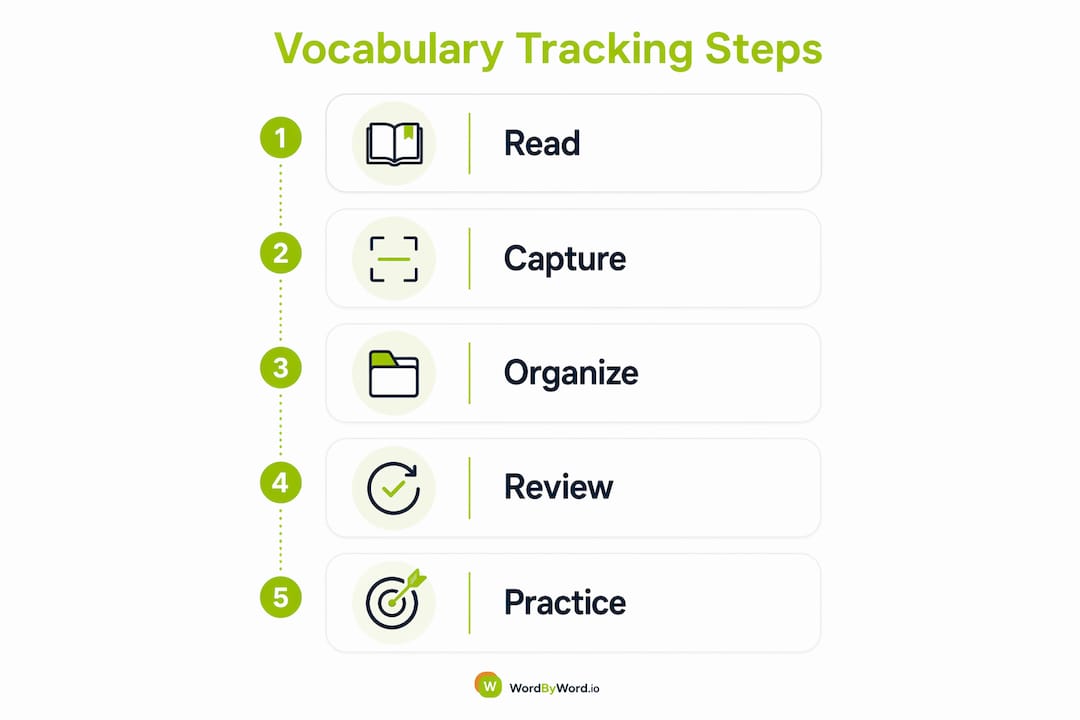
Read actively and flag unknowns. Open your text and read at a normal pace. When you hit an unfamiliar word, resist the urge to skip it. With WordByWord’s Spotlight mode active, unknown words are already highlighted before you even start reading. This visual map tells you immediately whether a text matches your current level.
-
Translate and save with context. Click the highlighted word to see an instant translation. Save the word along with its full sentence. Attaching sentence context to saved vocabulary items significantly improves recall during later review. A word saved without context is far harder to retrieve than one anchored to a real sentence you read.
-
Add a personal note or mnemonic. After saving, spend five seconds writing a note. It could be a synonym, a memory hook, or a sentence you compose yourself. The involvement load hypothesis shows that retention improves when learners engage with words through multiple modes, including seeing, saving, and writing. Deeper engagement produces more durable memory.
-
Rate your confidence. Use a simple Vocabulary Knowledge Rating Scale: mark each word as “never seen,” “seen but unsure,” “know it roughly,” or “know it well.” The Vocabulary Knowledge Rating Scale helps learners focus study on the words that actually need work, rather than reviewing words they already know.
-
Review with spaced repetition. WordByWord’s built-in flashcards use your saved words and their context sentences. Review daily for 10 minutes. Words you get right move to longer intervals. Words you miss come back sooner. This cycle is what converts short-term recognition into working vocabulary.
Pro Tip: After each reading session, spend two minutes writing three sentences using words you just saved. Producing language, not just recognizing it, is the fastest path to real fluency.
What challenges come up when tracking vocabulary, and how do you fix them?
Every learner who tracks vocabulary hits the same walls. Knowing them in advance saves weeks of frustration.
Collection bloat is the most common problem. You save 50 words in a week and review none of them. The fix is a 3-check mastery system: a word is only marked as mastered after three separate successful reviews across different sessions. This prevents your vocabulary list from becoming a dumping ground and keeps your review queue manageable.
Over-reliance on instant translation is the second trap. Clicking to translate every unknown word feels productive, but it bypasses the cognitive effort that builds retention. Before clicking, try to guess the meaning from context. Use the translation to confirm or correct your guess. This one habit dramatically increases how much you retain from each session.
Motivation drops hit hardest between months two and four of a learning project. Progress feels invisible. WordByWord’s Spotlight mode provides a concrete counter to this feeling. As your vocabulary grows, fewer words on any given page get highlighted. Watching the highlights fade over weeks is a visible, real-time measure of growth that no test score can replicate.
Tracking vocabulary is not about collecting words. It’s about retiring them. Every word you move from “unknown” to “mastered” is a word that no longer slows your reading. The goal is a shorter list, not a longer one.
Inconsistent review routines undo weeks of collection work. Set a fixed daily review window, even if it’s only 10 minutes. Learners who review at the same time each day retain significantly more than those who review in irregular bursts. Pair your review session with an existing habit, such as morning coffee or a lunch break, to make it automatic.
How do you monitor vocabulary acquisition progress over time?
Measuring growth requires more than counting saved words. Saved words are inputs. Acquired words are outputs. The distinction matters.
-
Use self-rating scales weekly. Revisit your Vocabulary Knowledge Rating Scale entries every seven days. Words that move from “seen but unsure” to “know it well” represent real acquisition. Words stuck at the same rating after two weeks need a different approach, such as a new mnemonic or more reading exposure.
-
Record spontaneous usage. Spontaneous use of vocabulary in speech or writing is a stronger indicator of working vocabulary than any worksheet or quiz. Write three to five sentences each week using recently tracked words. If you can produce them naturally, the words are yours.
-
Watch your Spotlight highlights decrease. Open the same type of article you read a month ago and count how many words WordByWord highlights. Fewer highlights mean your reading vocabulary has grown. This is one of the most honest progress metrics available because it reflects real reading conditions, not controlled test environments.
-
Compare against fluency milestones. Research on language acquisition shows conversational fluency typically arrives after about two years of consistent study, while academic fluency takes five to seven years. These timelines set realistic expectations. Learners who understand this front-load their motivation and avoid the false belief that slow progress means failure.
-
Run a periodic vocabulary test. Every month, take a standardized vocabulary test in your target language. Record your score. Over six months, the trend line tells you more than any single score.
Long-term tracking, measured in months and years rather than days, is what separates learners who plateau from those who reach genuine fluency. The data you collect now becomes the evidence you need to stay on course later.
Key Takeaways
Consistent vocabulary tracking, combining AI-assisted capture with spaced repetition review and spontaneous output practice, is the most reliable path from recognition to fluency.
| Point | Details |
|---|---|
| Start with context capture | Always save the full sentence with a new word to improve recall during review. |
| Use the 3-check mastery rule | Mark a word as mastered only after three successful reviews across separate sessions. |
| Rate your confidence weekly | Apply a Vocabulary Knowledge Rating Scale to focus study on words that still need work. |
| Measure output, not just input | Write sentences using new words each week to confirm real acquisition, not just recognition. |
| Track progress visually | Watch WordByWord’s Spotlight highlights decrease over time as a reliable measure of vocabulary growth. |
What I’ve learned about vocabulary tracking after watching thousands of learners
The WordByWord Team has watched a consistent pattern across learners at every level. The ones who grow fastest are not the ones who save the most words. They’re the ones who review the fewest words, because they’ve mastered them and moved on.
Most learners treat their vocabulary log like a trophy case. They collect words to feel productive. Real acquisition looks different. It’s quieter. It’s a shrinking list, not a growing one. The moment you start measuring success by how many words you’ve retired rather than how many you’ve saved, your entire approach shifts.
The other mistake we see constantly is separating tracking from reading. Learners open a separate app, type in a word, close the app, and return to reading. That context switch kills momentum and reduces the chance they’ll actually review the word later. The best tracking happens inside the reading experience itself. WordByWord’s Spotlight mode was built around this principle. The word is highlighted where you find it. You translate it where you find it. You save it where you find it. The reading flow stays intact.
Combining AI-assisted tracking with deliberate manual input for complex words gives you the best of both approaches. Let automation handle high-frequency words. Reserve your manual effort for academic or domain-specific vocabulary that needs a personal mnemonic or a written definition to stick.
One more thing: don’t wait for fluency to feel real before you trust your progress. The highlights fading on your screen are real. The sentences you write each week are real. Trust the system, not the feeling.
— WordByWord Team
WordByWord Spotlight: vocabulary tracking built into your browser
WordByWord’s Spotlight mode solves the biggest problem in vocabulary tracking: the gap between reading and reviewing. Every word on a web page gets color-coded based on how well you know it. Words you haven’t learned yet stand out instantly. Click any highlighted word to translate it, save it with its context sentence, and add it to your personal vocabulary collection. As your knowledge grows, the highlights fade. That visual change is your progress report, updated in real time on every page you read. WordByWord works across websites, PDFs, and YouTube in over 50 languages. Start tracking vocabulary without leaving your browser.
FAQ
What does it mean to track vocabulary while reading?
Tracking vocabulary while reading means capturing, organizing, and reviewing unfamiliar words encountered in texts. The goal is to move words from passive recognition to active use through structured review.
How many new words should I save per reading session?
Saving five to ten words per session is more effective than saving thirty. A smaller set reviewed consistently produces better retention than a large set that never gets revisited.
Does saving words with context sentences really help?
Yes. Context sentences improve recall significantly compared to decontextualized flashcards. Always save the sentence where you found the word, not just the word and its definition.
How long does it take to reach conversational fluency?
Conversational fluency typically takes about two years of consistent study. Academic fluency requires five to seven years. Consistent vocabulary tracking accelerates both timelines.
What is the Vocabulary Knowledge Rating Scale?
The Vocabulary Knowledge Rating Scale is a self-assessment tool where learners rate each word on a scale from “never seen” to “know it well.” It helps focus study time on words that genuinely need work rather than words already mastered.


