
TL;DR:
- Active recall is the most effective study method for language retention, significantly outperforming passive review.
- Using retrieval practice strengthens neural pathways and improves vocabulary ability, especially when combined with spaced repetition.
Active recall is the single most effective study technique for language retention, and the research on this is not close. Students using retrieval practice retain material substantially better after one week compared to those who only re-read. That gap is the difference between vocabulary that shows up in conversation and vocabulary that vanishes the moment you close your notes.
The core idea is simple: instead of reviewing a word by looking at it, you force your brain to produce it from scratch. No prompts, no hints, no peeking. That act of retrieval, even when it feels rough and incomplete, physically strengthens the neural pathway to that memory. Recognition (understanding a word when you see it) and recall (producing it mid-sentence) are different cognitive processes. Passive review builds the first. Active recall builds the second, which is the one that actually matters for fluency.
Three tools that serious language learners rely on for this kind of practice are Pearson’s research-backed learning frameworks, Language Transfer’s input-heavy audio method, and WordByWord’s AI-powered browser extension, which turns everyday reading into structured vocabulary retrieval.
- Active recall means retrieving language from memory without external prompts
- Recognition feels easier but fades faster than genuine recall
- Every retrieval attempt strengthens the neural pathway to that word or phrase
- Passive review builds familiarity; active recall builds the retrievability you need in real conversation
- Cognitive science reviews consistently rank active recall as the most effective retention method available
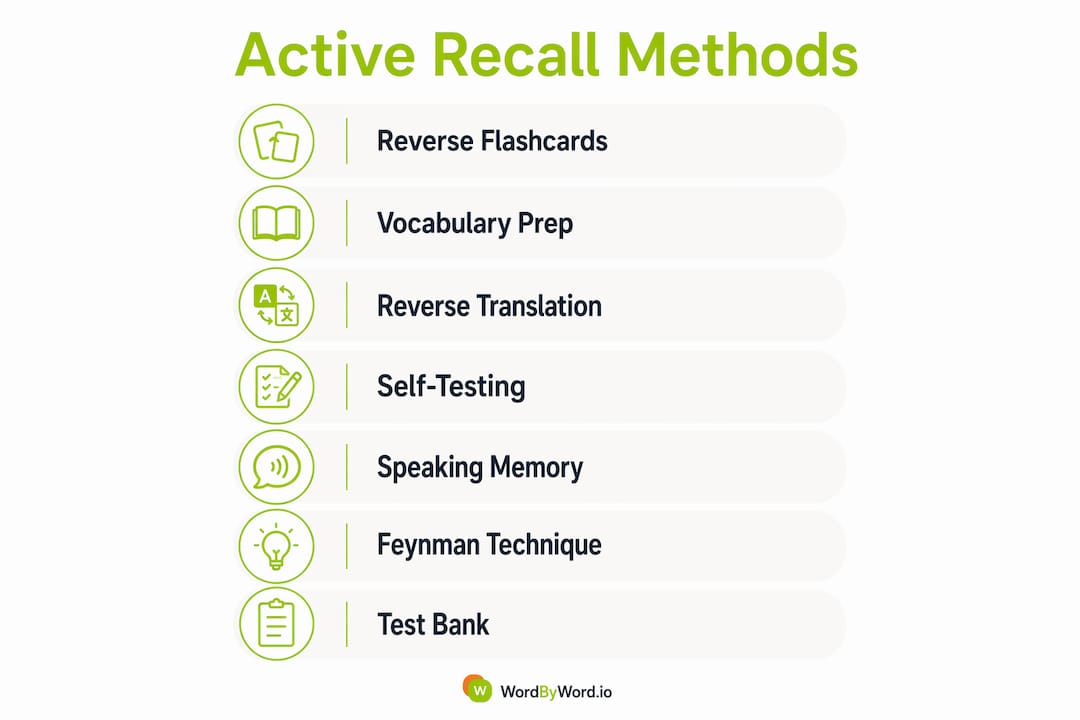
Seven practical active recall study methods for language learners
1. Reverse flashcards
Standard flashcards show you the foreign word and ask for the translation. That trains recognition. Reverse flashcards flip it: you see the English word and have to produce the target language equivalent. This mimics exactly what happens in conversation, when you think “I need the word for chestnut” and have to retrieve it under pressure. The effort of that search is what makes the word stick.
2. Prepared vocabulary for conversation sessions
Before any speaking session with a tutor or language partner, write down five to ten words you want to actively use. Hand the list to your partner and ask them to weave those words into the conversation. By the end of an hour where you’ve had to retrieve and deploy each word in multiple contexts, you will likely retain them much more effectively.

3. Reverse translation
Take a short paragraph in your target language and translate it into English. Then cover the original and translate it back. This is one of the hardest active recall techniques, and one of the most effective. You’re not just recalling vocabulary in isolation; you’re recalling how words behave grammatically, which produces far deeper encoding than a flashcard ever could.

4. Self-testing quizzes
Write your own questions about material you’ve studied, then answer them later without looking at your notes. The act of generating the questions forces you to identify what actually matters, and answering them later forces retrieval. A 2024 systematic review found that self-testing and retrieval practice were consistently associated with higher GPAs and better exam scores across student types and subjects.
5. Speaking from memory
After listening to a podcast episode or audio lesson, pause and summarize what you heard out loud in the target language. No notes, no replay. This forces your brain to reconstruct vocabulary and grammar simultaneously, which is a more demanding retrieval task than any written exercise. The gaps you notice are exactly where your next study session should focus.
6. The Feynman Technique
Explain a grammar rule or a set of vocabulary words as if you’re teaching someone who knows nothing about the language. Wherever your explanation breaks down or you reach for a word you can’t produce, that’s a genuine knowledge gap. The Feynman Technique works because explanation is a demanding form of retrieval: you can’t just recognize the concept, you have to reconstruct and translate it into accessible language.
7. Building a personal test bank
As you read or listen to new material, write one question for each key word or phrase rather than highlighting it. Over time, you accumulate a personalized set of retrieval prompts built from content that actually interests you. Research on question generation shows that creating questions during the initial input phase improves subsequent retrieval efficiency, because you’ve already done the cognitive work of identifying what matters.
How spaced repetition and self-testing work together
Spaced repetition is the practice of reviewing material at increasing intervals, timed so that each review happens just before the memory would otherwise decay. The first review might come the day after you learn a word, then three days later, then a week, then two weeks. Spacing leads to better retention than massed study or cramming because it forces retrieval when the memory trace has weakened, which strengthens it more than reviewing it while it’s still fresh.
The real power comes from combining spacing with active retrieval rather than passive re-reading. A study comparing optimized and typical study regimens found an 18 percentage-point accuracy improvement in learners using spaced retrieval practice with corrective feedback, versus 8 points for typical study. The feedback loop matters too: when you get something wrong and immediately see the correct answer, that error correction encodes the right version more deeply than if you’d never been tested at all.
WordByWord’s smart flashcard system applies this principle directly. Words you’ve translated or looked up while browsing get automatically queued for review, with the spacing managed for you so you’re always retrieving at the right moment.
Best practices for spacing and self-testing:
- Review new vocabulary the same day you encounter it, then again after 2–3 days
- Use expanding intervals: day 1, day 3, day 9, day 17 is a well-tested schedule
- Always attempt retrieval before checking the answer, even when you’re unsure
- Flag words you get wrong and return to them more frequently
- Keep sessions focused: 20–30 minutes of genuine retrieval beats an hour of passive review
How listening and writing reinforce memory retrieval
Listening is where most vocabulary enters your awareness first. A podcast, a YouTube video, a conversation: these are the moments when words move from unknown to recognized. But recognition is not retrieval. The gap between hearing a word and being able to produce it is where most language learners stall.
The fix is to treat listening as input that feeds retrieval practice, not as the practice itself. After a listening session, close everything and write a summary in the target language from memory. You’ll find words you thought you knew suddenly unavailable, and that friction is the learning signal. Writing from memory forces your brain to reconstruct vocabulary and sentence structure simultaneously, which is a more productive recall exercise than any amount of re-listening.
Practical methods combining listening and writing:
- After each podcast episode, write a 5-sentence summary in the target language without replaying it
- Transcribe a short audio clip from memory, then compare it to the original to identify gaps
- Keep a vocabulary journal where you write new words in full sentences you compose yourself, not copied from a source
- Use YouTube videos with subtitles to catch new words, then practice writing sentences using those words from memory
- Adjust the difficulty to your level: beginners summarize in their native language first, then attempt the target language version
WordByWord’s integration with YouTube subtitles makes this workflow practical. You can highlight unfamiliar words mid-video, add them to a personalized collection, and then practice writing sentences with them afterward, all without leaving the browser.
Pro Tip: For vocabulary you want to retain long-term, try the CELPIP vocabulary tracker to build structured word lists from your listening and reading sessions, then use those lists as the basis for your writing-from-memory exercises.
How to keep active recall engaging and sustainable
The biggest obstacle to active recall is not difficulty. It’s the feeling that you’re failing. When you can’t retrieve a word, it feels like evidence that you’re bad at languages, when it’s actually evidence that the method is working. Active recall feels more difficult than passive review precisely because it exposes what you don’t yet know, and that discomfort is what drives deeper learning. Reframing struggle as progress, not failure, is the single most useful mindset shift you can make.
Sustaining the practice over weeks and months requires more than willpower. Structure and variety help.
- Gamify your sessions: turn vocabulary retrieval into a timed challenge, or compete against your own previous scores
- Use acronyms and mnemonics to make abstract words memorable before you drill them
- Balance input and retrieval: spending the majority of your study time on reading, listening, and conversation, with a smaller portion on active recall practice, prevents burnout while maintaining progress
- Set session-level goals, not outcome goals: “I will test myself on 20 words today” is achievable; “I will be fluent by summer” creates anxiety without direction
- Keep sessions short: short, discrete active recall units outperform longer sessions, especially when attention is limited
Boredom usually signals that your material is too easy. If you’re breezing through your self-tests, you need harder questions or longer intervals between reviews. The discomfort of not knowing is not a problem to solve. It’s the mechanism.
Pro Tip: Generate your own questions while reading new material rather than waiting until review time. This intensifies cognitive processing during the input phase and makes later retrieval noticeably more efficient.
What the research says about active recall effectiveness
The evidence for active recall as the best retention method has accumulated across more than a century of cognitive science research. Every retrieval attempt strengthens the memory trace. Every failed attempt, where you try and can’t produce the answer, still primes the brain to encode the correct version more deeply when you check it. Passive review produces familiarity. Active recall produces retrievability. Those are not the same thing, and only one of them helps you in conversation.
One technique that amplifies this effect for vocabulary specifically is the keyword mnemonic method. It works by linking the sound of a foreign word to a native-language “keyword” through a vivid mental image. For example, the Spanish word caballo (horse) sounds like “cob-eye-oh,” so you might picture a horse with a cobblestone eye. That image creates a retrieval cue that bypasses the need for rote repetition. Research shows the keyword mnemonic technique produces vocabulary retention results 20%–25% better than rote learning.
| Active recall method | Retention strength | Best used for |
|---|---|---|
| Spaced retrieval practice with feedback | Very high | Vocabulary, grammar rules |
| Keyword mnemonic technique | High (20%–25% above rote) | New vocabulary acquisition |
| Self-testing and quizzes | High | Any language skill |
| Reverse translation | High | Grammar and contextual vocabulary |
| Feynman Technique | High | Grammar concepts, complex structures |
| Passive re-reading | Low | Initial exposure only |
Why active recall outperforms passive study:
- Retrieval strengthens the neural pathway to a memory; re-reading does not
- Failed retrieval attempts still improve later learning of the correct answer
- Active recall reveals genuine knowledge gaps that passive review conceals
- Effortful retrieval signals to the brain that the information matters, triggering deeper encoding
- Combining retrieval with corrective feedback produces compounding retention gains over time
WordByWord brings active recall into your daily browsing
Most active recall tools require you to stop what you’re doing and enter a separate study mode. WordByWord works differently. As a browser extension, it sits inside your existing reading habits, whether that’s news articles, PDFs, or YouTube videos, and turns them into vocabulary retrieval opportunities without interrupting your flow.
Its Spotlight mode is particularly well-suited to the retrieval-first approach. It highlights words directly on any page based on how well you know them, from unknown to mastered, so you can instantly see which words in a given article are within your current vocabulary range and which ones need work. As you learn words, the highlights fade. That visual feedback is a form of progress tracking that passive reading never provides.
The smart flashcard system and AI trainer take newly encountered words and schedule them for spaced retrieval practice automatically, applying the same expanding-interval logic that the research consistently validates. You can also build personalized vocabulary collections, import word lists via CSV, and access community-shared collections for your target language.
If you want a tool that makes active recall part of how you already spend time online, try WordByWord and see how quickly your vocabulary retention changes.
Key Takeaways
Active recall is the most effective language retention method because it builds retrievability, not just familiarity, and the gap between the two shows up every time you try to speak.
| Point | Details |
|---|---|
| Retrieval beats re-reading | Learners using retrieval practice retain material substantially better after one week compared to those who only re-read. |
| Spaced practice compounds gains | Combining spaced intervals with retrieval practice produced an 18 percentage-point accuracy improvement over typical study. |
| Keyword mnemonics amplify vocabulary | The keyword mnemonic technique produces 20%–25% better vocabulary retention than rote learning. |
| Struggle is the signal | Difficulty during retrieval indicates the method is working; easy self-tests mean the intervals or questions need to be harder. |
| Input and recall both matter | Spending the majority of study time on comprehensible input, with a focused portion on active retrieval, produces the best long-term results. |