Use interleaving for language learning once you have basic familiarity with the material. The evidence is clear: mixing related topics in a single session, rather than drilling one at a time, improves long-term retention and your ability to apply what you know in new contexts. Two cognitive mechanisms drive this. Discriminative contrast forces your brain to compare and distinguish between similar forms, which is exactly what real language use demands. Desirable difficulty makes practice harder in the short term, and that friction predicts stronger recall days and weeks later. The main caveat: if you are encountering a new phoneme or pronunciation rule for the very first time, blocked practice may serve you better at that initial stage. Once the basics are in place, interleaving is the stronger long-term bet.
Key takeaways
Interleaving language learning is most effective after basic familiarity is established, paired with spaced retrieval, and measured with mixed-format quizzes to confirm gains over time.
| Point | Details |
|---|---|
| Start after basics are solid | Interleave only once you can produce target forms accurately under blocked conditions. |
| Mix related topics, not random ones | Choose 2–4 topics from the same language domain so discriminative contrast is meaningful. |
| Pair with spaced retrieval | Convert session errors into SRS cards and review them within 24 hours. |
| Measure with mixed quizzes | Track pre/post quiz scores over 2–4 weeks; score improvement is the primary signal. |
| Prefer blocking for new phonemes | Early-stage pronunciation learning benefits from blocked practice before interleaving begins. |
| Use WordByWord for reading sessions | WordByWord captures vocabulary in context and queues mixed flashcard reviews automatically. |
Table of Contents
- What does the research actually say about interleaving language learning?
- Why does interleaving work? The cognitive mechanisms explained
- When should you use interleaving vs. blocked practice?
- How to design an interleaved language study session
- Ready-to-use session templates and Pomodoro timing
- How to combine interleaving with spaced repetition
- How to measure whether interleaving is actually working
- Common myths and mistakes about interleaving
- How WordByWord supports interleaved reading and vocab sessions
- Limitations of the research and open questions for educators
- The case for trying interleaving this week
- WordByWord makes interleaved vocab practice part of your daily reading
- Sources
What does the research actually say about interleaving language learning?
The evidence base is solid, though not without nuance. Here are the key findings:
- A widely cited review by Rohrer (2012), available via PubMed, found that blocked practice outperformed interleaving for early-stage pronunciation learning in controlled experiments, a task-specific result worth noting before you apply interleaving across the board.
- A PMC review synthesizing experimental work on interleaving found consistent benefits for memory and problem-solving, while also identifying boundary conditions: interleaving works best when the mixed items share enough structure that comparison is meaningful.
- Research published in Frontiers in Psychology showed that interleaving improves category learning and transfer to new problems, particularly when tasks share underlying structure, which maps well onto grammar and vocabulary in a single target language.
- A 2025 lab report from UW–Madison’s Waisman Center suggests that mixing languages within a study session may increase effectiveness for some tasks. The researchers note this is emerging lab evidence and that conditions vary, so treat it as a promising signal rather than a settled finding.
- A broad psychological review synthesizing spacing and desirable difficulties (Doi) provides the theoretical backbone: interleaving belongs to a family of “desirable difficulties” that slow apparent progress but accelerate durable learning.
The mechanism, in plain terms:
The one qualified contradiction worth flagging: some pronunciation experiments found that blocked practice produced better short-term gains at the earliest stages of learning a new phoneme. This is task-specific and stage-specific, not a general argument against interleaving.
Why does interleaving work? The cognitive mechanisms explained
Discriminative contrast is the core mechanism. When you block practice, each item you encounter is already categorized: you know you are drilling the present perfect because that is the only thing on the page. Interleaving removes that cue. Your brain must first figure out which rule or form applies, then retrieve and apply it. That extra step is effortful, but it builds exactly the kind of flexible knowledge that transfers to reading, conversation, and writing.
Desirable difficulty, grounded in the broader spacing and retrieval literature, explains why harder practice predicts longer retention. When retrieval feels easy, encoding is shallow. When it requires effort, the memory trace is strengthened. Interleaving manufactures that effort systematically.
Three concrete examples of how these mechanisms map onto language tasks:
- Mixed verb-tense drills: Alternating present perfect, simple past, and past continuous in a single exercise forces you to select the correct tense rather than pattern-match to the last item. The discrimination is the learning.
- Alternating listening and grammar: Transcribing a short audio clip, then answering a grammar question about a different structure, then returning to listening keeps your attention active and prevents the passive drift that blocks listening-only sessions.
- Vocabulary from different semantic fields: Mixing words from food, travel, and business in one flashcard set, rather than drilling food vocabulary alone, reduces interference from near-synonyms and builds sharper distinctions.
Pro Tip: If cognitive load feels unmanageable at the start, shrink the set. Begin with two closely related topics (e.g., two verb tenses) before adding a third. Small, related sets let discriminative contrast do its work without overwhelming working memory.
When should you use interleaving vs. blocked practice?
The choice depends on your learning stage and the specific task. Use this as a quick decision guide.
Signals that interleaving is the right call:
- You can already produce the target form with reasonable accuracy under blocked conditions.
- Your goal is transfer: applying grammar or vocabulary in new, unpredictable contexts.
- You are preparing for a mixed-format exam or a real conversation where topics shift unpredictably.
- You are consolidating vocabulary or grammar at an intermediate or advanced stage.
Signals that blocked practice is still better:
- You are encountering a phoneme, script, or grammatical rule for the very first time.
- You cannot yet produce the target form accurately even under blocked conditions.
- Foundation skills are absent: interleaving before basics are in place produces confusion, not contrast.
Two short scenarios make this concrete.
Scenario A — Beginner pronunciation: You are learning Mandarin tones for the first time. Blocking is the right choice here. Drill Tone 1 until you can produce it reliably, then Tone 2, before mixing them. The PubMed evidence on early-stage pronunciation supports this staged approach.
Scenario B — Intermediate grammar consolidation: You have studied the Spanish subjunctive, indicative, and conditional separately and can produce each under blocked conditions. Now mix them in a single session. Interleaving forces you to read the sentence context and select the correct mood, which is exactly what reading and speaking require.
K-State’s Academic Achievement Center recommends starting interleaving only after learners have that basic familiarity, which aligns with both scenarios above.
How to design an interleaved language study session
This workflow is reproducible for self-study or classroom use.
- Set a specific goal. Name what you want to be able to do by the end: “Distinguish and produce three Spanish past tenses in mixed sentences.”
- Run a baseline check. Take a 5-question mixed quiz before the session. Record your score. This is your comparison point.
- Choose 2–4 related topics. Keep them within the same language domain (e.g., three tenses in Spanish, not Spanish tenses plus French vocabulary). Coursera’s interleaving guide describes several scheduling patterns: random (ABCACB), grouped (AABBCC), and mixed-with-review (AAABBBCCCABC). Random tends to produce the strongest discrimination; grouped is a gentler entry point.
- Design short task blocks. Each block should be 5–10 minutes. One block might be a grammar fill-in, the next a listening transcription, the next a vocabulary retrieval task. Vary the format, not just the topic.
- Alternate and test. After completing all blocks once, run a short mixed quiz (5–10 questions) covering all topics. Do not check answers until you have attempted every question.
- Reflect and schedule follow-ups. Note which items you missed. Flag them for spaced retrieval review within 24 hours.
Preparation checklist before you start:
- Materials ready for all 2–4 topics (no mid-session searching)
- Phone silenced or app notifications off
- A simple log open (paper or digital) to record errors and difficulty ratings
- A timer set for your chosen interval
Pro Tip: When a session goes poorly and confusion spikes, do not abandon interleaving entirely. Revert to one round of blocked practice on the weakest topic, then return to interleaving. A brief consolidation pass is not a failure; it is a calibration.
Ready-to-use session templates and Pomodoro timing
These three templates cover the most common use cases. Copy and adapt them.
Beginner template (blocking into interleaving)
Start with two blocked rounds (10 minutes each) on two related topics, then combine them in one interleaved round.
- Round 1 (blocked): 10 min on Topic A (e.g., present tense conjugation)
- Round 2 (blocked): 10 min on Topic B (e.g., past tense conjugation)
- Round 3 (interleaved): 10 min alternating A and B in mixed exercises
- 5-min review: note errors, rate difficulty 1–5
Intermediate template (true interleaving across three tasks)
Best paired with a 45/15 Pomodoro. K-State recommends this interval for sessions requiring sustained attention on harder material.
- Block 1 (8 min): Grammar task (e.g., subjunctive vs. indicative fill-in)
- Block 2 (8 min): Listening transcription (short audio, 60–90 seconds)
- Block 3 (8 min): Vocabulary retrieval (flashcard recall, mixed semantic fields)
- Repeat cycle once, then 5-min mixed quiz
- 15-min break, then SRS review of flagged items
Classroom rotation template
Works for groups of 12–30 students rotating across three stations every 8–10 minutes.
- Station A: Grammar discrimination task (pairs, written)
- Station B: Listening and transcription (individual, headphones)
- Station C: Vocabulary peer-quiz (pairs, oral)
- Full rotation = one interleaved cycle; run 2–3 cycles per class period
Timing reference:
| Session length | Block size | Cycles | Best for |
|---|---|---|---|
| 25 min (25/5) | 5–7 min | 2 | Beginners, low-stamina sessions |
| 45 min (45/15) | 8–10 min | 3 | Intermediate learners, classroom use |
| 60 min | 10–12 min | 3–4 | Advanced learners, exam prep |
For extensive reading sessions, a 45/15 interval works well: read for 45 minutes with vocabulary capture, then spend 15 minutes on mixed flashcard review of the words you flagged.
How to combine interleaving with spaced repetition
Interleaving and spaced repetition solve different problems. Interleaving builds discrimination and transfer within a session. Spaced repetition, or SRS, ensures that what you learned does not decay over days and weeks. They work best together.
Converting session errors into SRS cards:
- After each interleaved session, pull your error log.
- For each missed item, create a flashcard that includes the item in context (a full sentence, not an isolated word or form).
- Tag cards by error type: wrong tense selection, wrong vocabulary, mishearing.
- Add them to your SRS deck with a short initial interval (1–2 days).
- On the next SRS review, test them in a mixed queue alongside older cards, not in a separate new-items block.
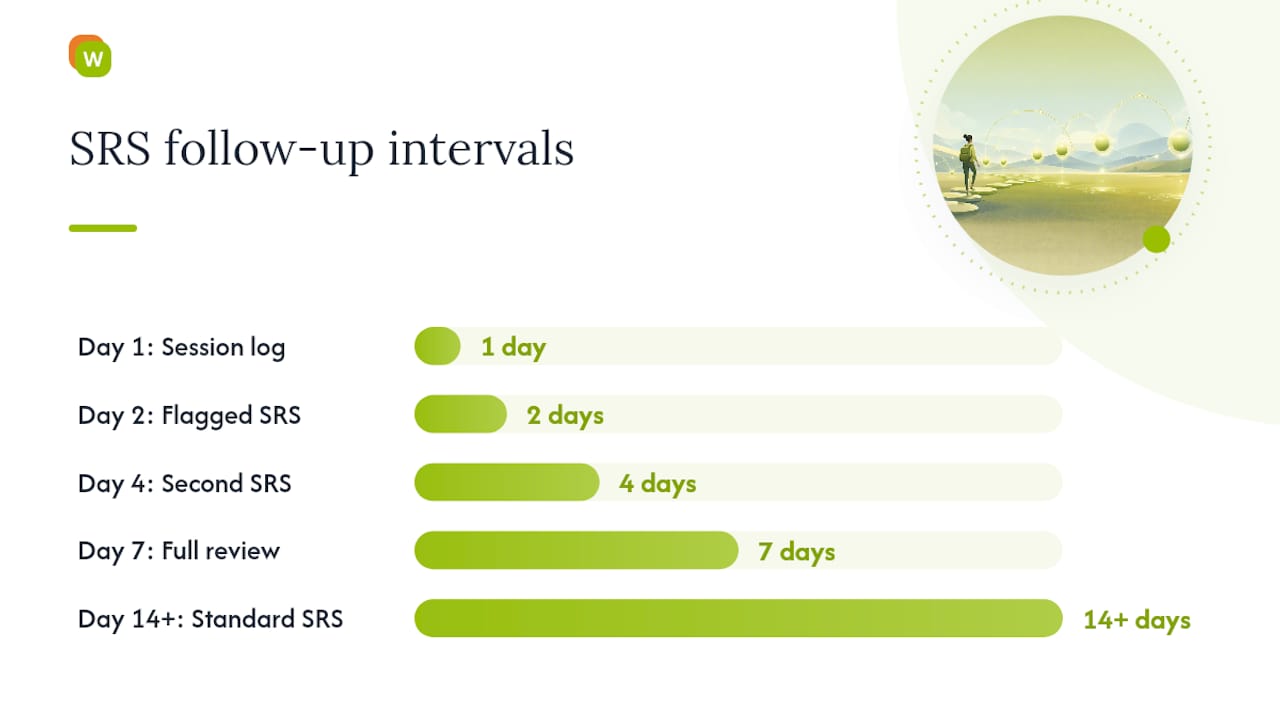
Follow-up schedule:
- Day 1: Interleaved session + error logging
- Day 2: SRS review of flagged items (short interval)
- Day 4: Second SRS review, now mixed with older material
- Day 7: Full mixed review including all items from the past week
- Day 14+: Standard SRS spacing takes over
Active recall techniques pair naturally with this schedule: instead of recognition-style flashcards, use production prompts (translate the sentence, fill in the blank, say it aloud) to keep retrieval effort high.
A practical spaced repetition schedule can help you map these intervals across a full week or month, especially when you are managing multiple topic sets simultaneously.
The key principle: interleaving generates the errors and difficulty that make SRS reviews meaningful. Without the discrimination challenge of interleaving, SRS reviews can drift toward passive recognition rather than active retrieval.
How to measure whether interleaving is actually working
Feeling confused during a session is not evidence that interleaving is failing. You need objective measures.
Three metrics worth tracking:
- Mixed-format quiz score: Take a 10-question quiz covering all topics from the session, in random order, before and after each session. Score improvement over 2–4 weeks is your primary signal.
- Timed retrieval accuracy: Set a 30-second timer per item. Track how many items you retrieve correctly within the time limit. Speed and accuracy together indicate fluency, not just recognition.
- Transfer task performance: Once a week, apply the target grammar or vocabulary in a new context you have not practiced: write two sentences using a structure from a different topic combination, or describe an image using mixed vocabulary sets.
Simple session log (fill in after each session):
- Date and session length
- Topics covered (list all 2–4)
- Pre-session quiz score / post-session quiz score
- Number of errors by topic
- Perceived difficulty rating (1 = easy, 5 = very hard)
- Items flagged for SRS follow-up
If your post-session quiz scores are not improving after three weeks, the most common causes are: mixing unrelated topics, interleaving before basics are solid, or skipping the SRS follow-up. Each has a specific fix in the next section.
Common myths and mistakes about interleaving
Myth vs. fact:
- “If it feels harder, it’s not working.” Fact: difficulty is the signal that encoding is happening. Duke’s Academic Resource Center calls this the “fluency illusion” — blocked practice feels smooth because it is shallow.
- “More switching is always better.” Fact: switching between unrelated topics (Spanish grammar and Python syntax) produces confusion, not contrast. The mixed items must be related enough that comparison is meaningful.
- “Interleaving replaces blocked practice.” Fact: blocking builds the initial foundation. Interleaving consolidates and transfers it. Both have a role; the question is sequencing.
- “Interleaving works from day one.” Fact: ASU’s University College and K-State both note that interleaving is most effective after learners have a basic grasp of the items being mixed.
Common errors and fixes:
- Overly broad mixing: You mix vocabulary from five unrelated semantic fields and retention drops. Fix: reduce to two or three related fields and add a fourth only after accuracy stabilizes.
- Skipping measurement: Sessions feel productive but scores do not improve. Fix: run a 5-question mixed quiz at the end of every session, no exceptions.
- Ignoring SRS follow-up: Interleaved sessions surface errors but you never review them. Fix: spend the first 10 minutes of the next session on flagged items before starting new interleaving.
Error-recovery checklist after a bad session:
- Identify which topic caused the most errors
- Run one 10-minute blocked pass on that topic only
- Re-enter interleaving with that topic included in the next cycle
- Lower the number of topics from 4 to 2 until accuracy recovers
How WordByWord supports interleaved reading and vocab sessions
Note: this section describes a WordByWord workflow as a practical example. Interleaving works with any reliable SRS or flashcard system.
WordByWord’s browser extension fits naturally into an interleaved reading-and-vocabulary session because it captures unknown words in context without interrupting the reading flow. Here is a step-by-step integration:
- Read an article or watch a YouTube video in your target language with WordByWord active. The Spotlight mode highlights words by familiarity level, so you can immediately see whether the text matches your current level.
- Capture unknown words by highlighting them. WordByWord logs them with the surrounding sentence as context, which is exactly the kind of sentence-level encoding that supports later retrieval.
- Build an interleaved practice set. After reading, open your vocabulary collection and group the new words into 2–3 related sets (e.g., by grammatical category or topic). Mix them into a single flashcard queue rather than reviewing by set.
- Run a mixed flashcard session using WordByWord’s smart flashcards and AI trainer. The AI-generated exercises vary the task format (translation, fill-in, multiple choice), which adds an interleaving layer on top of the vocabulary mixing.
- Flag difficult items and schedule SRS follow-ups. WordByWord tracks which words you miss and surfaces them in future reviews.
Example 45-minute intermediate session:
- 30 min: Read two short articles on different topics in your target language, capturing unknown words with WordByWord
- 10 min: Mixed flashcard review of all captured words in a single interleaved queue
- 5 min: Transfer task — write three sentences using words from both articles
Pro Tip: Use WordByWord’s Spotlight mode at the start of a reading session to quickly assess text difficulty. If more than 20–30% of words are highlighted as unknown, the text is likely too dense for interleaved reading practice. Drop down one level and build vocabulary there first.
Limitations of the research and open questions for educators
The evidence for interleaving is strong in aggregate, but the literature has real gaps that classroom teachers and self-directed learners should understand before scaling up.
Methodological caveats:
- Most lab studies use short retention intervals (hours to days). Fewer studies track outcomes over months, which is the timescale that matters for language acquisition.
- Sample sizes in many interleaving experiments are small, and most participants are university students in controlled settings, not diverse classroom populations.
- Task differences are large: interleaving effects on grammar and vocabulary are better documented than effects on pronunciation or listening comprehension.
- The PMC review notes that boundary conditions (how related the mixed items need to be, optimal block sizes) are not yet precisely defined.
Open research questions:
- What is the optimal block size for language-specific tasks at different proficiency levels?
- How does interleaving interact with SRS interval length? Does interleaving reduce the required SRS frequency?
- Are effects on pronunciation and listening as robust as effects on grammar and vocabulary?
- The UW–Madison 2025 findings on mixing languages within a session are promising but need replication outside lab conditions.
Practical advice for cautious classroom adoption:
- Pilot with one unit before committing to a full curriculum redesign
- Measure pre/post quiz scores for the pilot group and a comparison group if possible
- Start with grammar and vocabulary interleaving before extending to pronunciation tasks
- Iterate based on student error data, not intuition
The case for trying interleaving this week
The research does not promise a miracle. What it does show, consistently, is that the discomfort of interleaving is productive. Blocked practice feels efficient because it is easy. Interleaving feels slow because your brain is doing more work per item, and that work is what retention is made of.
The practical argument for trying it now is that the cost is low. You do not need new materials. You need the same materials you already have, shuffled into a different order. A 25-minute session with two related grammar topics, alternated in 5-minute blocks, is enough to test whether the approach works for you.
Here is a four-step starter plan for the first week:
- Day 1: Pick two related topics you have already studied. Run one 25-minute interleaved session using the beginner template above. Take a 5-question mixed quiz at the end and record your score.
- Day 2: Review flagged errors with SRS. Do not run another interleaved session yet.
- Day 4: Run a second interleaved session, same two topics. Compare your quiz score to Day 1.
- Day 7: Add a third related topic. Run a 45-minute session using the intermediate template. If scores are improving, continue. If not, check whether you are mixing unrelated topics or skipping the SRS follow-up.
Measure before you judge. The fluency illusion is real: sessions that feel harder are often the ones that stick.
WordByWord makes interleaved vocab practice part of your daily reading
Reading in your target language is already the most natural way to build vocabulary. WordByWord turns that reading into a structured interleaved practice loop without adding a separate study session to your day.
The extension captures words in context as you browse, builds smart flashcards automatically, and queues them for mixed review across sessions. The Spotlight mode shows you exactly which words you know and which you do not, so you can assess text difficulty in seconds and adjust your reading level before you start. The AI trainer varies exercise formats across your vocabulary sets, which is the interleaving layer built directly into the review workflow.
Interleaving also works with any SRS or flashcard system you already use. But if you want a tool that captures, organizes, and interleaves vocabulary from your actual reading without manual card creation, try WordByWord free and run your first interleaved reading session today.
Sources
- Interleaving – Academic Resource Center
- Interleaving Technique
- Interleaving | University College
- New research suggests mixing languages during study …
- Does interleaved practice enhance foreign language learning …
- Pmc
- How to Use Interleaving for Deeper Learning | Coursera
- Frontiersin
- Doi