
The three techniques worth your time are the keyword method, the method of loci, and acronyms or acrostics. Use them in a single daily routine: create a mnemonic for each new word, review it with spaced repetition (SRS), then use the word in a sentence the same day. That cycle, run for 20–30 minutes a day, is what separates words you recognize once from words you actually own.
Start right now with three steps:
- Pick 5 words you keep forgetting.
- Build one mnemonic for each using the keyword method (details below).
- Schedule your first SRS review for tomorrow.
When to use each method:
- Keyword method: Single difficult words, especially foreign vocabulary with a sound-alike in English.
- Method of loci (memory palace): Ordered lists, themed vocabulary sets, or exam word banks.
- Acronyms/acrostics: Small clusters of related terms (grammar categories, subject-area jargon).
- Peg/pegword system: Numbered sequences where order matters.
- Story method: Abstract or emotionally flat words that need a narrative hook to feel real.
Key Takeaways
The keyword method, paired with spaced repetition and same-day context use, is the most research-backed routine for converting mnemonics into fluent vocabulary.
| Point | Details |
|---|---|
| Use mnemonics surgically | Reserve them for stubborn, abstract, or false-friend words, not every item. |
| Follow the three phases | Recode, relate, and retrieve — skipping the imagery phase sharply reduces recall. |
| Build your own images | Self-generated mnemonics encode more deeply than borrowed ones. |
| Pair with spaced repetition | Review on a Day 1, 3, 7, 21 cadence to move words into long-term memory. |
| WordByWord captures and trains | The extension saves words in-browser, attaches mnemonic notes, and schedules SRS reviews automatically. |
Table of Contents
- What mnemonics for vocabulary actually work?
- How do you build a mnemonic that you can actually retrieve?
- How do you practice so mnemonics become fluent recall?
- Worked examples: mnemonics for real words
- Which tools help you find and practice mnemonics?
- Common mistakes that kill mnemonic retention
- What does the research say about mnemonic methods?
- A word on using mnemonics every day
- WordByWord fits directly into this mnemonic workflow
- Sources
What mnemonics for vocabulary actually work?
Memory aids for language learning fall into a handful of reliable families. Knowing which one fits which word type saves you from forcing the wrong tool.
Keyword method
You find a word in your target language that sounds like part of the new word, then create a vivid mental image linking that sound-alike to the meaning. The Spanish word carta (letter/mail) sounds like “cart.” Picture a shopping cart stuffed with envelopes. When you hear carta, the cart rolls in, and the meaning follows.
Method of loci (memory palace)
You mentally place vocabulary items at specific locations along a familiar route — your apartment, your commute, a building you know well. Walking the route in your mind retrieves the words in order. This method shines for structured vocabulary sets: the 50 most common verbs, a thematic unit on medical terms, a TOEFL word list.
Peg/pegword system
Each number gets a fixed “peg” word (1 = bun, 2 = shoe, 3 = tree, and so on). You link the vocabulary item to the peg for its position. Useful when sequence matters, less so for random acquisition.
Acronyms and acrostics
FANBOYS (For, And, Nor, But, Or, Yet, So) is the classic grammar example. Acronyms work when the initial letters of a group of words can be compressed into something pronounceable or memorable. Acrostics turn those letters into a sentence (“Every Good Boy Does Fine” for musical notes).
Chunking and phonetic decomposition
Break a long word into smaller, recognizable pieces. Philanthropy becomes “Phil” + “ant” + “trophy” — picture a guy named Phil winning a trophy shaped like an ant. This is especially useful for academic or technical vocabulary where no single keyword fits cleanly.
Story method
String several vocabulary items into a short, absurd narrative. The stranger the story, the better it sticks. Best for abstract adjectives or words with no obvious phonetic hook.
Multisensory hooks
Songs, gestures, and rhythm exploit different memory channels. Singing a word’s definition to a familiar tune, or pairing a word with a physical gesture, adds a motor or auditory layer that purely visual mnemonics miss.
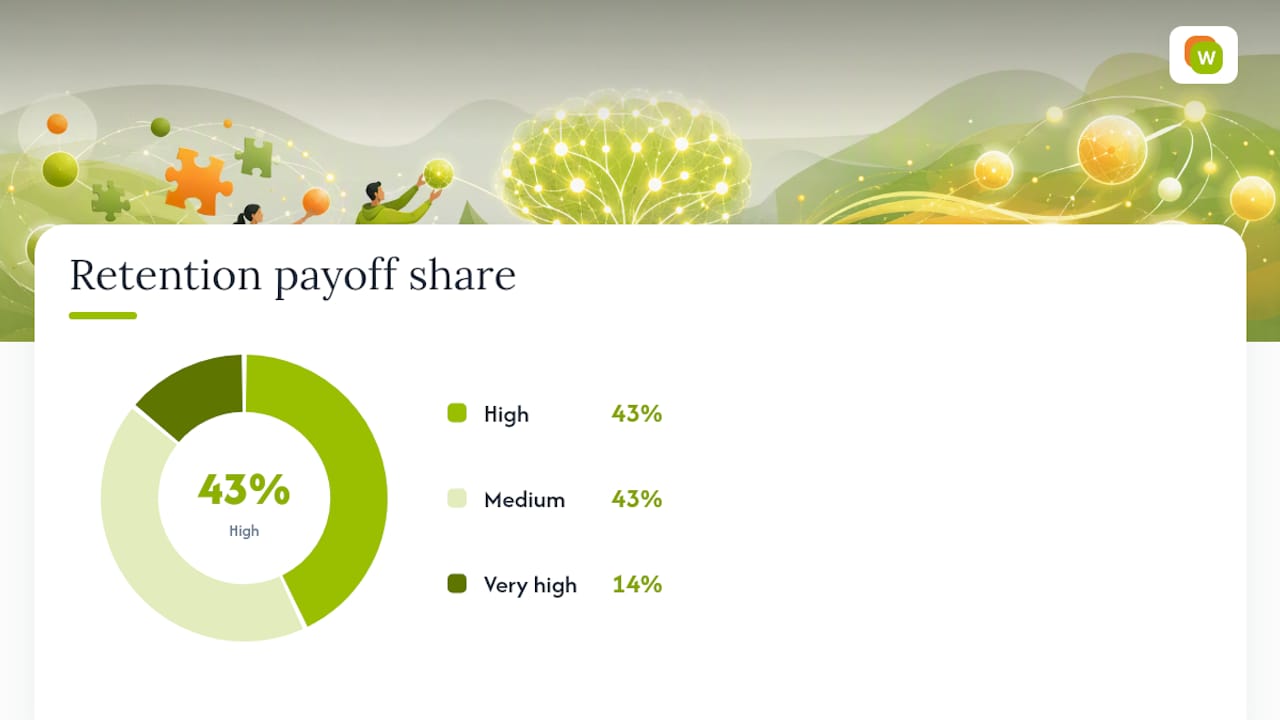
| Method | Initial effort | Retention payoff | Best use case |
|---|---|---|---|
| Keyword method | Medium | High | Single foreign words |
| Method of loci | High | Very high | Ordered lists, large sets |
| Acronyms/acrostics | Low | Medium | Small grouped terms |
| Peg/pegword | Medium | High | Numbered sequences |
| Story method | Medium | High | Abstract or emotionally flat words |
| Chunking/phonetic | Low | Medium | Long academic terms |
| Multisensory hooks | Low | Medium | Beginners, tonal languages |
How do you build a mnemonic that you can actually retrieve?
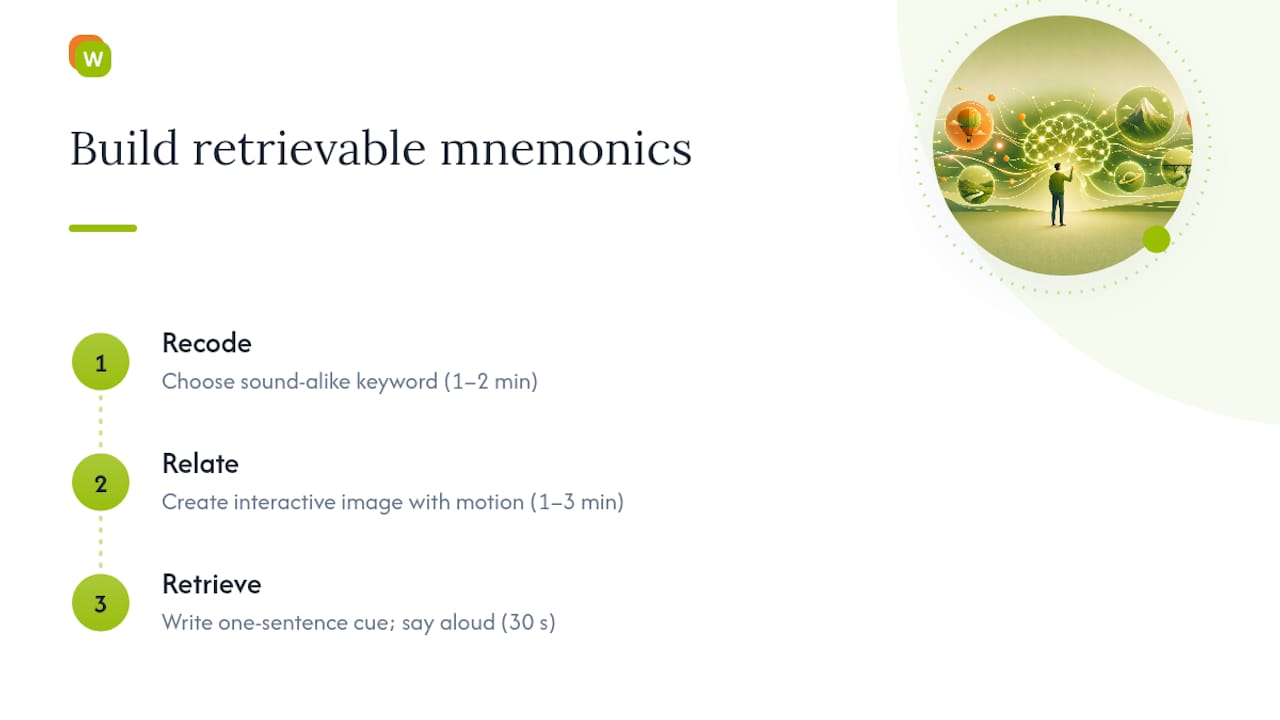
The keyword method’s three phases — recoding, relating, and retrieving — give you a repeatable construction process. Skip the imagery phase and recall drops sharply.
1. Recode: choose your keyword (1–2 minutes)
Find a word in a language you know that sounds like part of the target word. It doesn’t need to match perfectly — close enough to trigger the sound is all you need. For the French word grenouille (frog), the first syllable sounds like “greh” or “green.” “Green” works.
2. Relate: build an interactive image (1–3 minutes)
Put the keyword and the meaning into a single, dynamic scene. The image must interact — not just sit side by side. A green frog painting itself green with a tiny brush is interactive. A green frog next to a green wall is not. Art of Memory’s guidance recommends vivid, action-oriented, and unusual images: exaggerate scale, add motion, make it bizarre or funny.
3. Retrieve: script a retrieval cue (30 seconds)
Write a one-sentence prompt: “When I see grenouille, I hear ‘green,’ I see a green frog painting itself, and the meaning is frog.” Say it aloud once. This scripts the path your brain will follow during recall.
Time estimates: A solid mnemonic for a common word takes 1–3 minutes. A complex academic term with no obvious phonetic hook can take 5–10 minutes. That investment pays off when the word stays with you for months instead of days.
Pro Tip: Use exaggeration and motion in every image. A frog the size of a bus painting a skyscraper green is far more retrievable than a normal-sized frog on a leaf. The brain flags unusual, dynamic scenes as worth keeping.
For long or tonal words (Mandarin, Vietnamese, Thai), combine phonetic decomposition with a motion cue for the tone. The Mandarin word mǎ (horse, third tone) can be encoded as a horse that dips down and then rises — mirroring the falling-rising shape of the third tone. Research on learner-generated mnemonics consistently shows that building your own image, rather than borrowing someone else’s, deepens the encoding and makes retrieval faster.
How do you practice so mnemonics become fluent recall?
The mnemonic gets you to first recall. Fluency requires a different engine: spaced repetition combined with active recall, plus using the word in real context the same day you learn it.
A practical SRS cadence for new mnemonics:
- Day 0: Create the mnemonic, review it once.
- Day 1: Active recall — cover the answer, retrieve from the cue.
- Day 3: Second review.
- Day 7: Third review.
- Day 21: Fourth review; by now the mnemonic scaffold usually fades and the word feels direct.
Keep your daily practice block to 20–30 minutes. Fifteen minutes on SRS reviews, five to ten minutes on production: write one sentence using each new word, or say it aloud in a phrase. Vocabulary consolidates through contextual encounters — reading, listening, producing — not through isolated list drilling.
Flashcard setup:
- Front: Target word + pronunciation guide (no translation).
- Back: Definition in the target language, plus a hint field with your mnemonic image description.
- Keep the mnemonic in the hint field, not on the back face. Force yourself to retrieve before you peek.
Practice modes that work:
- SRS app reviews (daily, timed).
- Self-testing with physical cards or a folded sheet.
- Partner quizzes where your partner reads the word and you give the definition plus the mnemonic image aloud.
- Memory Palace walk-throughs for themed vocabulary sets.
- Embedding new words in a short paragraph or journal entry.
For a detailed spaced repetition schedule tailored to language learners, the cadence above is a starting point — adjust intervals based on how quickly you’re recalling each word.
Worked examples: mnemonics for real words
These examples follow the three-phase process so you can model them directly.
1. Concrete noun — Spanish mariposa (butterfly)
- Keyword: “Mary” + “posa” sounds like “poses.” Picture Mary posing with butterfly wings.
- Image: Mary, arms spread wide like wings, posing for a photo.
- Flashcard front: mariposa
- Flashcard back: butterfly (hint: Mary posing with wings)
- Retrieval cue: “Mariposa → Mary poses → butterfly.”
2. Abstract adjective — English ephemeral (lasting a very short time)
- Keyword: “eff” + “femoral” — the femoral artery. Picture a doctor saying an artery is so fragile it only lasts a moment.
- Image: A doctor holding a glass artery that shatters in seconds.
- Flashcard front: ephemeral
- Flashcard back: lasting a very short time (hint: glass artery shattering)
- Retrieval cue: “Ephemeral → femoral → shatters → fleeting.”
3. False friend — French sensible (sensitive, NOT sensible)
- Keyword: Looks like “sensible” in English, but means the opposite of what you’d expect.
- Image: A person labeled “sensible” bursting into tears at a sad movie — they’re sensitive, not level-headed.
- Flashcard front: sensible (French)
- Flashcard back: sensitive (hint: crying at a movie, NOT being reasonable)
- Retrieval cue: “Sensible in French → tears → sensitive.”
4. Long academic term — anthropomorphism (attributing human traits to non-human things)
Phonetic decomposition: “anthro” (human) + “morph” (shape/form) + “ism.”
- Keyword: Picture a human-shaped robot (morph) at an anthropology lecture.
- Image: A robot in a tweed jacket giving a lecture on human behavior.
- Flashcard front: anthropomorphism
- Flashcard back: attributing human traits to non-humans (hint: robot professor)
- Retrieval cue: “Anthro + morph → human-shaped robot → treating non-humans as human.”
5. Tonal/multisyllabic — Mandarin píngguǒ (apple, second + third tone)
- Keyword: “ping” sounds like a ping-pong ball; “guǒ” sounds like “gwa” or “go.”
- Image: A ping-pong ball shaped like an apple bouncing off a table and rolling away.
- Tone cue: Second tone rises (the ball bounces up), third tone dips then rises (it rolls down and back up).
- Retrieval cue: “Píngguǒ → ping-pong apple → bounces up, dips, rises → apple.”
Which tools help you find and practice mnemonics?
The most useful setup combines a mnemonic idea library, an SRS app, and a browser tool that captures words the moment you encounter them.
Mnemonic idea libraries:
- MnemonicDictionary.com — a crowd-sourced database of keyword-method mnemonics for English vocabulary. Search any word and browse community-submitted images. Useful when you’re stuck on a keyword.
- Art of Memory (artofmemory.com) — tutorials on image creation, memory palaces, and peg systems; one of the most thorough free resources available.
SRS flashcard apps:
Generic SRS platforms let you build decks with custom hint fields for your mnemonic images. Look for apps that support a hint/note field on the card back, audio pronunciation, and adjustable review intervals. Comparing vocabulary builder apps by feature set helps you find one that fits your workflow.
Browser-based capture tools:
The gap most learners hit is the distance between encountering a word and encoding a mnemonic for it. By the time you open a separate app, the context is gone. A browser extension that lets you highlight, translate, and tag a word on the page closes that gap immediately. Tracking vocabulary while reading is far more consistent when the capture step happens in the same window as the reading.
Academic guides:
- IRIS Center at Vanderbilt University (iris.peabody.vanderbilt.edu) — free, research-backed modules on the keyword method with classroom examples.
- Purdue OWL — general academic writing and vocabulary resources.
Pro Tip: Keep your mnemonic text in a dedicated note or hint field, not on the card’s answer face. This forces active retrieval before you see the image description, which is where the memory work actually happens.
Common mistakes that kill mnemonic retention
The most damaging habit is using mnemonics for every word you encounter. They’re a high-effort tool, and spreading that effort across 50 common words leaves you with 50 weak mnemonics instead of 10 strong ones.
| Mistake | Better approach |
|---|---|
| Using mnemonics for every word | Reserve them for stubborn, abstract, or false-friend words |
| Copying someone else’s bland image | Build your own bizarre, personal image — it encodes deeper |
| Skipping the retrieval phase | Script a retrieval cue and say it aloud at least once |
| Making the image static | Add motion and interaction; static images fade faster |
| Reviewing without active recall | Cover the answer before looking; guessing is the workout |
| Keeping the mnemonic forever | Phase it out once the word feels direct; the scaffold should disappear |
| Grouping similar-sounding words together | Separate them spatially in your Memory Palace to prevent interference |
Pro Tip: When two words sound alike and keep getting confused — say, Spanish estar and ser — place them in completely different rooms of your Memory Palace. Physical separation in the imagined space reduces retrieval interference.
The transition off a mnemonic is a sign of success, not failure. Once you recall a word directly, without mentally running through the image, the mnemonic has done its job. Stop reviewing the image and let the word stand on its own.
What does the research say about mnemonic methods?
The keyword method is the most thoroughly tested mnemonic technique for vocabulary acquisition. Early controlled experiments showed that linking a phonetic keyword to a translation through imagery produced strong gains in initial learning and high acceptance among students — results that held across classroom-scale applications.
The IRIS Center’s summary of keyword-method research makes the mechanism clear: recoding, relating, and retrieving are each necessary. Skipping the imagery phase — just picking a keyword without building an interactive scene — degrades recall to near-baseline levels.
Self-generated mnemonics outperform teacher-provided ones. When learners construct their own images, the act of building the mnemonic deepens encoding and creates stronger retrieval pathways. Borrowing someone else’s image is better than nothing, but making your own is consistently more effective.
Research on learner-generated mnemonics supports this directly: active construction strengthens memory traces in ways that passive reception does not.
On the neuroscience side, studies on mnemonic training and brain connectivity report altered functional network organization in trained memory performers — changes involving visual, medial temporal, and default mode networks. This isn’t just a study trick. Systematic mnemonic practice appears to reshape how the brain handles memory retrieval.
A word on using mnemonics every day
The routine that actually works is shorter than most learners expect. Spend the first 10 minutes of a study session creating mnemonics for 3–5 new words: recode, relate, script the retrieval cue. Then spend 15 minutes on SRS reviews of older words. Close with 5 minutes of production: write one sentence per new word, or say it in a phrase aloud.
The stubborn word that convinced me this process works was the German Verschlimmbessern — making something worse while trying to improve it. The keyword “verschlimm” sounds vaguely like “very slim.” The image: a tailor making a suit “very slim” and ruining it completely. That image was ridiculous enough to stick, and after about four SRS reviews the word came back without the image at all.
That’s the signal to stop using the mnemonic: when the word arrives before the image does. At that point, the scaffold has served its purpose. Continuing to review the image is wasted effort — move the word to a passive review pile and let it consolidate through reading and listening instead.
WordByWord fits directly into this mnemonic workflow
Most learners lose words between the moment of encounter and the moment of encoding. WordByWord closes that gap. The browser extension lets you highlight any unknown word on a webpage, PDF, or YouTube subtitle, get an instant translation, and save it to a personal collection — without leaving the page.
From there, WordByWord’s smart flashcards carry the word into SRS review automatically. The Spotlight mode highlights words on any page based on your current knowledge level, so you can see at a glance which words still need mnemonic work and which have graduated to fluent recall. You can add a mnemonic note directly to each card’s hint field, keeping your image description attached to the word through every review cycle. The AI trainer generates exercises around your saved words, and the CSV export lets you move your collection into any other SRS tool if you prefer a different review interface.
Try the free tier at WordByWord — install the extension, highlight five words from the next article you read, and build your first mnemonics before the session ends.
Sources
- Mnemonic Strategies: Keyword Method — IRIS Center, Vanderbilt University
- Mnemotechnics in Second-Language Learning — American Psychologist (Stanford/UCSD paper, 1975)
- How to remember new words — IELTS IDP
- Mnemonic training and brain network changes — NCBI / PMC4056179
- How to Create Mnemonic Images — Art of Memory