
Extensive reading is defined as reading large amounts of easy, enjoyable text to build fluency and motivation, while intensive reading is the focused, detailed analysis of shorter texts to deepen vocabulary and comprehension accuracy. Both approaches are recognized by the Extensive Reading Foundation as distinct but complementary methods in language instruction. Recent research confirms that blending the two produces stronger gains in reading speed, retention, and overall proficiency than either method alone. Understanding the difference between extensive and intensive reading is the first step toward building a reading practice that actually works.
What are the key differences between extensive and intensive reading?
The core difference between extensive and intensive reading comes down to purpose and pace. Extensive reading prioritizes volume, enjoyment, and fluency. Intensive reading prioritizes accuracy, depth, and vocabulary precision.

Goals and reader engagement
Extensive reading asks learners to read freely chosen, easy and interesting texts without pressure to finish or analyze every word. The goal is exposure. Learners build an intuitive feel for grammar, phrasing, and vocabulary through sheer volume of input. Intensive reading, by contrast, asks learners to slow down and examine a text closely. Every sentence, word choice, and grammatical structure becomes a learning target.
Text difficulty, length, and dictionary use
Extensive reading works best with texts at or slightly below the learner’s current level. Learners should understand at least 95–98% of the words on the page without stopping. Intensive reading typically uses shorter, more challenging texts where dictionary use is expected and encouraged. The reader may spend an hour on a single page, unpacking meaning, checking usage, and noting grammar patterns.
Here is a direct comparison of both approaches:
| Feature | Extensive reading | Intensive reading |
|---|---|---|
| Text length | Long (books, articles, stories) | Short (passages, excerpts) |
| Difficulty | Easy to moderate | Moderate to challenging |
| Reading speed | Fast | Slow |
| Dictionary use | Rare | Frequent |
| Primary goal | Fluency and motivation | Accuracy and vocabulary depth |
| Reader choice | Learner selects material | Often teacher selected |
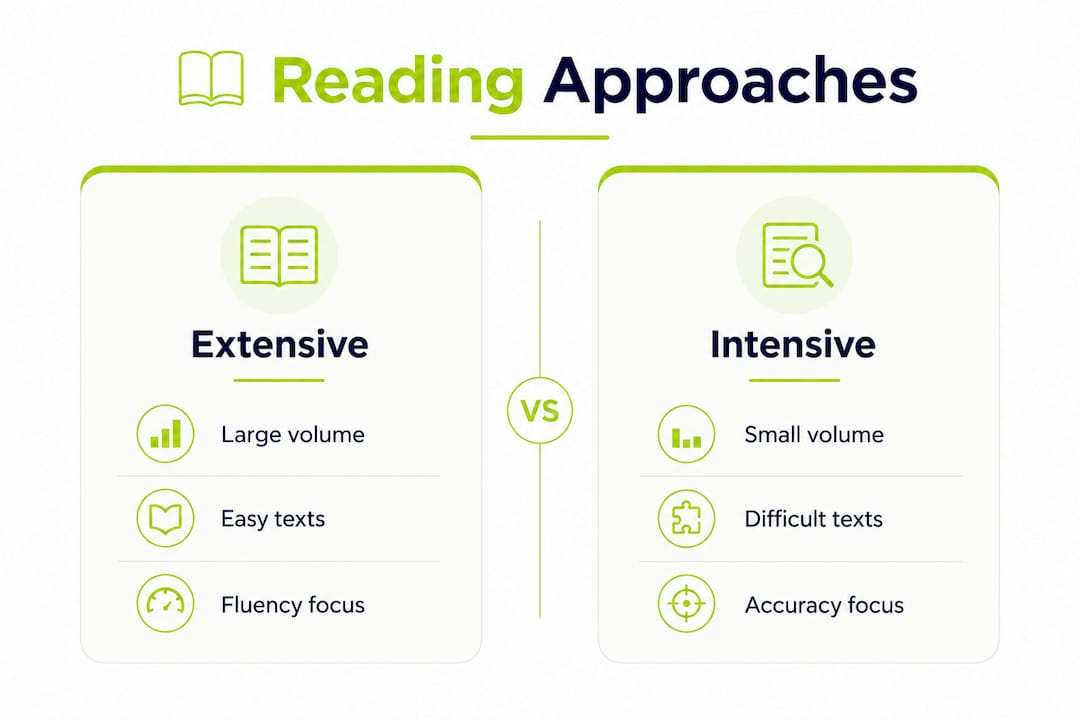
The table makes one thing clear: these two methods serve different cognitive purposes. Using only one of them leaves a significant gap in language development.
Key contrasts at a glance:
-
Extensive reading builds reading stamina and positive attitudes toward the target language.
-
Intensive reading builds precision, grammar awareness, and the ability to decode unfamiliar vocabulary in context.
-
Extensive reading rarely requires comprehension tests; intensive reading almost always does.
-
Extensive reading works across any genre; intensive reading often targets academic or professional texts.
How does extensive reading benefit vocabulary acquisition and language fluency?
Extensive reading improves fluency, vocabulary, and motivation by giving learners repeated, low-pressure exposure to words in context. That exposure is the engine behind incidental vocabulary learning, which is the process of picking up new words without deliberately studying them. A learner who reads a Spanish novel for pleasure will encounter the word aunque dozens of times before consciously registering it as “although.” That repetition, spread across natural contexts, produces durable retention.
The broader language gains are real
Extensive reading does not just improve reading. Learners develop positive attitudes and stronger skills in listening, speaking, and writing as a result of sustained reading practice. This happens because reading exposes learners to authentic sentence structures, collocations, and discourse patterns that transfer across all four language skills. A learner who reads widely in French will write more naturally in French, even without explicit writing instruction.
The challenges learners face
The biggest practical obstacle is material selection. Extensive reading requires texts pitched in the “zone of proximal development,” meaning texts that are engaging but not frustrating. Too easy and learners disengage. Too hard and they revert to intensive, word-by-word decoding, which defeats the purpose entirely. Finding level-appropriate graded readers, news sites, or podcasts in the target language takes real effort, especially for less commonly taught languages.
Motivation is the second obstacle. Immediate testing after extensive reading reduces learner motivation significantly. Reading should feel like its own reward. Optional, light follow-up activities work far better than comprehension quizzes that turn pleasure reading into homework.
Pro Tip: Pick content you would read in your native language anyway. If you love cooking, find food blogs in your target language. If you follow soccer, read match reports. Genuine interest overrides difficulty far more reliably than any graded reader program.
Effective extensive reading strategies include:
-
Choose texts where you understand at least 95% of words without a dictionary.
-
Set a daily reading time rather than a page count to reduce pressure.
-
Keep a vocabulary log for words that appear repeatedly across different texts.
-
Use technology to access authentic content in your target language across websites, PDFs, and video platforms.
What are the benefits and limitations of intensive reading for comprehension and vocabulary?
Intensive reading builds comprehension accuracy and vocabulary knowledge through close analysis of language features including grammar, syntax, and word meaning. This is the method most language classrooms default to, and for good reason. When a learner needs to understand a legal contract, a medical document, or an academic paper in a second language, intensive reading is the right tool. Skimming for general meaning is not enough.
Where intensive reading excels
Intensive reading gives learners explicit control over language. They can stop, look up a word, analyze a sentence structure, and then re-read the passage with that new knowledge applied. This deliberate processing creates strong, explicit memory traces for new vocabulary. Research confirms that intensive reading is particularly effective for learning grammar patterns and understanding how words function in specific contexts, not just what they mean in isolation.
The real limitations
The main drawback of intensive reading is pace. Learners read slowly, process less total text, and can develop a habit of stopping at every unfamiliar word, even in contexts where guessing from context would serve them better. Over-reliance on intensive reading can also reduce reading confidence. Learners who only practice intensive reading sometimes struggle to read fluently when speed and comprehension must happen simultaneously.
Pro Tip: During intensive reading sessions, limit yourself to one or two grammar or vocabulary targets per passage. Trying to analyze everything at once produces cognitive overload and reduces retention of any single item.
Intensive reading also carries a motivational cost when overused. Learners who spend every session dissecting texts rarely develop a love of reading in the target language. That emotional relationship with reading is exactly what extensive reading builds.
How can language learners and educators combine both reading approaches?
A blended reading program produces greater gains in reading speed, retention, listening, and writing than intensive reading alone. That finding is not surprising once you understand what each method contributes. Intensive reading builds the vocabulary and grammar foundation. Extensive reading puts that foundation to work at speed and scale.
A practical framework for blending both methods
The ratio of extensive to intensive reading should shift with proficiency level. Beginners need more intensive work to build foundational vocabulary. Intermediate and advanced learners benefit from a heavier extensive reading load, with intensive sessions reserved for specific grammar targets or high-stakes texts.
Educators play a direct role in making this work. Successful blended programs require official curriculum integration, budget planning for reading materials, and a designated coordinator who monitors learner progress and material quality. Without institutional support, extensive reading programs collapse into informal suggestions that learners ignore.
Steps for building a blended reading practice:
-
Assess your current level. Use a vocabulary size test or graded reader level guide to identify where you sit.
-
Set a weekly reading ratio. Beginners: 60% intensive, 40% extensive. Intermediate learners: 40% intensive, 60% extensive. Advanced learners: 20% intensive, 80% extensive.
-
Schedule both types separately. Do not mix them in the same session. Intensive reading requires focused attention; extensive reading requires relaxed flow.
-
Select extensive materials by interest, not just level. Motivation sustains the habit. Level-appropriate but boring texts will not.
-
Use intensive reading for specific targets. Pick one grammar point or vocabulary set per intensive session and build your text selection around it.
-
Track vocabulary across both modes. Words you encounter in extensive reading and then study in intensive sessions stick far longer than words learned in only one context.
Educators should explain extensive reading clearly to learners before implementation. Learners who misunderstand it as passive or unstructured tend to disengage or revert to intensive habits. Framing it as active, purposeful reading with a different goal than intensive work changes how learners approach it.
Integrating technology is one of the eight research-backed recommendations for promoting extensive reading in EFL contexts. Digital tools that allow learners to access authentic content, look up words without breaking reading flow, and track vocabulary growth make both extensive and intensive reading more practical and sustainable.
Key Takeaways
A blended reading program that combines extensive and intensive reading produces stronger vocabulary growth, faster reading speed, and higher retention than either method practiced alone.
| Point | Details |
|---|---|
| Define your purpose first | Use extensive reading for fluency and motivation; use intensive reading for accuracy and grammar. |
| Match difficulty to method | Extensive texts should be easy (95%+ comprehension); intensive texts can be challenging. |
| Blend by proficiency level | Beginners need more intensive work; advanced learners benefit from heavier extensive reading. |
| Avoid over-testing extensive reading | Comprehension quizzes after pleasure reading reduce motivation; keep follow-ups optional and light. |
| Use technology to sustain both | Digital tools that support in-context vocabulary lookup make both reading modes more consistent. |
What I’ve learned from watching learners get this wrong
Most learners I have observed default entirely to intensive reading because it feels productive. Stopping to look up every word, annotating margins, and re-reading paragraphs creates the sensation of serious study. Extensive reading, by contrast, can feel almost too easy, which makes learners distrust it.
That distrust is the biggest obstacle I see. Learners abandon graded readers after a week because they feel like they are not working hard enough. They return to grammar drills and vocabulary lists, which are intensive by nature, and then wonder why their reading fluency never improves. The research is clear on this: fluency comes from volume, not from depth alone.
The other mistake I see regularly is treating extensive reading as a reward for finishing intensive work, rather than as a core part of the program. When extensive reading gets scheduled last, it gets skipped first. The learners who make the most progress treat both methods as non-negotiable, scheduled separately, and protected from each other’s demands.
My honest recommendation: start with 15 minutes of extensive reading per day in content you genuinely enjoy. Do not grade yourself. Do not quiz yourself. Just read. Add intensive sessions around specific vocabulary or grammar goals you are actively working on. Within a few months, you will notice that your intensive reading sessions feel easier because your extensive reading has been quietly building your language intuition the whole time.
— Vladimir
How WordByWord fits into your reading practice
Reading in a second language is most effective when you can move between extensive and intensive modes without friction. WordByWord makes that possible by letting you highlight and instantly translate unknown words across websites, PDFs, and YouTube in over 50 languages, without leaving the page or breaking your reading flow.
For extensive reading, WordByWord keeps you in the text. You get a quick translation when you need it, then keep moving. For intensive reading, its smart flashcards and AI trainer turn the words you look up into long-term vocabulary. You can track your progress and build a personalized vocabulary collection that reflects exactly what you have been reading. Try the WordByWord platform and put both reading strategies to work in your daily browsing.
FAQ
What is the main difference between extensive and intensive reading?
Extensive reading focuses on reading large volumes of easy, enjoyable text to build fluency and motivation. Intensive reading focuses on detailed analysis of shorter, more challenging texts to develop vocabulary accuracy and comprehension.
Which reading method is better for vocabulary acquisition?
Both methods contribute to vocabulary growth in different ways. Extensive reading builds vocabulary through repeated incidental exposure in context, while intensive reading builds explicit knowledge of word meaning, grammar, and usage.
How often should language learners practice extensive reading?
Daily practice is most effective. Even 15–20 minutes of free reading in the target language, using content the learner genuinely enjoys, produces measurable gains in fluency and motivation over time.
Can extensive reading replace intensive reading entirely?
No. Extensive reading builds fluency and broad vocabulary, but intensive reading is necessary for accuracy, grammar development, and understanding complex or high-stakes texts. A blended approach produces the strongest overall results.
How do educators integrate both reading types into a curriculum?
Effective programs assign dedicated time for each method, provide level-appropriate materials for extensive reading, and use intensive reading sessions to target specific grammar or vocabulary goals. Institutional support and a designated program coordinator improve long-term success.