
Sentence mining is the practice of pulling sentences containing exactly one unknown word or grammar point (an “i+1” or “1T” sentence) out of real content and feeding them into a spaced repetition system for review. The best-practice version of this method is simple: mine sentences with only one new element, review them on an expanding schedule, and then reuse those same sentences when you speak or write. The workflow behind that claim, find, filter, store, review, is what the rest of this guide breaks down.
TL;DR:
- Miners should focus on sentences with only one unknown word or grammar point to maximize retention and avoid overwhelming review.
- Sentence length should stay under 20 words, with natural phrasing and relevance to common usage to facilitate practical recall.
- Beginners should start with a small, manageable number of sentences weekly, prioritizing high-frequency words, while advanced learners can increase volume.
- Construction of review cards should emphasize context and targeted sentence recall, avoiding clues like translations on the front that hinder retrieval practice.
- Pruning and balancing the deck are essential; stopping new mining if reviews lag more than two weeks helps maintain motivation and review quality.
Table of Contents
- How Does the Sentence Mining Method Actually Work?
- Why Does Sentence Mining Improve Vocabulary Retention?
- When Should You Start Mining Sentences?
- What Makes a Sentence Worth Mining?
- How Should You Build a Sentence Mining Flashcard?
- Which Tools Fit Your Sentence Mining Workflow?
- How Do You Review Mined Sentences Without Burning Out?
- What Mistakes Derail Sentence Mining the Most?
- What Do Sample Mined Sentences and Cards Look Like?
- How Does WordByWord Support Each Step of Sentence Mining?
- Our Take on Making Sentence Mining Stick
- Try Sentence Mining Inside the Content You Already Read
- Sources
How Does the Sentence Mining Method Actually Work?
Sentence mining runs on a four-step loop, and once it becomes automatic, it barely interrupts whatever you’re reading or watching.
- Notice an unfamiliar word or phrase while reading, watching, or listening.
- Decide whether to mine it now (pause-and-make) or flag it for later (asynchronous mining).
- Capture the full sentence, not just the word, along with a quick gloss.
- Store it in your deck or a to-mine list, then review it on a spaced schedule.
Pause-and-make suits slow, deliberate reading, since stopping doesn’t break your focus. Asynchronous mining works better for shows, podcasts, or anything with momentum. You jot a timestamp or copy the line, then batch-build cards later. A workable weekly routine looks like this: mine a little each day as you consume content, then spend one 30 to 60 minute session on Sunday turning that raw list into finished cards.
Why Does Sentence Mining Improve Vocabulary Retention?
Two mechanisms do most of the work here: context and repetition. A sentence pins down meaning, grammar, and collocation all at once, which is exactly what a bare word list can’t do. Research on contextualized vocabulary learning shows that learners who encounter words inside real sentences pick up nuance and usage patterns that isolated definitions simply skip.
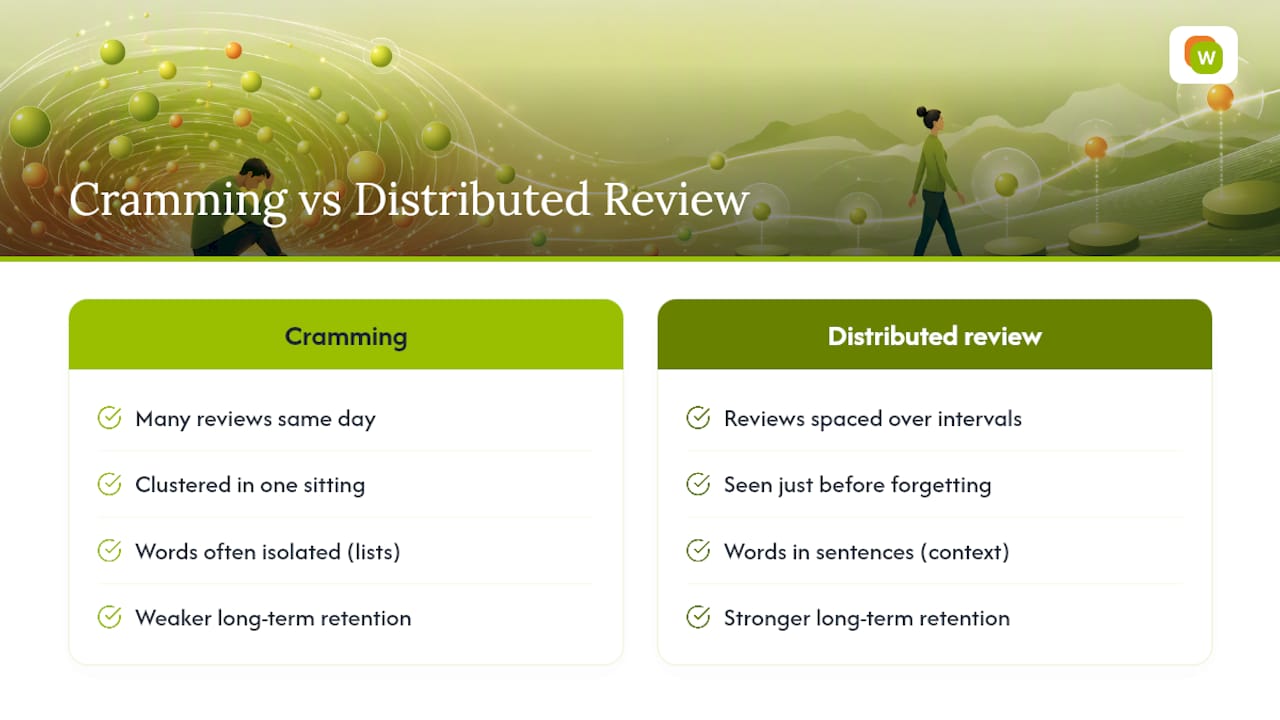
Spacing does the rest. A study on expanding and equal spacing intervals found that distributed review outperforms cramming the same material into one sitting. That’s the entire logic behind spaced repetition software: instead of reviewing everything daily, you see a card right before you’d otherwise forget it. The Routledge Handbook of Vocabulary Studies reaches a similar conclusion across dozens of studies: contextualized input paired with repeated retrieval beats either one alone.
When Should You Start Mining Sentences?
Readiness matters more than ambition. Mining sentences you barely understand at all just builds a pile of cards you’ll never review properly.
- Beginners should mine sparingly, a small manageable number of sentences per week, focused on high-frequency words.
- Intermediate learners can handle a moderate weekly number, once basic grammar feels automatic.
- Advanced learners can increase their sentence mining volume appropriately, since most content is already comprehensible.
- If a text feels like a wall of unknowns rather than one or two gaps, delay mining and build comprehension first.
What Makes a Sentence Worth Mining?
The single biggest mistake in sentence mining methods is grabbing sentences with three or four unknowns instead of one. Follow the 1T rule strictly: a mined sentence should carry exactly one unfamiliar target, whether that’s a word, a collocation, or a grammar pattern. Everything else in the sentence should already be comprehensible.
- Keep sentences under roughly 15 to 20 words. Longer ones bury the target and slow review down.
- Favor natural phrasing over stiff or overly literary lines, since you want language you’ll actually use.
- Weigh usefulness before you save anything: does the target word show up often, does it pair with common collocations, and does its register match how you actually plan to speak or write?
Sourcing sentences from stories rather than dry example lists tends to produce better recall, since narrative context sticks. Guides on using storytelling for vocabulary development make this case well: a sentence tied to a character or a scene is easier to retrieve later than one lifted from a grammar textbook.
Pro Tip: If a sentence has two unknowns, don’t skip it, just split it. Mine the sentence twice, once for each target word, with two separate cards.
How Should You Build a Sentence Mining Flashcard?
Card design decides whether review sessions build fluency or just waste time. Put the target sentence on the front, with the unknown word or phrase visible in context. On the back, add a short gloss, a translation, a usage note, and audio if you have it.
- Use full-sentence recall cards for grammar patterns, verb conjugations, or anything where word order matters.
- Use cloze deletions when you want to test one slot in an otherwise familiar sentence.
- Use single-word cards mainly for concrete nouns, where a picture or short definition does the job without a sentence.
- Never put a translation or an obvious cue on the front. That spoils recall and trains you to read the answer instead of retrieving it.
Community mining guides describe this front/back split as the difference between targeted sentence cards and single-word cards, and the distinction holds up: grammar needs context, vocabulary often doesn’t.
Which Tools Fit Your Sentence Mining Workflow?
Three tool categories cover most sentence mining setups: browser extensions that capture text and translations as you read, subtitle processors for video and podcast content, and SRS apps that handle the actual review scheduling. CSV import lets you move sentences between tools without retyping anything.
- 5 minute capture: jot the sentence or timestamp, keep moving through your content.
- Weekly build session: 30 to 60 minutes to turn raw captures into finished cards.
- To-mine list: a running document or app tag that holds sentences until your build session.
This split matters because constant context switching kills immersion. Asynchronous mining lets you stay inside a show or a book instead of stopping every ninety seconds to build a card.
How Do You Review Mined Sentences Without Burning Out?
Review is where most sentence mining methods quietly fail, usually because the deck grows faster than anyone can realistically study it.
- Cap daily new cards at a number you can review in under 15 minutes, even on a busy day.
- Once a sentence feels easy, actively adapt it: swap the subject, change the tense, or use it in a sentence of your own.
- Suspend or delete cards that keep failing after five or six reviews, since they’re usually mined wrong, not just hard.
Pro Tip: Merge near-duplicate cards instead of keeping both. Two sentences testing the same collocation waste review time without adding retention.
What Mistakes Derail Sentence Mining the Most?
Over-collection is the most common failure mode: decks balloon past a thousand cards, review backs up, and motivation collapses.
- If your backlog outpaces your reviews for more than two weeks, stop mining new cards and prune the deck instead.
- Break dense sentences with two or three unknowns into smaller, single-target cards rather than skipping them.
- Avoid cards where the meaning depends on a picture, a memory of the show, or a translation printed on the front. Those cues don’t transfer once the card leaves that context.
What Do Sample Mined Sentences and Cards Look Like?
Three examples show the pattern in practice, one for a phrasal verb, one for a noun, and one for an idiom.
- “She decided to put off the meeting until Friday.” Front: the sentence with “put off” bolded. Back: gloss, translation, audio. Production prompt: reschedule something in your own words using “put off.”
- “The bakery on the corner smells like cinnamon.” Front: sentence, target word “bakery.” Back: definition, translation. Production prompt: describe a place near your home using the same structure.
- “He’s been riding the fence on this decision for weeks.” Front: full idiom in context. Back: meaning, register note (informal), translation. Production prompt: use the idiom about a real decision you’re stalling on.
Before saving any sentence, run it through a quick checklist: one unknown target, under 20 words, natural phrasing, and a clear production use.
How Does WordByWord Support Each Step of Sentence Mining?
The described workflow can be supported by tools that highlight unknown words on any page as you read, covering the “find” step. Some tools also show what share of a text you already know, helping you judge whether a page is worth mining at all.
- Find: Some tools flag unknown words across websites, PDFs, and video subtitles.
- Store: Collections may hold mined sentences, which can be built manually, generated by AI, or imported by CSV.
- Review: Various training modes, including sentence builder and listening, may be available with spaced repetition scheduling.
Our Take on Making Sentence Mining Stick
Consistency beats intensity every time we’ve seen this method work. A learner mining five sharp sentences a week for six months ends up with a stronger, more usable vocabulary than one who mines fifty and reviews none of them. The habit is the method.
Start small: pick five sentences this week, one unknown each, and review them daily for seven days before adding more. Selectivity is what makes the routine survive past week two.
— WordByWord Team
Try Sentence Mining Inside the Content You Already Read
Some language learning platforms are designed to integrate the find, store, and review steps into normal browsing, reading, and video watching, reducing the need for separate mining sessions.

Certain software highlights unknown words automatically during reading online for the “find” step. Collections can be used to save sentences directly from various content sources into a deck. Review is often done through customizable flashcards with multiple training modes and spaced repetition scheduling, sometimes without needing to switch apps. If you’re prepping for a specific goal, curated sets like the Spanish DELE vocabulary library show how a targeted collection speeds up the filtering stage. Install the WordByWord extension and start mining your first sentence from whatever you’re already reading today.
Sources
For deeper background, see the spacing effect study, the practical sentence mining guide, and WordByWord’s spaced repetition scheduling guide.
- Learning vocabulary in another language (Cambridge University Press)
- The Routledge handbook of vocabulary studies