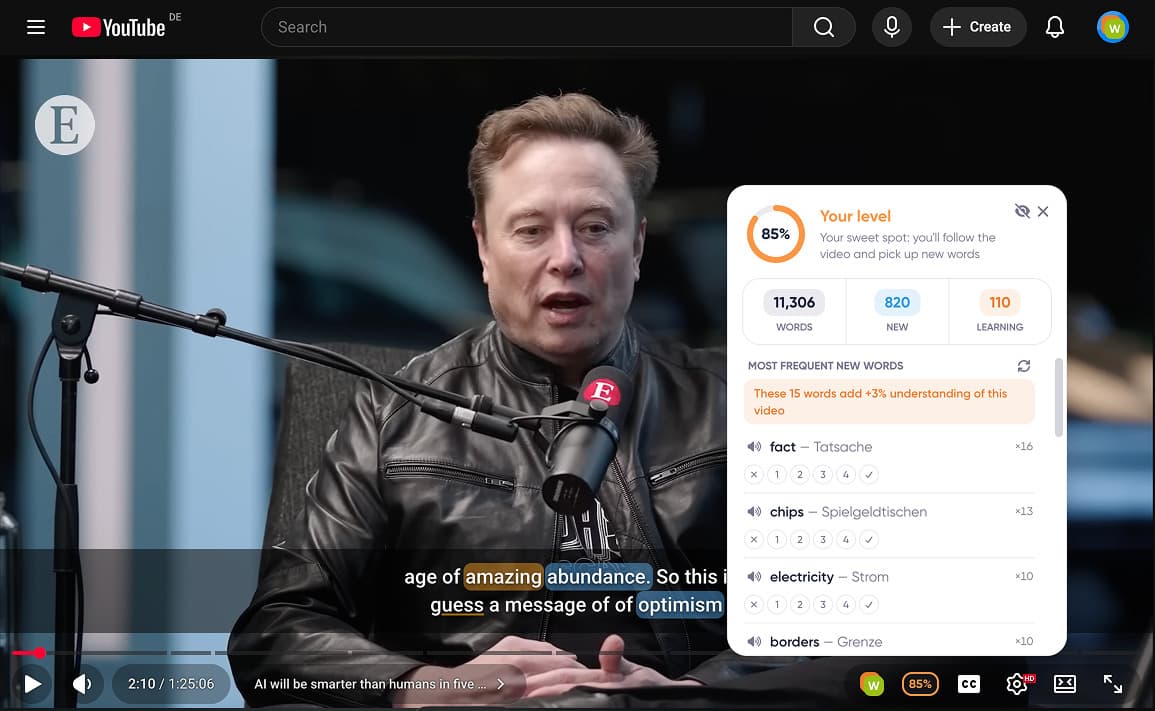
Comprehensible input is a language learning method where you understand the content almost all of the way — and "almost" turns out to be a specific number. Research on lexical coverage puts comfortable, unassisted comprehension at around 95–98% of known words, with the productive learning zone just below that. The catch: the number depends on your vocabulary, not on the content's official difficulty level, and you cannot estimate it by eye.
Every language learner has been told to consume content they can mostly understand. Almost nobody is told how to recognise it. So you open a video, struggle for three minutes, close it, and quietly conclude the problem is you — but it isn't!
This article in short
Research shows comfortable understanding starts at 95–98% known words — below that mark it drops off quickly.
"I understand about 90%" sounds fine — but it means stumbling on every tenth word.
The threshold is personal: it depends on your vocabulary, not on the content's difficulty label.
WordByWord shows the percentage for any YouTube video, article or PDF before you start — matched against the words you actually know.
The fastest way to progress: learn the 5–15 most frequent unknown words of a specific video, after which watching it becomes noticeably easier.
What is comprehensible input?
At the core of the method is material you understand most of, even though it still contains things you have not learned yet. Understanding comes first, and the unfamiliar parts ride along on top — close enough to the familiar ones to be worked out.
Krashen's input hypothesis and i+1
The term was coined by the linguist Stephen Krashen in the 1980s. His input hypothesis says language is acquired when you understand messages slightly above your level — not when you study rules about the language. He wrote that "slightly above" as i+1: i is your current level, +1 the next step. The idea is famous, but the formula measures nothing: it never says how much "slightly" is. Everything below is an attempt to turn that gap into a concrete number.
Comprehensible input examples
The same material is comprehensible input for one learner and noise for another. A rough illustration for a learner at an intermediate level:
Comprehensible: a cooking video in your target language — repetitive vocabulary, visible actions, predictable structure. You miss words and still follow everything.
Borderline: a podcast interview on a familiar topic. You follow the thread, lose the jokes, and have to re-listen to some sentences.
Not comprehensible: a legal drama with courtroom vocabulary and overlapping dialogue. You catch fragments. Nothing accumulates.
Notice what determines the category: not the format, not a label on the content, but the overlap between the words in it and the words in your head.
Why "comprehensible" is a number, not a feeling
Linguists measure that overlap and call it lexical coverage: the percentage of running words in a text that the reader or listener already knows. "Running words" means every occurrence — if the appears forty times, it counts forty times, because that is how reading and listening actually work.
Coverage is the quantitative version of Krashen's qualitative idea. And the research on it produced something surprisingly useful: hard thresholds.
What the research says about the thresholds
The thresholds come not from marketing but from research into extensive reading — the practice of reading a lot of easy material instead of grinding through difficult texts with a dictionary. Researchers measured how comprehension depends on the share of known words, and got concrete numbers.
Reading: 98% for comfort, 95% as the floor
In the classic study, Hu and Nation manipulated a fiction text so that learners knew 80%, 90%, 95% or 100% of the words, then measured comprehension. The finding that became a reference point in the field: around 98% coverage is needed for comfortable, unassisted reading, and 95% is roughly the floor below which adequate comprehension stops being achievable — and even at 95% only a minority of readers managed it, which makes that figure a lower bound, not a working target. A later replication by Kremmel and colleagues supported the same pattern.
The more interesting question is what happens when you drop below these numbers.
Listening and video are more forgiving
Van Zeeland and Schmitt ran the same logic on spoken narratives and found listening behaves differently from reading: comprehension at 90% and at 95% coverage was close enough to be practically similar, with 95% the safer target. Work on viewing comprehension — video rather than audio alone — points the same direction: images, gesture and situation carry meaning that text has to spell out, so visuals partly compensate for words you don't know.
Which matches ordinary experience. You can follow a cooking video in a language you barely speak. You cannot follow a page of prose the same way.
Why it gets hard so fast below the threshold
The main thing that happens below the threshold: you lose the ability to guess new words from context. To work out an unknown word, everything around it has to be clear — and when too much is unfamiliar, no clear context is left. So in dropping from 95% to 90% you are not losing "another 5% of the meaning"; you are losing the footing the rest of your guesses stood on. How abruptly this happens is still debated — the fall was sharp in Hu and Nation’s data, smoother in Schmitt, Jiang and Grabe’s — but the direction is the same everywhere.
This is why "just push through harder content" fails so reliably, and why it feels like a personal failure rather than a mismatch of numbers.
Why 2% unknown is not 2 words per page
Percentages are deceptive until you translate them into words. 98% coverage means one unknown word in every fifty — about one every four or five lines: new words keep appearing, but they do not get in the way of reading. And 90% — the level people usually describe as "understanding most of it" — already means stopping at every tenth word.
How to find out your coverage percentage
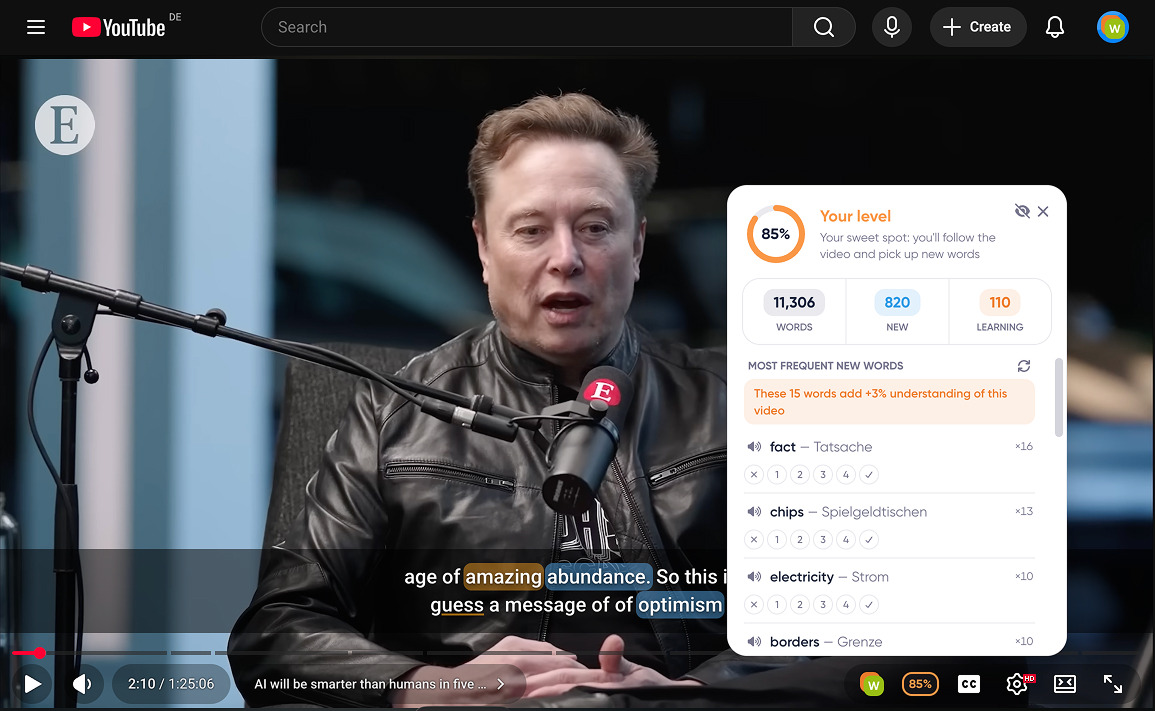
WordByWord counts the words in whatever you have open — the subtitles of a video, the text of an article, the pages of a PDF — matches them against the words you have actually learned, and shows the share you already know before you start. 85% on that video means thirteen points below the 98% at which unassisted reading is comfortable, inside the range where visuals and subtitles carry you, with the specific words responsible listed underneath.
The rest of this article is what sits behind that number: where it comes from, how it is computed, and where we deliberately made it stricter than it needed to be.
The real problem: finding input at your level
None of the above is controversial in language learning circles. The bottleneck is practical: the thresholds are personal, and nothing you open tells you where it sits relative to your vocabulary.
The usual workarounds all approximate:
Graded content and level labels (A2, B1, "beginner-friendly") describe an average learner. Your vocabulary is not average — it is shaped by whatever you happen to have read and watched.
Readability scores (Flesch and friends) measure sentence and word length in the abstract. They know nothing about you.
"Try it and see" works, but the cost of a wrong guess is a wasted evening and a dent in motivation.
Curated level systems from input-focused projects are genuinely useful, and they exist precisely because the selection problem is real — but they can only cover their own library.
What is missing is a measurement: this specific page, this specific video, against this specific vocabulary.
A comprehension score for anything you open
That measurement is exactly what WordByWord's Comprehension Level provides — and it works on anything you open.
Any YouTube video
On YouTube a button appears next to the player with the score in its tooltip — Comprehension: 85% — click for details. The score is computed from the video's subtitles in the language you are learning, so it reflects what is actually said rather than the title or the topic. If subtitles in that language do not exist, WordByWord says so plainly instead of inventing a number.
Any web article
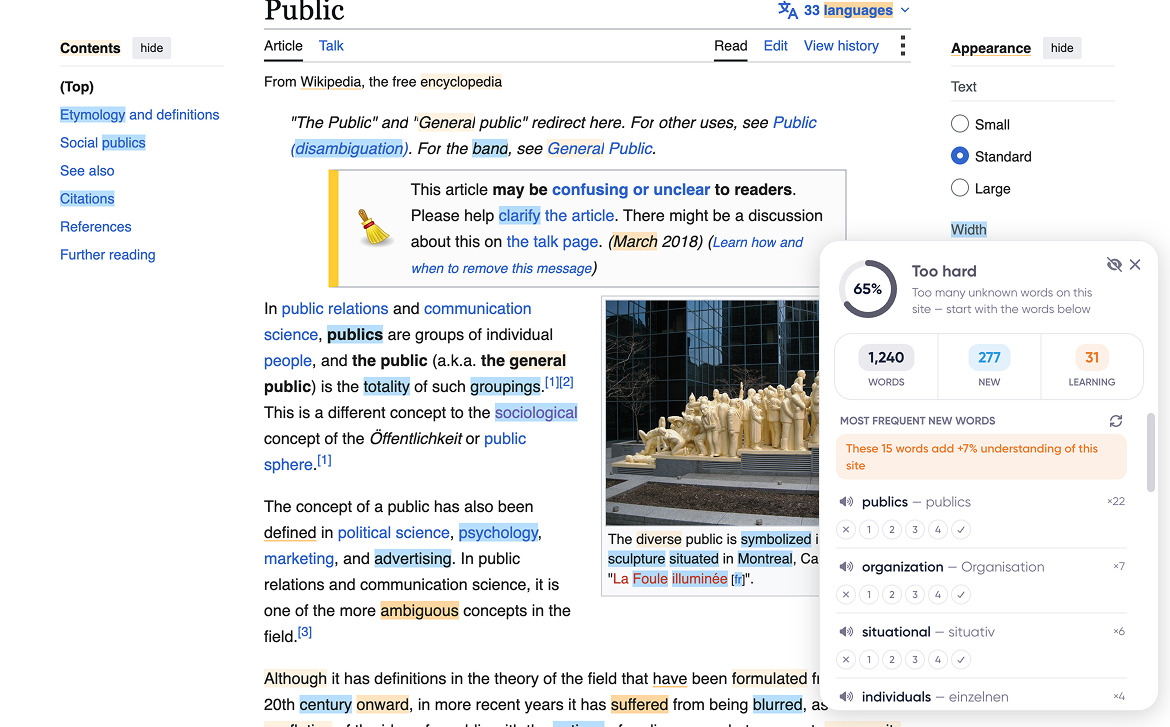
On ordinary web pages a chip shows the count of new words, and opening it gives you the same panel as on video: the percentage, the counters, and the words that would raise it most. One glance tells you whether this is a five-minute read or a forty-minute slog with a dictionary.
Any PDF
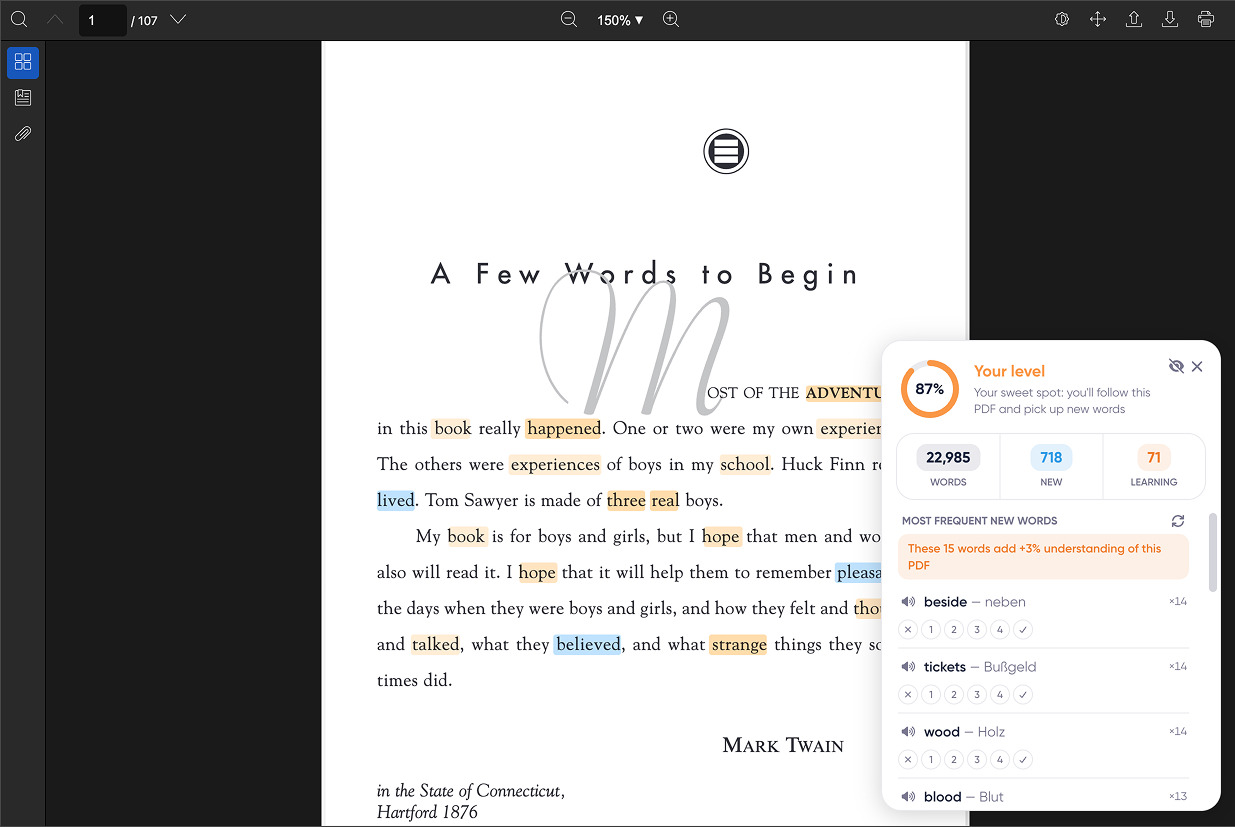
PDFs are scored progressively: text is fed to the engine page by page and the score updates as more of the document is read, so a long document produces a running estimate rather than nothing at all.
Any language you are learning
The score has nothing English-specific about it. It compares tokens to your saved vocabulary, whatever language that vocabulary is in — Spanish, French, German, Italian, Portuguese, Korean and dozens more. Learners of Spanish looking for input at their level get exactly the same number for a Spanish video that learners of Korean get for a Korean one.
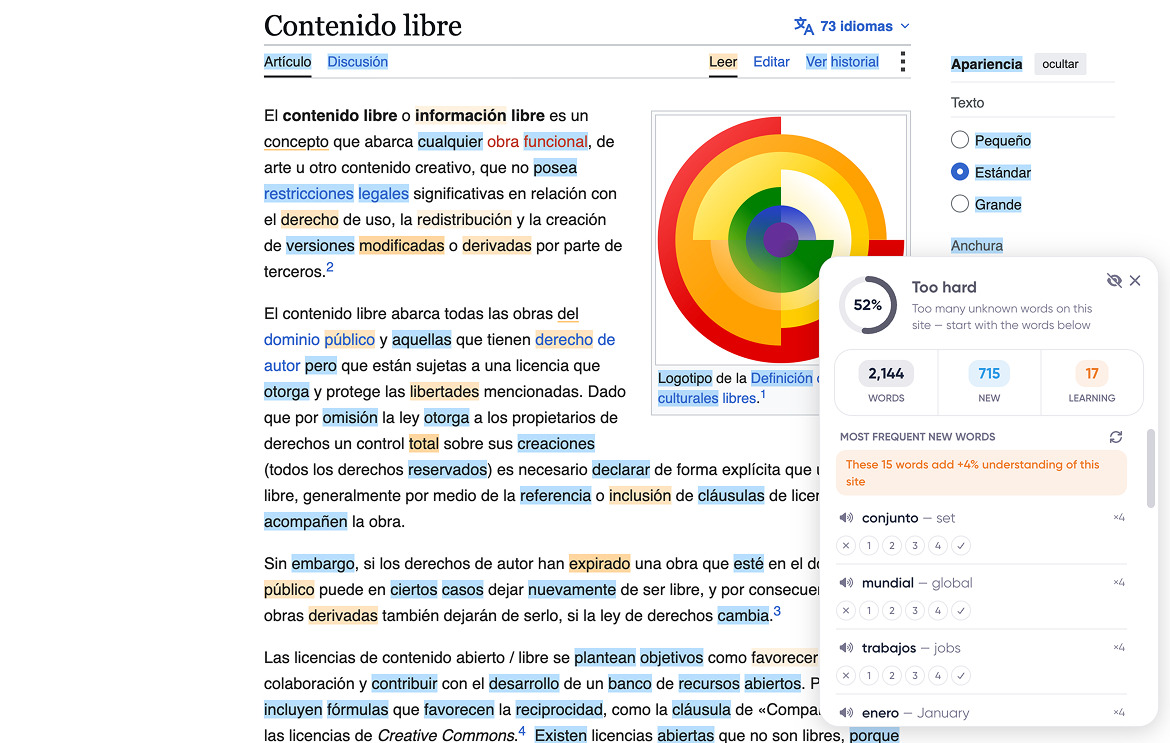
What the four zones mean
The raw percentage is turned into four zones, so you can decide without doing arithmetic:
| Zone | Coverage | What it means |
|---|---|---|
| Easy | 95% and up | An easy watch or read — good for consolidating what you already know |
| Your level | 85–94% | The growth zone: you follow the content and still meet new words |
| Challenging | 70–84% | Doable with effort — interactive subtitles, pauses and highlighting will carry you |
| Too hard | below 70% | Save it. Start with its most frequent words instead |
The zone boundaries build on the same research, adjusted for how you actually watch and read with WordByWord. The studies measured comprehension without any support — that is where the 95% line comes from. You, however, have interactive subtitles, highlighting and click-to-translate at hand, and they noticeably raise what you can handle. So the 85% and 70% boundaries are our calibration for those conditions: with support, the growth zone starts lower than in the experiments without it.
The hints adapt to the format: a video is "an easy watch", an article "an easy read" — and in the Too hard zone WordByWord goes straight to the list of words worth starting with.
How the number is computed — and where we made it stricter on purpose
A score like this is only worth having if you know what it counts. Ours makes several deliberately conservative choices, and they are worth stating openly.
"Known" means genuinely known. A word counts towards your coverage only from the Learned level upwards. Words you have saved but are still working through — New, Recognised, Familiar — are reported separately as "learning" and do not inflate the percentage. The flip side: if you have only just started using the extension, the score will run below reality — it only knows the words you have saved.
The denominator excludes noise, not difficulty. Anything the highlighting engine would not treat as a word to learn is left out entirely: your personal ignore list, text in a different writing system, URLs, e-mail addresses, hashtags, and tokens without letters. The score measures vocabulary, not page furniture.
Too little text, no score. Below 20 counted tokens nothing is shown. A percentage over a handful of words is noise dressed up as data.
100% does not lie. 99.5% rounds down to 99. You only see 100% when coverage is genuinely complete.
The words that buy the most understanding
Why a handful of words moves the number
In any language, words are spread very unevenly: a small group does the work constantly, while most of the rest appear once or twice in a whole text — linguists call this Zipf's law. The same goes for the unknown words in a specific video: most of the gaps come from a handful of words that repeat again and again. So learning the ten most frequent unknown words of one video is a small investment with a disproportionate return: the coverage of that video rises by several points at once.
The score knows how many times each word repeats — so it can also answer the more interesting question: which words are worth learning for this specific content. The panel shows the most frequent new words with their occurrence counts, and above them a line like:
These 15 words add +3% understanding of this video
That is not a marketing estimate but simple arithmetic over the subtitles and your vocabulary: once those words become known, coverage rises by exactly that much.
The length of the list is not fixed. WordByWord picks between 5 and 15 words — exactly as many as it takes to close the most frequent gaps of the specific text. A dense technical article where four terms repeat constantly needs only a short list; a documentary where new words are scattered one by one needs a long one. One more detail: words with the same frequency are never cut by the list boundary — if six words appear ten times each, all six make the list, not five of them.
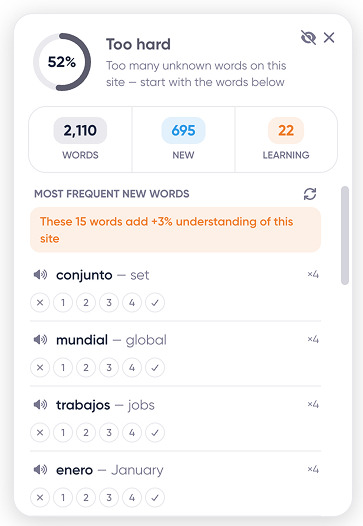
Each word can be saved at a level, ignored, heard aloud, or read with its translation right there. Learn them, reopen the video, and the score has moved — usually enough to shift it from Challenging into Your level.
Do you have to avoid translation?
Part of the comprehensible input community deliberately works without translation, dictionaries or word lists, believing they get in the way of acquisition. WordByWord does not argue with that: the score is a measurement, not a method. It tells you what share of the words in front of you you already know — and what you do next, click for a translation or rewatch the video until the meaning settles on its own, is up to you.
Choosing material is something every method requires. If you practice input without translation, use the score and the zones and leave the rest of the extension switched off.
How to use it in practice
Choosing a series. Open the first episodes of three candidates and compare scores before you commit. One will be in your growth zone; the others are for later or for consolidation.
Filtering a reading list. Scan your saved articles and let the new-words chip sort them. Read the ones in your zone now; keep the too-hard ones and revisit them in a month, when the number will have changed on its own.
Getting through a book or PDF. Score it, and if it lands in Challenging, learn the word list first instead of starting and abandoning it. Ten to fifteen words is an evening; the difference it makes to a 300-page document is not.
FAQ
What is a comprehensible input example?
A video, podcast or text where you understand nearly everything and still meet a few new words — a cooking video with repetitive vocabulary and visible actions is a common example for early learners. The same material stops being comprehensible input once your level moves past it, and starts being it once your vocabulary catches up. It is defined by the match to the learner, not by the material alone.
What is the comprehensible input method?
Broadly, an approach to language learning that prioritises understanding large amounts of material at or slightly above your level over studying grammar rules or drilling isolated words. Variants differ sharply on details — especially whether translation is allowed — but they share the premise that acquisition comes from understood input.
What is Stephen Krashen's theory of comprehensible input?
Krashen's input hypothesis holds that language is acquired by understanding messages containing structures slightly beyond your current level, which he summarised as i+1. It is one of five hypotheses in his broader model of second language acquisition, and it is descriptive rather than quantitative — it does not specify how far beyond your level input should be.
Does comprehensible input work?
Yes — the evidence is strong. The debates are about details: how much explicit study to add and whether translation interferes; the consensus is that input is necessary but not the only mechanism, with speaking practice contributing too. What usually breaks is not the principle but the execution: input that is too hard is not comprehensible input, and most people overestimate how much they understand.
How to get comprehensible input as a beginner?
At the start, coverage against native content is low enough that unassisted comprehension is not realistic, so lean on material where meaning comes from outside the words: visuals, gesture, familiar situations, slow speech made for learners. Use the score to avoid the trap of picking something that merely looks easy — a short video with dense vocabulary can be harder than a long, repetitive one.
How much comprehensible input per day do you need?
There is no established number, and anyone quoting one precisely is quoting a habit rather than a finding. What the coverage research does imply is that the hours are not interchangeable: an hour spent on material where you know 90% of the words does far more than an hour spent on material where you know 50%, because below the threshold you stop being able to infer anything and the time stops compounding. Consistency and match to your level both matter more than the size of the daily block.
How many words do you need to know?
It depends on the content: reaching 98% coverage of ordinary written texts takes roughly 8,000–9,000 word families, and spoken language about 6,000–7,000 (Nation's estimates). But the practical answer is simpler: what matters is not the total size of your vocabulary but its overlap with a specific piece of content — two texts "at the same level" can sit far apart. WordByWord counts exactly that overlap: from your saved words, for whatever you have open right now.
How do I know if a video is comprehensible input for me?
Check the share of words in it you already know. Above roughly 95% it will feel comfortable; 85–94% is the productive zone where you follow along and still pick things up; below about 70% you are pattern-matching rather than understanding. WordByWord computes that percentage for a video, article or PDF against your own saved vocabulary before you start.
Is 95% coverage the same as 95% comprehension?
No, and this trips people up. Coverage is the proportion of words you know; comprehension is how much of the meaning you get. They are related but not equal — which is the whole reason the research had to measure comprehension separately at fixed coverage levels, and why the thresholds are as high as they are.
Is there a comprehensible input app?
Several kinds exist, and they solve different halves of the problem. Graded-reader apps and curated video libraries hand you material already sorted by level, which works well until you want something outside their catalogue. Browser-based tools instead work on the content you already watch and read, and that is the category WordByWord belongs to: rather than supplying a library, it measures whatever you open against your own vocabulary, in any language you are learning.
What is the 15 30 15 method?
A study-session structure occasionally recommended for input practice: a short warm-up, a longer block of focused input, then a short review — the exact splits vary by whoever is recommending it. It is a scheduling technique, not a claim about acquisition, and it is unrelated to how coverage is measured.
Try it on the next thing you open
The shortest version of everything above: comprehensible input is not a genre you can shop for, it is a relationship between content and your vocabulary — and that relationship is now a number you can see before you spend an evening on the wrong video.
WordByWord is a language learning Chrome extension that does the measuring for you. Install it, open something in the language you are learning, and look at the number before you commit your evening to it.
References
Hu, M., & Nation, P. (2000). Unknown vocabulary density and reading comprehension. Reading in a Foreign Language, 13(1), 403–430. Article page
van Zeeland, H., & Schmitt, N. (2013). Lexical coverage in L1 and L2 listening comprehension: The same or different from reading comprehension? Applied Linguistics, 34(4), 457–479. Publisher page
Schmitt, N., Jiang, X., & Grabe, W. (2011). The percentage of words known in a text and reading comprehension. The Modern Language Journal, 95(1), 26–43. Publisher page
Kremmel, B., Indrarathne, B., Kormos, J., & Suzuki, S. (2023). Unknown vocabulary density and reading comprehension: Replicating Hu and Nation (2000). Language Learning. Publisher page (open access)
Durbahn, M., Rodgers, M., & Peters, E. Lexical coverage in L1 and L2 viewing comprehension. Studies in Second Language Acquisition. Publisher page