
Vocabulary coverage is the share of running words in a text a reader already knows, and it is one of the strongest predictors of whether that reader will understand what they’re reading. Decades of research, starting with Laufer and Ravenhorst-Kalovski’s lexical threshold work, converge on two practical benchmarks: 95% coverage as a minimal floor and 98% as the level associated with comfortable, unassisted reading. Those percentages translate to roughly 4,000 to 5,000 word families for the lower bar and around 8,000 for the higher one.
TL;DR:
- Most texts are covered by the first 1,000 most frequent word families, which account for around 72% of content, easing initial comprehension.
- Achieving 95% vocabulary coverage requires roughly 4,000 to 5,000 word families, while 98% demands about 8,000, affecting reading smoothness.
- Listening and audiovisual comprehension typically tolerate lower coverage than reading because context and prosody compensate for unknown words.
- Coverage measurement relies on tokenizing texts and mapping words to frequency lists, but short samples under 200 words can produce unreliable estimates.
- Teaching and assessment should tailor coverage targets: 95% for extensive reading and enjoyment, 98% for high-stakes academic and technical texts.
Table of Contents
- What Is Vocabulary Coverage in Texts?
- How Do Vocabulary Thresholds Vary Across Studies?
- How Is Vocabulary Coverage Measured in Practice?
- What Do Coverage Thresholds Mean for Teaching and Assessment?
- Where Do Coverage Metrics Fall Short?
- A Practical Checklist for Measuring and Acting on Coverage
- Showing a learner their comprehension level before they start a text does the same job as a lexical coverage calculation, just faster and in context. Spotlight mode highlights unknown words directly on the page, making visible the gap between what a reader knows and what a text demands. That said, an extension’s in-app data on what one learner knows is a useful signal for daily study decisions, not a replacement for controlled research on thresholds. The two should inform each other, not stand in for one another.
- Sources
- FAQ
What Is Vocabulary Coverage in Texts?
Vocabulary coverage measures the proportion of words in a text that a reader recognizes, expressed as a percentage of total running words rather than unique words. Researchers calculate it by taking a text, tokenizing every word, and checking each one against a frequency-ranked word list or a known-vocabulary profile for a given reader or learner group.
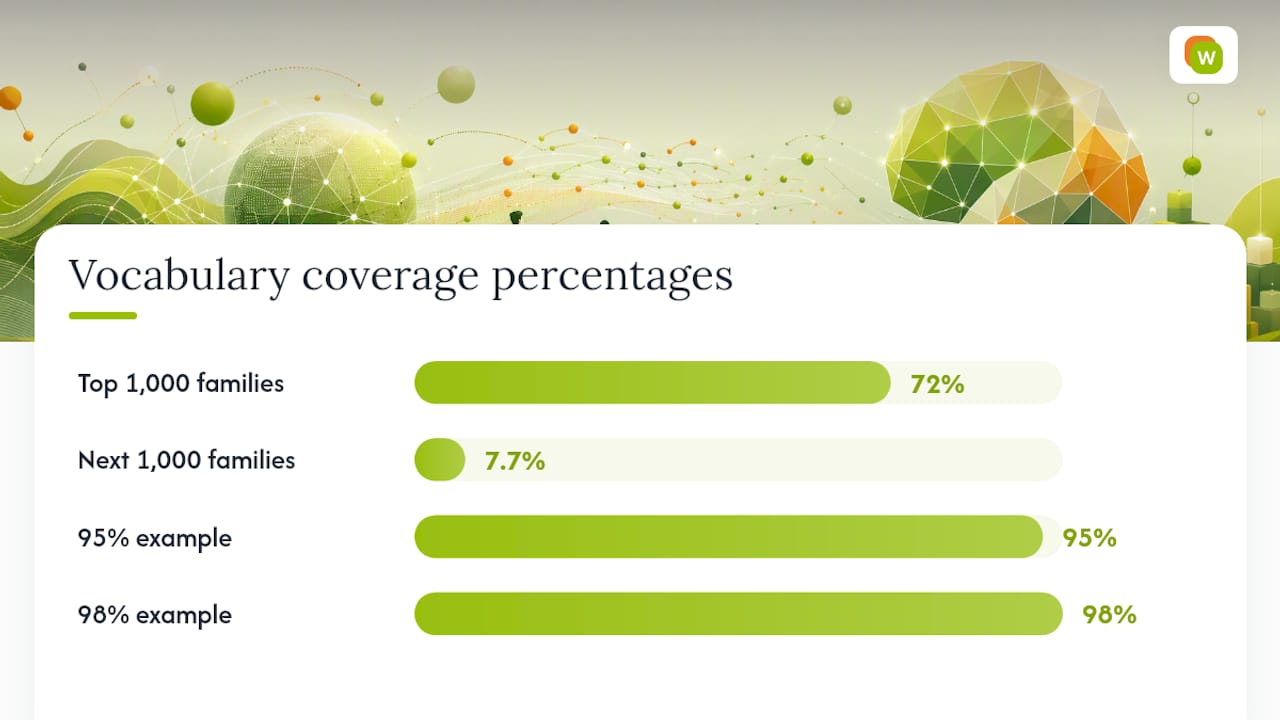
The math behind this is deceptively simple but the pattern it reveals is not. Word frequency in any language follows a Zipfian distribution: a small number of words account for a huge share of any text. That’s why the first 1,000 most frequent word families cover about 72% of a typical text, while the next 1,000 add only about 7.7 percentage points. Coverage gains shrink fast as you move down the frequency list, which is the core reason why closing the last few percentage points to reach 98% takes so many more word families than closing the first 70%.
A quick worked example makes this concrete:
- A 500-word article where a reader knows 475 words sits at 95% coverage, meaning roughly 1 word in 20 is unknown.
- The same article at 98% coverage means only 10 words are unfamiliar, about 1 in 50.
- That five-word gap between 95% and 98% is where reading often shifts from “workable but effortful” to “smooth.”
How Do Vocabulary Thresholds Vary Across Studies?
The 95%/98% figures are not a single study’s finding, they’re a pattern that keeps showing up across a body of research with some real variation underneath. Laufer and Ravenhorst-Kalovski’s foundational study set the optimal threshold at 98% coverage, equivalent to roughly 8,000 word families including proper nouns, and the minimal threshold at 95%, closer to 4,000 to 5,000 families.
Other work complicates the picture in useful ways. The Percentage of Words Known in a Text and Reading Comprehension finds a broadly positive, graded relationship between percent known and comprehension scores rather than a sharp cliff at either threshold, and suggests 98% is a reasonable target specifically for academic texts. That graded pattern matters: it means coverage operates more like a dial than a switch, with comprehension improving steadily as coverage rises rather than flipping suddenly at one number.
The word-family range behind the thresholds: 95% coverage lines up with roughly 4,000 to 5,000 word families for many general texts, while 98% typically requires around 8,000, according to the lexical threshold research.
Modality matters too. Listening and audiovisual comprehension tend to tolerate lower coverage than reading because prosody, visuals, and context carry some of the load, while dense academic prose usually demands coverage at the higher end of the range just to stay legible.
How Is Vocabulary Coverage Measured in Practice?
Lexical profiling is the standard workflow, and it runs in three steps. First, a text gets tokenized into individual words. Second, each token maps to a word family on a frequency-ranked list, since knowing “run” is treated as partial credit toward “running,” “runner,” and “ran.” Third, a script tallies what percentage of total running words the reader’s known vocabulary accounts for.
Tools built for this include:
- Vocabulary Profile and the English Vocabulary Profile, which map words to frequency bands and CEFR levels for cross-referencing against a learner’s known set.
- Frequency lists built from large corpora such as the British National Corpus or COCA, which anchor what “common” even means in a given language.
- Newer LLM-assisted approaches that assess word-level proficiency in context rather than by static list lookup, which helps with polysemy since a word like “light” means something different depending on the sentence around it.
Pro Tip: Coverage numbers are only as reliable as the sample they’re computed on. Avoid reporting coverage for texts under 200 running words, since short samples swing wildly on a handful of rare words; where a short text is unavoidable, average across several samples instead of trusting one score.
Multiword expressions are the other quiet trap. A rule-based tool that scores “kick the bucket” as three separately known words will overstate a reader’s real comprehension of that sentence.

What Do Coverage Thresholds Mean for Teaching and Assessment?
Coverage targets should shift depending on what a lesson or assessment is actually trying to achieve, and treating 95% and 98% as interchangeable defaults is a common mistake.
- Use 95% for comprehensible input and extensive reading. When the goal is volume, enjoyment, and incidental vocabulary pickup rather than full comprehension, a 95% floor keeps texts challenging without overwhelming the reader. This is the territory of extensive reading as a classroom mode.
- Reserve 98% for unassisted, high-stakes reading. Academic articles, exam passages, and technical material generally need the higher bar, since there’s no teacher or context to fill comprehension gaps.
- Select texts deliberately. Graded readers can hit 98% coverage with as few as 3,000 word families, while unadapted novels or newspaper text often need 8,000 to 14,000 families to reach the same ceiling, so text choice does more work than most people assume.
- Prioritize Tier 2 vocabulary in instruction. Academic, cross-domain words that show up in many subjects give the biggest coverage return per hour of teaching, more than rare technical terms or already-familiar Tier 1 words. Guidance on comprehension and vocabulary priorities covers this in more depth.
- Pair coverage with contextual recognition checks. A raw coverage percentage tells you what a reader probably knows; a task modeled on the ROAR-Written Vocabulary approach tells you whether they can actually retrieve meaning in context, which is the real target.
Where Do Coverage Metrics Fall Short?
Coverage predicts comprehension, but it doesn’t guarantee it. A few caveats keep the numbers honest:
- High coverage can still leave a reader confused if the unknown 2% consists of dense, concept-loaded terms rather than filler words.
- Short texts, heavy polysemy, and multiword expressions all reduce the reliability of a single coverage score, a point echoed in research on lexical profiling limitations.
- Diversity indices like type-token ratio or MATTR are useful side measures of text complexity, but they’re unstable on short samples and don’t substitute for coverage when the question is comprehension.
- Much of the classic threshold literature draws on a modest number of studies, so treating 95%/98% as universal laws rather than useful approximations overstates what the evidence supports.
Transparent reporting, meaning the text type, sample length, and reference corpus used, matters more than most papers acknowledge.
A Practical Checklist for Measuring and Acting on Coverage
Researchers and instructors benefit from a repeatable sequence rather than an ad hoc glance at a percentage.
- Select a representative text sample, ideally 200 running words or more, matched to the genre you actually care about.
- Choose a frequency list or profiling tool and state which one, since coverage estimates shift depending on whether you’re using a BNC-based list or a different corpus.
- Run the tokenization and coverage computation, tracking word families rather than raw word forms.
- Report the method alongside the number. Text type, sample length, and corpus source all belong in the write-up, not just the final percentage.
- Pair the coverage score with a comprehension check, whether that’s a cloze test, a retelling task, or a contextual recognition instrument.
- Act on the gap. If coverage sits below 95%, pre-teach key vocabulary or swap texts; if it clears 98%, consider assigning unassisted reading.
Pro Tip: When you’re tracking your own reading level rather than running a formal study, a tool like WordByWord’s browser extension can show comprehension level on a page before you commit to reading it, which is the same logic as a coverage calculation, just applied in real time instead of after the fact. For classroom use, WordByWord’s guide to tracking vocabulary while reading walks through a similar process step by step.
Showing a learner their comprehension level before they start a text does the same job as a lexical coverage calculation, just faster and in context. Spotlight mode highlights unknown words directly on the page, making visible the gap between what a reader knows and what a text demands. That said, an extension’s in-app data on what one learner knows is a useful signal for daily study decisions, not a replacement for controlled research on thresholds. The two should inform each other, not stand in for one another.
— WordByWord Team
Sources
- Lexical threshold revisited: Lexical text coverage, learners’ vocabulary size and reading comprehension
- Research Investigating Lexical Coverage and Lexical Profiling: What We Know, What We Don’t Know, and What Needs to be Examined
- ROAR-Written Vocabulary (ROAR Comprehension Suite) — instrument description
FAQ
How Do You Find Vocabulary Words in a Text?
Run the text through a lexical profiling tool such as Vocabulary Profile, which tokenizes every word and flags which ones fall outside common frequency bands, or manually cross-check against a frequency list to see which words sit beyond the reader’s known vocabulary.
What Are the Main Types of Text Structure?
Text structures commonly discussed in reading research include description, sequence, cause and effect, compare and contrast, and problem and solution; some frameworks add narrative structure as a distinct sixth or seventh category, though definitions vary across sources.
Can You Give Examples of Vocabulary Words by Frequency Level?
High-frequency examples include “the,” “make,” and “get”; mid-frequency academic examples include “significant,” “factor,” “analyze,” and “context”; low-frequency or technical examples include “morpheme,” “corpus,” “lexeme,” and “polysemy,” each drawn from a different band on a frequency-ranked list.
What Are the Main Types of Vocabulary Educators Track?
Vocabulary research generally groups words into listening, speaking, reading, and writing vocabulary, sometimes with a fifth category for sight vocabulary, reflecting the fact that a learner’s receptive vocabulary (words understood) is typically larger than their productive vocabulary (words used).
Is 95% or 98% the Better Target for Language Learners?
It depends on the goal: 95% coverage works well for extensive reading and comprehensible input, while 98% suits unassisted reading of demanding academic or technical texts, per Laufer and Ravenhorst-Kalovski’s findings.