
Collocations, not isolated words, drive how fluent and natural your English sounds, while single words give you the raw material to build them. A learner who knows “heavy rain” and “make a decision” will sound more competent than one who has memorized twice as many individual words but strings them together like “strong rain” or “do a decision.” The practical payoff is speed and appropriacy: collocational knowledge alone explains roughly 48.4 to 48.8% of the variance in how proficient a speaker sounds to listeners. Keep reading for the exact examples and classroom routines that turn this research into daily practice.
TL;DR:
- High-frequency collocations like make a decision and heavy rain are processed almost automatically by native and advanced speakers, improving fluency.
- Collocational knowledge accounts for nearly half of the variance in how fluent a second-language speaker sounds, far outperforming single-word vocabulary.
- Classroom methods such as concordance hunts, gap-fill exercises, and collocation swap activities effectively build practical collocational competence.
- Explicit focus on collocations helps learners produce more natural speech and requires targeted instruction beyond memorizing individual words.
- Daily practice routines involving reading, listening, and spaced repetition with sentence-level flashcards significantly enhance collocational mastery.
Table of Contents
- Collocations vs single words: what actually separates them
- Collocation examples that trip up even advanced learners
- What the research says about fluency and collocation knowledge
- How to build collocational competence, in class and alone
- Eight collocation mistakes learners make (and how to fix them)
- Where to look up collocations and how to practice them daily
- Why we built collocation practice into reading, not around it
- Turn your reading into a collocation practice loop
- Sources
Collocations vs single words: what actually separates them
A collocation is two or more words that native speakers habitually place together, even though other combinations would be grammatically fine. Cambridge and Oxford both define it this way: not a rule of grammar, but a pattern of usage that sounds “right” to a native ear because it’s the version people actually say. You could technically say “make a mistake” as “do a mistake,” and every grammar rule would survive intact. It just isn’t what English speakers say, and that gap between grammatical and natural is exactly what collocation knowledge closes.
A single word, by contrast, is a standalone lexical unit. It carries meaning on its own: “rain,” “decision,” “heavy.” Single words are the raw vocabulary that fills a dictionary, and they matter enormously for comprehension. You cannot understand a sentence if you don’t know its words. But knowing “rain” and knowing “heavy” separately doesn’t tell you that English pairs them, while French might pair “rain” with a word closer to “strong.” That pairing knowledge lives in a different mental category from single-word meaning, which is why Cambridge’s ELT guidance treats collocation instruction as a distinct strand of vocabulary teaching, not an afterthought to word lists.
It helps to separate collocations from two categories learners often confuse them with:
- Idioms carry a meaning you can’t guess from the individual words: “kick the bucket” has nothing to do with buckets. Collocations, by contrast, keep their literal meaning; you can guess “heavy rain” even if you’ve never heard it before. WordByWord’s collection of English idioms is a useful place to see that contrast side by side.
- Phrasal verbs are verb plus particle combinations (“give up,” “look into”) that often shift meaning entirely from the base verb. Collocations can include phrasal verbs, but the category is broader and includes adjective+noun and noun+noun pairs that have nothing to do with particles.
- Single words are the atoms; collocations are the molecules. You need both, but they’re tested and taught differently, and conflating them is why so many vocabulary lists fail to produce fluent speech.
For assessment purposes, the takeaway is simple: testing single-word recall (matching a word to its definition) measures something real, but it doesn’t measure whether a learner can produce natural-sounding sentences. Fluency assessment needs a separate lens.
Collocation examples that trip up even advanced learners
Some collocation errors are so common they’ve become a kind of shorthand for “this person learned English from a dictionary.” Here are ten pairs where the natural collocation and the technically-correct-but-wrong alternative sit side by side.
- Make a decision, not “take a decision” (common in French and German transfer errors).
- Heavy traffic, not “strong traffic” or “big traffic.”
- Do homework, not “make homework.”
- Strong coffee, not “hard coffee” or “heavy coffee.”
- Catch a cold, not “take a cold” or “get sick of cold.”
- Pay attention, not “give attention” or “put attention.”
- Fast food, not “quick food,” even though “quick” and “fast” are near-synonyms.
- Take a shower, not “make a shower” or “do a shower.”
- Deep sleep, not “heavy sleep” (though “heavy sleeper” flips the pattern back).
- High risk, not “big risk” or “large risk,” even though all three describe magnitude accurately.
Not every collocation deserves equal classroom time. High-frequency collocations like “make a decision” or “heavy rain” show up constantly across registers and contexts, and processing research finds native and advanced speakers process these faster, treating them almost like single units. Low-frequency collocations, things like “commit an atrocity” or “wreak havoc,” matter for precision and register in academic or professional writing but shouldn’t crowd out the high-frequency backbone early on. A beginner drilling “wreak havoc” before mastering “make a decision” has the priority backward.
Two quick tasks turn this list into practice rather than trivia:
Gap-fill task: Give learners five sentences with the noun supplied and the verb missing (“She decided to ___ a shower before dinner”). This forces them to retrieve the collocate, not just recognize it, which is a much closer match to real speaking demands.

Choose-the-natural-collocation task: Present three options per sentence, one correct collocation and two grammatically valid but unnatural alternatives (“heavy rain / strong rain / big rain”). Because none of the wrong answers are grammatically incorrect, learners have to rely on collocational memory rather than grammar rules, which is precisely the skill this task is meant to build.
What the research says about fluency and collocation knowledge
Here’s the number that should reorganize how any curriculum weighs vocabulary instruction: collocational knowledge explains between 48.4 and 48.8% of the variance in how listeners rate a second-language speaker’s oral proficiency. That’s not a marginal factor buried among a dozen others. It’s close to half the picture, and it dwarfs what single-word vocabulary breadth contributes on its own.
Collocation frequency and association strength (measured through statistics like mutual information or log Dice) shape how fast listeners judge a phrase as appropriate. High-frequency collocations get processed almost automatically, while unnatural combinations create a detectable hesitation, even when every individual word is correct.
That processing gap explains why a learner can have a large vocabulary and still sound effortful rather than fluent. Controlled classroom studies back this up directly: instruction that targets collocations produces measurable gains in speaking fluency and accuracy compared with instruction that teaches the same target words in isolation, according to research comparing the two approaches. The effect isn’t subtle. Students taught collocations produced speech that sounded more automatic and required fewer self-corrections.
There’s a nuance worth keeping, though, because the evidence doesn’t say single-word study is pointless. Some experiments find that learning words in isolation actually produces slightly better short-term retention on vocabulary tests, but collocational learning wins out on functional, natural-sounding use over time, according to research on adult EFL learners. In other words, single words might win the quiz; collocations win the conversation.
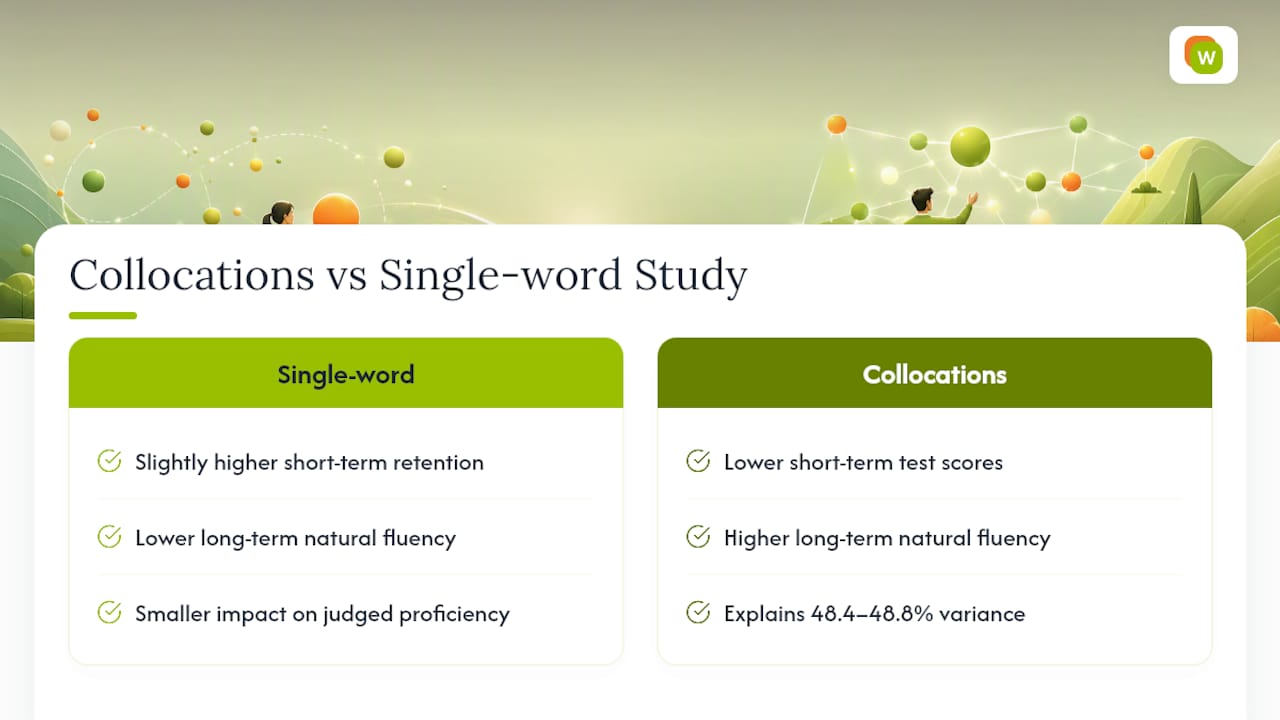
For curriculum design, this evidence points toward a rebalancing rather than a replacement. Vocabulary syllabi built entirely around word frequency lists (the “first 2,000 words” approach) miss the layer that most affects how a learner is judged in real conversation. Even advanced learners often show a persistent gap here: studies comparing lexical and collocational knowledge find that advanced EFL speakers use fewer and less varied collocations than native speakers, even when their single-word vocabulary size is comparable. That gap doesn’t close on its own with more single-word study. It needs targeted collocation instruction, at every level, not just at the beginner stage.
How to build collocational competence, in class and alone
Knowing that collocations matter doesn’t automatically translate into knowing what to do on Monday morning. Here’s what actually converts the research into a routine.
Start with noticing. Learners who read or listen without any system for capturing multiword chunks will keep meeting the same collocations without ever internalizing them. A dedicated collocation notebook, or a digital collection organized by theme rather than alphabetically, works far better than a generic vocabulary list because it forces you to record the pair, not just the headword.
Context-first learning matters just as much as the recording method. If you learn “decision” as an isolated flashcard with an L1 translation, you’ll likely need a second pass to learn which verb goes with it. If you learn “make a decision” as a chunk from the start, that step disappears. This is the single biggest efficiency gain available in vocabulary study, and it’s backed by the same research that shows collocational learning outperforming isolated word study on functional use.
Spaced repetition still applies to collocations, but the card design has to change. A single-word flashcard with an L1 translation on the back teaches recognition, not production. A better format uses a full sentence with the collocate blanked out (“She ___ a decision to leave early”), which forces retrieval of the exact word that fits the slot, not just a vague sense of meaning.
Six activities work reliably across classroom levels:
- Concordance hunt. Learners search a corpus tool or search engine for a target word plus wildcard (“make a ___”) and record the five most frequent results.
- Collocation swap. Give a paragraph with collocations replaced by unnatural synonyms; learners find and correct each one.
- Sentence transformation. Learners rewrite a sentence using a target collocation instead of a longer descriptive phrase.
- Category sort. Sort a mixed list of collocations into verb+noun, adjective+noun, and noun+noun buckets to build pattern awareness.
- Register matching. Present two collocations with the same meaning at different formality levels (“commence a project” vs. “start a project”) and ask learners to match each to a context.
- Chain dictation. Read a short passage rich in collocations aloud; learners transcribe it and highlight every multiword chunk they catch.
Four self-study routines extend this outside class: reading with a running collocation log, watching short videos and pausing to note verb+noun pairs, rewriting a paragraph from memory to force collocation retrieval, and reviewing collocation flashcards for five minutes before sleep, a timing that several memory studies associate with better consolidation.
Pro Tip: When you build a flashcard for a new collocation, write the example sentence first and delete only the collocate, not the whole phrase. Deleting the whole phrase turns the card into a translation exercise; deleting just the collocate forces you to retrieve the exact word English speakers use in that slot.
WordByWord’s guide to building vocabulary from context walks through this noticing-first approach in more depth, and the companion piece on tracking vocabulary while reading covers the collection side of the same workflow. For teachers looking to adapt these ideas into full lesson plans, task-based language teaching offers a practical framework for turning any of the six activities above into a complete task cycle.
Eight collocation mistakes learners make (and how to fix them)
Most collocation errors fall into a short list of recognizable types, which makes them easier to diagnose in real time.
- Literal translation from L1, like “make a photo” instead of “take a photo,” carried over from languages where that verb pairs differently.
- Wrong verb choice with an otherwise correct noun, such as “do a mistake” instead of “make a mistake.”
- Synonym substitution, assuming “strong” and “heavy” are interchangeable (“strong rain” instead of “heavy rain”).
- Register errors, using an informal collocation in formal writing or vice versa.
- Overgeneralizing a pattern, applying one correct collocation’s structure to a similar word that doesn’t follow it.
- Omitting the collocate entirely, producing a grammatically bare sentence that sounds childlike rather than wrong.
- Blending two correct collocations into a hybrid that matches neither.
- Relying on a bilingual dictionary’s first listed word, which often gives the most common single-word translation, not the collocate.
The fix in every case is the same three-step routine: show the wrong version next to the correct one, drill the correct pair in five to six new sentences, then check retention a week later in a fresh context, not the original sentence. A quick classroom check that reveals these gaps fast: ask learners to describe their weekend in three sentences using at least one verb+noun collocation each, then scan for literal translations. WordByWord’s page on commonly confused English words is a good companion resource for the literal-translation category specifically.
Where to look up collocations and how to practice them daily
A handful of reference tools cover most of what a learner or teacher needs. The Oxford Collocations Dictionary remains the standard print and digital reference for checking whether a pairing is natural. Corpus tools like the British National Corpus or COCA let you search a word and see its most frequent collocates ranked by frequency, which is exactly the concordance hunt activity described above. Online collocation dictionaries built into major learner dictionary sites serve the same function with a gentler learning curve for lower levels.
The workflow that ties reference and practice together looks like this: read a text at your level, highlight collocations you don’t already produce automatically, add them to a collection organized by theme or source text, then review with spaced repetition using sentence-level cards. This is a contextualized, metacognitive approach, and it’s the same pattern that research on strategy training associates with stronger outcomes than passive list memorization.
Multi-modal exposure helps too. Reading gives you the written form; listening gives you stress and rhythm patterns that reveal which syllable in a collocation carries emphasis. WordByWord’s guide to commonly mispronounced English words is a useful cross-check once you’ve built a collocation list, since mispronouncing a key word in a fixed phrase draws just as much attention as using the wrong collocate. For structured routines beyond English specifically, simple language-learning methods for beginners offers transferable habits worth adapting to collocation practice in any language.
Why we built collocation practice into reading, not around it
Most vocabulary tools still treat words as isolated units to memorize, which is exactly backward given what the research shows about fluency. Spotlight mode highlights vocabulary directly on the page by how well you know it, and because it works on real articles and YouTube subtitles, the words you save keep their original sentence context, collocate included, rather than getting stripped down to a bare headword. Comprehension level then shows what share of a text’s vocabulary you already know before you commit to reading it, which matters more for collocation exposure than raw difficulty: a text you comprehend at 90% still teaches you which words that “90%” habitually pairs with. That’s the layer single-word study alone never reaches.
— WordByWord Team
Turn your reading into a collocation practice loop
There are other ways to build this skill: paper notebooks, standalone corpus tools, dictionary apps you check manually. All of them work if you’re disciplined enough to keep using them daily, but they require you to stop reading and go somewhere else to study. WordByWord skips that step. Spotlight mode highlights collocations and unfamiliar words directly inside the article, PDF, or video you’re already reading or watching, so the phrase gets saved with its full sentence context intact, not chopped down to a single headword that loses its collocate.

For teachers, a simple pilot: spend ten minutes before a reading lesson letting students highlight and save unfamiliar collocations from the assigned text, then run a two-week follow-up where the class reviews those saved collections using the spaced repetition flashcards, checking which pairs have moved from “unknown” toward “mastered.” Collections can be built by hand, generated by AI from a prompt, or imported from Anki or a spreadsheet, so you’re not locked into starting from zero. Professionals prepping for meetings can start from the business English vocabulary collection instead of building one from scratch.
The free plan works indefinitely with no expiration, so there’s no pressure to decide anything today beyond trying it on the next article you were going to read anyway. Install WordByWord and see your own comprehension level on the first page you open.
Sources
- Collocational processing in L1 and L2: The effects of word frequency and collocational frequency
- Comparing the effect of teaching collocations versus single words on speaking fluency and accuracy