The word context means the background information or surrounding words that make a statement, event, or idea meaningful. Without it, language breaks down fast. Here are six model sentences to get you started right away:
-
“Without the proper context, that joke sounds offensive.”
-
“Read the paragraph again to understand the context of her argument.”
-
“The judge asked the lawyer to place the remark in context.”
-
“In the context of the Cold War, that speech carried enormous weight.”
-
“Students use context clues to figure out unfamiliar words.”
-
“His words were taken out of context and misrepresented online.”
Usage note: The most common mistake with context is quoting someone out of context, which strips away the surrounding information and distorts the original meaning. Always check what comes before and after.
Key Takeaways
The word context has two core senses: situational background and linguistic surroundings. Naming which type you mean is the single most effective way to use it precisely.
| Point | Details |
|---|---|
| Two core senses | Situational background (historical, social) and linguistic surroundings (words before and after). |
| Top collocations | Use “in the context of,” “put into context,” and “out of context” — each has a distinct register and function. |
| Precision over vagueness | Always name the type of context: historical, cultural, sentence-level. “More context” alone tells readers nothing. |
| Practice with real sentences | Exercises like fill-in-the-blank and context-clue hunts build flexible word knowledge faster than memorizing definitions. |
| WordByWord for active practice | Save real example sentences to collections and review them through spaced repetition to lock in usage patterns. |
Table of Contents
What ‘context’ really means and why it matters
Context carries two distinct senses, and mixing them up leads to fuzzy writing.
Sense 1: Situational background. This is the broader environment in which something happens — the historical moment, the social setting, the relationship between speakers. Merriam-Webster defines context as “the parts of a discourse that surround a word or passage and can throw light on its meaning” and also as “the interrelated conditions in which something exists or occurs.” When a historian says “you have to understand the context of the French Revolution,” they mean the political, economic, and social conditions surrounding that event.
Sense 2: Linguistic surroundings. This is the words immediately before and after a term in a sentence. Oxford’s Advanced Learner’s Dictionary notes that words can shift meaning entirely depending on their linguistic context. The word bank means something different in “river bank” than in “savings bank” — same word, different context.
The word itself comes from the Latin contextus, meaning “connection” or “coherence,” from contexere (to weave together). That etymology is a useful memory hook: context is what weaves meaning together.
-
Situational context: “The policy makes sense in the context of a post-pandemic economy.”
-
Linguistic context: “Look at the surrounding sentences to determine what ‘it’ refers to.”
Getting the distinction right matters because precise writing names which kind of context you mean. Vague uses of the word (“we need more context”) leave readers guessing.
Common phrases and collocations you need to know
Longman’s dictionary identifies the most frequent collocations for context: it pairs with adjectives like historical, social, political, and cultural, and with verbs like put, place, see, and understand. The phrases below are the ones you will encounter most often in reading and need to use correctly in writing.
| Construction | Quick meaning and example |
|---|---|
| in the context of | “within this situation” — “In the context of climate change, water scarcity is urgent.” |
| put into context | “explain the surrounding situation” — “Let me put these numbers into context.” |
| out of context | “stripped of surrounding information” — “That quote was taken out of context.” |
| context clues | “surrounding words that hint at meaning” — “Use context clues to guess the word.” |
| within the context of | “inside this framework” — “Within the context of the law, that action is permitted.” |
| context for | “background that explains something” — “The introduction provides context for the study.” |
Usage tips by phrase:
-
In the context of is formal and works well in academic or professional writing. Avoid it in casual conversation, where “given the situation” sounds more natural.
-
Put into context is versatile across registers. Journalists and teachers use it constantly.
-
Out of context is almost always negative — it signals distortion or unfairness.
-
Context clues is a teaching term. Use it when discussing reading comprehension or vocabulary instruction.
Pro Tip: When you write “in the context of,” ask yourself whether you can replace it with a more specific phrase like “during the recession” or “under federal law.” If you can, the specific phrase is almost always stronger.
Thirty example sentences grouped by register
These examples of ‘context’ in a sentence span six registers. Read across groups to see how the word shifts in tone and function.
Everyday speech
-
“Can you give me some context before I answer that?”
-
“Without context, I have no idea what you’re talking about.”
-
“That story makes a lot more sense in context.”
-
“She laughed, but you had to be there — it was all about the context.”
-
“Stop taking my texts out of context.”
Academic writing
-
“The study situates its findings within the broader context of urban poverty research.”
-
“Scholars must consider the historical context before interpreting primary sources.”
-
“The author provides insufficient context for the statistical claims made in Chapter 3.”
-
“Context shapes how readers interpret ambiguous passages.”
-
“The experiment was designed to replicate real-world context as closely as possible.”
Journalism and media
-
“The editor added a paragraph to provide context for international readers.”
-
“Reporters have a responsibility to present quotes in their proper context.”
-
“The headline, stripped of context, caused widespread confusion online.”
-
“In the context of rising inflation, the central bank’s decision surprised analysts.”
-
“The documentary failed to give adequate context for the archival footage it used.”
Teaching and education
-
“Students who use context clues can often decode unfamiliar vocabulary on their own.”
-
“The teacher asked the class to identify the context of the poem before analyzing its imagery.”
-
“Understanding the cultural context of a text helps readers connect with its themes.”
-
“Context-based learning tends to produce stronger retention than rote memorization.”
-
“The lesson plan included exercises to help students recognize sentence-level context.”
Legal and policy writing
-
“The court considered the full context of the defendant’s statements before ruling.”
-
“Within the context of existing legislation, the proposed amendment is redundant.”
-
“Policy analysts must account for the economic context when evaluating program outcomes.”
-
“The regulation applies differently depending on the regulatory context of each state.”
-
“The contract clause must be read in the context of the agreement as a whole.”
Creative writing and fiction
-
“The silence in the room gave context to everything she had left unsaid.”
-
“He understood her anger only when he learned the context of her childhood.”
-
“The author withholds context deliberately, letting readers piece together the story.”
-
“A single detail can shift the entire context of a scene.”
-
“Her smile meant nothing without the context of what had just happened between them.”
Collins English and YourDictionary both maintain large corpora of real-text examples across these registers, and browsing them is one of the fastest ways to see how native writers actually deploy the word.
Eight model sentences explained
Each sentence below shows context doing a specific job. The explanation tells you exactly what the word refers to in that sentence, plus one or two alternative phrasings.

**1. “You need to understand the historical context of the speech.”**Context here means the political and social conditions surrounding the speech. The adjective historical narrows the sense precisely. Alternatives: “You need to understand the historical background of the speech.” / “The speech only makes sense against its historical backdrop.”
**2. “Her comment was taken out of context.”**Context refers to the surrounding conversation or text that gave the comment its original meaning. Removing it distorts the intent. Alternatives: “Her comment was misrepresented by omitting the surrounding discussion.” / “Without the full exchange, her words sound harsher than they were.” Watch out: “Taken out of context” is sometimes used as an excuse rather than a genuine claim of distortion. Use it only when the surrounding material genuinely changes the meaning.
**3. “In the context of a global pandemic, remote work became the norm.”**Context signals the situational frame — the pandemic — that explains why the shift happened. The phrase in the context of introduces that frame. Alternatives: “During the pandemic, remote work became the norm.” / “Given the global health crisis, remote work became standard.”
**4. “Use the context clues in the paragraph to figure out what ‘ephemeral’ means.”**Context here is purely linguistic: the words and sentences surrounding ephemeral that hint at its definition. Alternatives: “Use the surrounding words to infer the meaning of ‘ephemeral.’” / “The paragraph itself gives you enough information to guess the word’s meaning.”
**5. “The report lacks context for its main conclusions.”**Context means the explanatory background — data, methodology, or situational framing — that would make the conclusions credible. Alternatives: “The report does not explain the basis for its conclusions.” / “The conclusions appear without supporting background.” Watch out: Saying a report “lacks context” is vague. Name the specific missing piece: “lacks historical data,” “lacks demographic background.”
**6. “Within the context of the agreement, that clause is enforceable.”**Context refers to the legal framework of the contract. Within the context of is a formal construction suited to legal and policy writing. Alternatives: “Under the terms of the agreement, that clause is enforceable.” / “Read alongside the rest of the contract, that clause holds up.”
**7. “The teacher asked students to identify the social context of the novel.”**Context means the social conditions — class, race, gender norms — present in the world the novel depicts or was written in. Alternatives: “The teacher asked students to describe the social setting of the novel.” / “Students were asked to map the social forces shaping the novel’s world.”
**8. “I can’t answer that without more context.”**Context here is open-ended: the speaker needs more background information before responding. This is the most casual use of the word. Alternatives: “I need more information before I can answer.” / “Give me the full picture first.”
Pro Tip: If you find yourself writing “more context” or “better context” without specifying what kind, stop and name it: historical context, sentence-level context, cultural context. Specificity is what separates clear writing from vague writing.
How to use ‘context’ clearly in writing and speech
The word context is easy to overuse as a catch-all. These dos and don’ts will keep your usage precise.
Do:
-
Name the type of context. Write “historical context,” “cultural context,” or “sentence-level context” rather than just “context.”
-
Use put into context when you are about to explain a number or event that might otherwise seem surprising. “To put that figure into context, the average household spends less than $500 a year on the same category.”
-
Pair context with a specific noun when possible. “The political context of the 1960s” is clearer than “the context at the time.”
-
Use context clues specifically for vocabulary instruction or reading comprehension discussions — it has a precise educational meaning.
-
When quoting someone, include enough surrounding text that the quote cannot be accused of being taken out of context.
Don’t:
-
Don’t write “we need more context” in a professional document without specifying what information is missing.
-
Don’t use in the context of as a filler phrase. “In the context of our discussion” often just means “here” or “now.”
-
Don’t confuse context with content. Context is the surrounding situation; content is the actual material or substance.
Revision checklist:
-
Every use of context in your draft: can you name which type?
-
Does the sentence explain what the context is, or just assert that context exists?
-
Could you replace “context” with a more specific word (“background,” “setting,” “framework”) and gain clarity?
Chegg Writing’s usage guide and EasyBib’s grammar guide both flag the vague-noun trap as the most common error writers make with this word.
Three quick exercises to make ‘context’ active
Reading examples is a start. Writing your own sentences is where the word sticks.
Exercise 1: Fill in the blank Complete each sentence with the correct phrase (in the context of, out of context, context clues, put into context):
-
“The statistic sounds alarming until you _______ it: the baseline was unusually low.”
-
“That phrase, _______, sounds rude — but she was joking with a close friend.”
-
“Use the _______ in the sentence to guess the meaning of the underlined word.”
-
“_______ the ongoing negotiations, the ceasefire announcement was expected.”
Exercise 2: Sentence revision Take a vague sentence and make it precise. Rewrite each one by naming the specific type of context:
-
Vague: “You need to understand the context.” → Specific: ___________
-
Vague: “The article lacks context.” → Specific: ___________
Exercise 3: Context-clue hunt Open any article or book chapter. Find three words you do not know. For each one, write down the surrounding sentence and underline the words that hint at the meaning. This is active recall in practice: you are training yourself to read for meaning, not just words.
A simple workflow that works well: find a sentence in real text that uses context in an interesting way, save it to a vocabulary collection, then review it through spaced repetition so the usage pattern moves into long-term memory. WordByWord is built for exactly this kind of workflow — more on that below.
Why teaching ‘context’ matters more than teaching definitions
Most learners, when they encounter an unfamiliar word, reach for a dictionary. That is not wrong, but it is incomplete. A definition tells you what a word means in isolation. Context tells you what it means here, in this sentence, for this reader. The gap between those two things is where comprehension actually lives.
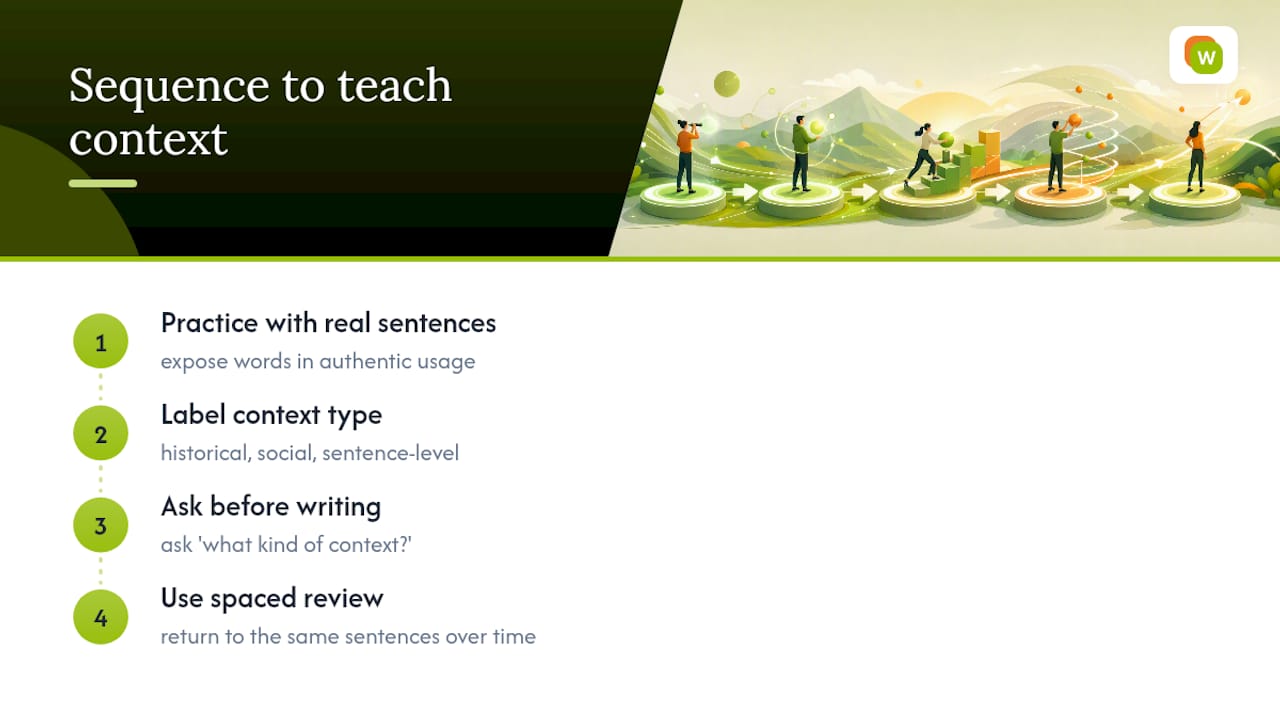
A pattern that shows up repeatedly in vocabulary instruction: students who memorize definitions can often pass a matching quiz but stumble when the same word appears in a different sentence. They learned the label, not the usage. The fix is straightforward — practice with real sentences, label the type of context (historical, social, sentence-level), and return to those sentences through spaced review. That sequence builds the kind of flexible word knowledge that transfers to new texts.
The concrete classroom tip: when introducing a new word, ask students to identify what kind of context makes the usage meaningful before they write their own sentence. That one question shifts the task from recall to interpretation, which is the harder and more durable skill.
Build your ‘context’ vocabulary with WordByWord
Collecting example sentences from real reading is the fastest way to internalize how context works across registers. WordByWord turns that process into a habit.

Here is a concrete workflow: you are reading an article and spot a sentence that uses context in an interesting way — say, a legal brief using “within the context of existing legislation.” Click the word in your browser, save the sentence to a collection, and it enters your spaced repetition queue. Later, a flashcard surfaces that sentence, and you practice recalling the usage pattern rather than a bare definition. Over time, your collection becomes a personal corpus of real examples across registers.
WordByWord works across 50+ languages, inside any website, PDF, or YouTube video, with no separate study session required. The free plan covers the core features; Premium removes usage limits. Start building your collection today and let real reading do the teaching.