The fastest working setup is three tools, not ten: an extension that adds interactive captions to video, one that lets you look up and save words in context anywhere online, and a spaced-repetition tool that receives everything you save. Start with content you already understand most of, capture only the words that actually block you, and review them daily. That loop, repeated for a few weeks, does more than any single “best” app ever will.
TL;DR:
- Using a single spaced-repetition tool as the review hub ensures all saved words remain accessible and prevents the creation of multiple, incomplete vocab decks.
- Capture sentence context and audio clips for each new word, limiting daily additions to 8-12 to maintain effective review sessions and prevent backlog.
- Set up extensions to activate only on click or specific sites, and disable unnecessary ones to keep browser speed steady during long study periods.
- Start with content where most vocabulary is familiar, gradually increasing difficulty by progressing from simplified material to native-level content on unfamiliar topics.
- Customize keyboard shortcuts to streamline common actions like rewinding, pausing, or opening review queues to maximize study efficiency.
Table of Contents
- What Should My Language Learning Browser Setup Include First?
- How Do I Install and Configure Language Learning Browser Extensions?
- How Do I Pick the Right Extension Features?
- The Notice, Check, Save, Review Loop That Actually Works
- Privacy, Permissions, and Keeping Your Browser Fast
- How WordByWord Fits This Setup
- How to Start With Easy Content and Level Up Without Stalling
- Customizing Keyboard Shortcuts to Speed Up Your Sessions
- Connecting Browser Flashcards to Other Apps and Devices
- Keeping Your Browser Fast During Long Study Sessions
- Author Perspective: What This Setup Won’t Do
- Get Your Setup Running With WordByWord
- Primary Sources and Further Reading
- Sources
- FAQ
What Should My Language Learning Browser Setup Include First?
Ten to twenty minutes gets you a working environment if you install in the right order. Skip the temptation to grab five vocabulary extensions at once, since overlapping tools tend to fragment your saved words across accounts you’ll forget to check.
Set up in this order:
- Interactive subtitle support for video, so YouTube and streaming captions become clickable instead of just scrolling text.
- A contextual word lookup and save tool that works on articles, PDFs, and video captions alike, not just one content type.
- One spaced-repetition destination for everything you save. Pick a single home for your vocabulary before you start collecting words, or you will end up with three half-full decks and no clear review habit.
- YouTube caption defaults turned on, with your target language selected rather than auto-translated English.
- Extension site access set to “On click” or “On specific sites” wherever the extension allows it, instead of leaving every install on “On all sites.”
The order matters more than the tool names. Get the review destination sorted first, because every extension you add afterward should feed into it, not create a separate pile.
How Do I Install and Configure Language Learning Browser Extensions?
Chromium browsers (Chrome, Edge, Brave) all handle extensions the same way, and Google’s own support documentation walks through the core installation and permission settings if you want the full reference. Here’s the short version for a language-learning setup:
- Open the Chrome Web Store and search for the extension by name.
- Click Add to Chrome, then read the permissions dialog before confirming. It tells you exactly what the extension can see and do.
- Pin the extension to your toolbar so it’s one click away instead of buried in a menu.
- Decide on “Allow in incognito” only if you actually plan to use the tool in private windows. Leaving it off by default keeps your incognito browsing separate from your learning data.
- Change site access from “On all sites” to “On click” or “On specific sites” in the extension’s details page, unless you genuinely need it running everywhere.
- Test it: open a YouTube video with captions on, hover over an unfamiliar word, save it with its sentence, then open your review queue to confirm the word landed there.
Pro Tip: Run this test on one video and one article before you trust the setup for real study time. A broken sync between “save” and “review queue” is the single most common reason people abandon browser-based vocabulary tools within a week.
How Do I Pick the Right Extension Features?
Feature checklists matter more than brand names here, since most tools in this category overlap heavily on the basics. Judge any extension against what it actually lets you capture and where that capture goes.
Non-negotiable features:
- Sentence-level capture, not just the isolated word. A word without its sentence is much harder to recall later.
- Audio clip capture when the source has audio, since hearing a word alongside its meaning improves recall during review.
- One-click save to a collection, with no more than two clicks between “I don’t know this word” and “it’s saved.”
- Export or sync to your spaced-repetition tool, so nothing dead-ends in a browser-only list you never revisit.
Nice-to-haves worth checking for, but not deal breakers: automatic highlighting of unknown words on the page (useful if you can turn it off when it gets distracting), and keyboard shortcuts for controlling video playback without reaching for the mouse.
One thing to avoid: extensions that default to always-on dual subtitles in two languages. A 2026 review in the Journal of Language and Education found that constant bilingual subtitles can split your attention between reading the translation and actually processing the target language. Target-language captions with translation available on demand, rather than displayed by default, tend to serve learning better.
The Notice, Check, Save, Review Loop That Actually Works
This is the workflow the rest of your setup exists to support, and it’s simpler than most guides make it sound.
- Start with content you mostly understand. If you’re stopping every few seconds to look something up, drop down a level. Comprehensible input works because your brain has enough context to guess at the rest.
- Watch or read with target-language captions on first. Reveal translation only when a word genuinely blocks you. In an MIT pilot on interactive subtitles, intermediate learners defined a substantially greater number of new words using this kind of interactive, on-demand lookup compared to dual subtitles running constantly, with similar viewing time. The pilot involved a small group of learners on short clips, but the direction lines up with later research.
- Capture the sentence and, when possible, the audio for any word that blocks comprehension or that you notice recurring across different videos or articles. Recurrence is the signal that a word is worth your time, not just unfamiliarity.
- Cap yourself at 8 to 12 new words per session. This isn’t arbitrary caution. Saving everything unfamiliar turns your review queue into a chore you’ll quietly stop doing within two weeks.
- Sync saved items to your spaced-repetition tool and review daily, even if the session is only three or four minutes.
A quasi-experimental study with intermediate EFL learners found that a short preview activity before watching dual-subtitled video improved both immediate vocabulary gains and longer-term retention compared to watching with no preparation. The lesson isn’t “always use dual subtitles.” It’s that a little context-setting before you watch pays off regardless of which caption mode you land on.
Pro Tip: If your review queue is backing up faster than you can clear it, that’s not a discipline problem. It’s a sign you’re capturing too many words per session. Cut back to 8 before you consider quitting the habit altogether.
Privacy, Permissions, and Keeping Your Browser Fast
Every extension that reads page content to power a “click to translate” feature needs permission to see what’s on the page. That’s not optional for the feature to work, but how broadly it applies is very much something you control.
- Prefer optional, on-demand permissions over blanket access. Chrome’s developer guidance specifically recommends that extensions request only what they need, and you can enforce the same principle from your end by setting site access to “On click” for tools you use occasionally.
- Check “Allow in incognito” before you trust it there. Extensions don’t run in private windows by default, and most vocabulary tools shouldn’t save anything from a session you specifically wanted private. If it does, disable that setting.
- Turn off extensions you’re not actively using. Every active extension consumes some memory and CPU, and a browser running six vocabulary tools alongside a dozen open tabs will start to lag during long study sessions.
- Monitor performance through your browser’s built-in task manager if things feel sluggish. It shows exactly which tab or extension is eating resources.
How WordByWord Fits This Setup
Each piece of the loop above maps to a specific feature in WordByWord’s extension. You get one-click lookup on regular websites, YouTube captions, and PDFs, so you’re not switching tools depending on what you’re reading or watching. Saved words come with their original sentence and an audio clip when one’s available, which matters for recall later.
Spotlight mode highlights words directly on the page by how well you know them, from unknown to mastered, and fades those highlights as you actually learn the word. A comprehension level score shows what share of a given article, PDF, or video you already know before you commit to it, which takes the guesswork out of picking mostly-comprehensible content. Saved collections sync straight into customizable flashcards with seven training modes, including typing, listening, and a 60-second sprint, scheduled by spaced repetition.
How to Start With Easy Content and Level Up Without Stalling
Comprehensible input has a rough benchmark worth knowing: if you’re pausing to look something up more than once every sentence or two, the content is too hard for productive learning right now. Drop down a level. This isn’t a failure. It’s how you avoid the burnout that kills most self-directed language habits within the first month.
A practical way to gauge this without guessing is to check what share of the words in a given piece you already recognize before you start. If a video or article shows you already know most of the vocabulary, you’re in the productive zone where new words get absorbed through context rather than fought through with a dictionary.
Increase difficulty gradually and along one axis at a time. If you’re watching video, move from slow, clearly enunciated content (many educational channels and news broadcasts) toward faster, more colloquial speech, before also increasing topic complexity. Trying to jump from beginner-friendly content straight to unscripted native conversation about a specialized subject stacks too many difficulty spikes at once.
A reasonable progression looks like this: start with content aimed at learners or simplified news, move to native content on familiar topics (cooking, daily routines, hobbies you already know well in your first language), then branch into native content on topics you don’t already have a vocabulary base for. Each step should feel like a small stretch, not a wall. If your comprehension drops sharply and stays there for more than a few sessions, step back one level rather than pushing through frustration.

Customizing Keyboard Shortcuts to Speed Up Your Sessions
Reaching for the mouse to pause a video, rewind ten seconds, or open your lookup tool adds up to real friction across a study session. Most browsers and extensions let you remap these actions, and it’s worth five minutes of setup.
In Chrome, go to chrome://extensions/shortcuts to see and edit every keyboard shortcut assigned to your installed extensions. Assign something you’ll actually remember, ideally a key combination that doesn’t collide with a shortcut you already use for something else.
A few worth setting up specifically for language study:
- A single key to pause and rewind five to ten seconds, so you can catch a word you missed without breaking flow.
- A shortcut to trigger your word lookup tool, rather than clicking a toolbar icon every time.
- A shortcut to jump straight to your review queue, so starting a spaced-repetition session doesn’t require navigating through tabs first.
- Playback speed controls (usually already built into YouTube’s own keyboard shortcuts: comma and period keys adjust speed) so you can slow down dense dialogue without touching the mouse.
The point isn’t to memorize a dozen shortcuts. Two or three, used consistently, remove enough friction that you’ll actually do a five-minute review instead of skipping it because opening the right tab felt like a chore.
Connecting Browser Flashcards to Other Apps and Devices
Vocabulary you save in the browser shouldn’t be stuck there. Most spaced-repetition tools built for browser use support some form of export, typically CSV, which you can move into other systems if you already have an established Anki or Quizlet deck you don’t want to abandon.
Going the other direction works too: if you’ve built up a deck in Anki or Quizlet already, importing it via CSV into your browser-based review tool means you’re not starting from zero or maintaining two separate vocabulary systems. Pick one direction and stick with it, since running parallel decks in two places is exactly the fragmentation this whole setup is meant to avoid.
For studying away from your desktop, check whether your review tool has a mobile app or a synced web version. A queue that only lives in one desktop browser means your reviews stop the moment you close the laptop, which defeats the purpose of “daily micro-reviews.” Voiceover playback on flashcards also matters more than it sounds like it would if you’re studying on a commute or while doing chores, since it lets you review by ear without looking at a screen.

Keeping Your Browser Fast During Long Study Sessions
A sluggish browser is the quiet killer of long study sessions. A few settings changes prevent it from becoming a reason to quit early.
Close tabs you’re not actively using. Each open tab, especially video tabs, holds memory even when you’re not looking at it. Disable extensions you installed for a different purpose and aren’t using during this specific session; each one adds background overhead even when idle. If your browser has a built-in task manager (Chrome’s is under the three-dot menu, under “More tools”), check it once if things feel slow. It will show you exactly which tab or extension is the actual drain, rather than making you guess.
For long sessions specifically, consider a dedicated browser profile just for language study, separate from your everyday browsing profile. It keeps your learning extensions and bookmarks from cluttering the browser you use for work or general browsing, and it means your study session starts with fewer competing tabs by default.
Author Perspective: What This Setup Won’t Do
This loop builds recognition vocabulary fast, but it won’t teach you to produce language on its own. Pair it with speaking or writing practice, or your passive vocabulary will outgrow your active use of it by a wide margin. Skip saving every unknown word; recurrence and relevance to your goals matter more than raw unfamiliarity. Track progress by review completion and by how much harder content you can now follow, not by collection size.
— WordByWord Team
Get Your Setup Running With WordByWord
WordByWord fits directly into the loop this article just walked through, without asking you to change how you already read or watch. The Free Forever plan costs $0 per month and stays free indefinitely, with usage limits that Premium removes at $5.99 per month.
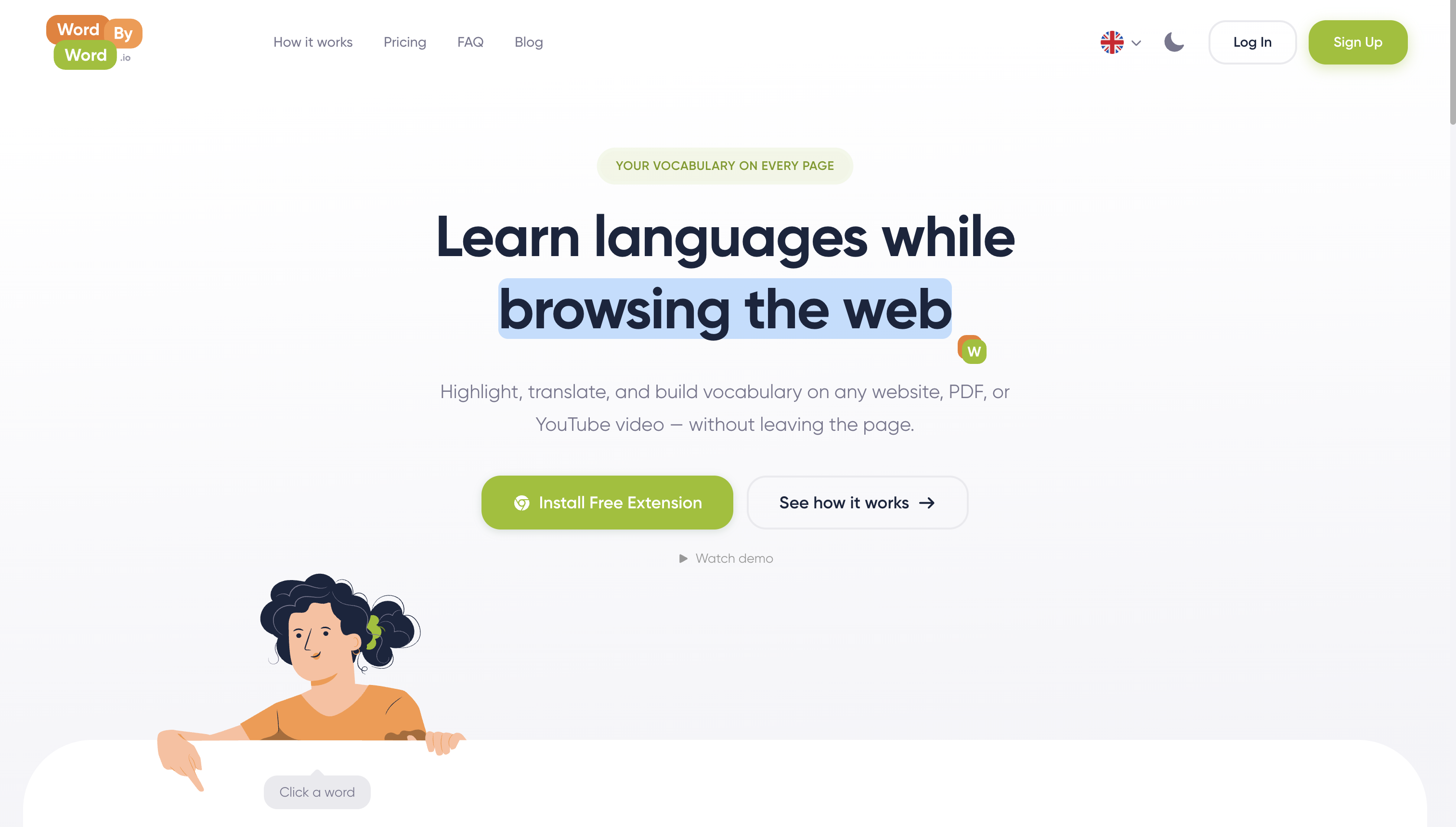
Getting started takes three steps: install the browser extension, save 8 to 12 words from one video or article using their original sentence, then run your first review session using customizable spaced-repetition flashcards. Spotlight mode will start highlighting unfamiliar words on the page immediately, and comprehension level will show you whether your next piece of content is actually at the right level before you commit to it. Install the extension today and save your first batch of words before the session’s over.
Primary Sources and Further Reading
- Smart Subtitles for Language Learning (MIT), the pilot behind the interactive subtitle findings cited above.
- Vocabulary learning through dual-subtitled videos, John Benjamins, on previewing and dual-subtitle retention.
- Journal of Language and Education (2026), on textual enhancement and split-attention effects.
- Install and manage extensions and Protect user privacy, Google’s official Chrome guidance.
- Capture 8 to 12 words per session, WordByWord’s guide to sustainable vocabulary capture.
Sources
- Smart Subtitles for Language Learning (MIT)
- Vocabulary learning through dual-subtitled videos (John Benjamins, 2025)
- Install and manage extensions - Google Chrome Help
- Protect user privacy | Chrome for Developers
FAQ
What browser extension can I use to learn languages?
Look for one that offers one-click word lookup across websites, YouTube captions, and PDFs, with the ability to save words alongside their original sentence. WordByWord covers all three content types and syncs saved words directly into spaced-repetition flashcards.
What is the 15-30-15 method for language learning?
This isn’t a standardized framework with a single agreed-upon definition, and it doesn’t map cleanly onto the browser-based workflow this article covers. If you’ve seen it referenced elsewhere, treat the specific numbers as one person’s routine rather than a research-backed method.
How does the FBI learn languages quickly?
Public reporting on intensive government language training points to immersive, high-repetition environments with daily structured practice across reading, listening, and speaking, rather than any single tool or trick. The core principle overlaps with the notice-check-save-review loop in this article: frequent, contextual exposure paired with active recall beats occasional long study sessions.
How do I set the language in my browser?
In Chrome, go to Settings, then Languages, and add or reorder your preferred languages there; this controls things like translation prompts and spell check, not the language of content you’re browsing. For YouTube caption language specifically, use the gear icon on the video player to pick your target language’s captions rather than relying on auto-translation.