
For vocabulary-first language learners, WordByWord is the best web page translator available right now. It translates individual words and short phrases directly on the page, saves them to a personal wordbook with the surrounding sentence for context, and converts every lookup into a smart flashcard you can review later. No switching tabs, no losing your place.
The case for a word-level approach is backed by real data. A 2025 study on MT use in foreign language education found that a majority of students primarily use machine translation for single-word and phrase lookups, not full-paragraph translation. That means the best website translator extension for learners is one built around that exact behavior.
Why WordByWord fits the vocabulary-first workflow:
-
Instant in-page translation of words and phrases across websites, PDFs, and YouTube
-
Automatic vocabulary tracking with source-sentence context saved alongside each word
-
Built-in smart flashcards and an AI trainer that turn passive lookups into active recall
-
Spotlight mode: a visual difficulty map that highlights unknown words directly on the page
Key Takeaways
For vocabulary-first learners, a word-level in-page translator that connects lookups to spaced-repetition review is significantly more effective than a full-page translation tool.
| Point | Details |
|---|---|
| Word-level lookup dominates | A majority of students use MT primarily for single words and phrases, not full paragraphs. |
| Avoid passive use | Use lookups to confirm guesses, not to skip comprehension effort. |
| Save with context | Always store the source sentence alongside the word for richer recall cues. |
| Review daily | Ten minutes of flashcard review per day outperforms longer but infrequent sessions. |
| WordByWord recommendation | Spotlight mode, smart flashcards, and AI trainer make it the strongest vocabulary-first browser extension available. |
Table of Contents
-
What does the best web page translator need to do for learners?
-
What browser extensions can access and how to protect your data
What does the best web page translator need to do for learners?
Not every translation tool is built for learning. Full-page translators swap out the original text entirely, which removes the very friction that builds comprehension. A vocabulary-first extension works differently: it keeps the original text intact and gives you a translation only for the word or phrase you actually need.
Core features to look for:
-
Click-or-hover word lookup with phrase and context support
-
Cross-format coverage: websites, PDFs, and YouTube subtitles
-
Automatic saving to a wordbook with the source sentence attached
-
Spaced-repetition flashcards or CSV export for use in an external SRS
-
A visual difficulty map (like WordByWord’s Spotlight mode) that shows which words you know
-
Pronunciation audio and example sentences in the tooltip
-
Support for 50+ languages
Useful extras that improve daily use:
-
Keyboard shortcuts for faster lookup without breaking reading flow
-
Customizable highlight colors and font size for accessibility
-
Cached or locally stored cards for offline review
Independent extension reviews consistently show that tools connecting lookups to spaced-repetition flashcards close the loop from incidental reading to long-term retention better than tools that translate without saving. The LexiGlow open-source documentation also highlights a key UX principle: fast default translation on hover with optional context expansion preserves reading flow while still supporting deeper analysis when you need it.
Pro Tip: Match your tool to your primary media. If you study mostly through video, prioritize YouTube subtitle support. If you read articles and PDFs, make sure the extension handles both formats before you commit to a workflow.
Why word-level translators actually help you learn
The cognitive case for in-page word lookup is straightforward. When you encounter an unknown word in context, look it up immediately, and then retrieve it again later through a flashcard, you are running a retrieval practice loop. That loop, especially when spaced over time, produces stronger retention than reading a translation once and moving on.
The 2025 research on MT use in foreign language education confirms that word and phrase translation is the dominant student behavior, which means tools designed around that use case align with how learners actually study rather than how educators assume they do.
That caveat matters. The risk with any translation tool is that you start using it to avoid thinking rather than to support thinking. Checking a word you genuinely could not parse is productive. Translating every sentence before you attempt it is not. The Open University’s guidance on MT in language learning is explicit: use the tool to check your understanding after you have tried, not before.
The practical difference looks like this:
-
Good use: Read a sentence, form a guess about the unknown word from context, then hover to confirm or correct your guess.
-
Passive use: Hover every word immediately, collect translations without forming any prediction, and skip the flashcard review.
The first approach builds vocabulary. The second builds dependency.
How to use a word-level translator as a study workflow
A five-step routine turns casual browsing into deliberate vocabulary study. You can run the full loop in 20–30 minutes.
-
Calibrate difficulty. Open a text and run a quick Spotlight scan. If more than 30% of words are highlighted as unknown, the text is too hard for productive reading. Drop one level and find something where you know roughly 90–95% of the words already.
-
Look up words in context. Hover or click an unknown word. Read the translation, then re-read the full sentence. Before saving, form a one-sentence guess about what the word means in this specific context.
-
Save with context. Add the word to your wordbook. The source sentence saves automatically. Add a short personal note or tag (topic, grammar category, register) so future-you has a hook to remember it by.
-
Schedule daily review. Use the built-in flashcard deck for a 10-minute daily session. The AI trainer can generate new example sentences so you are not just memorizing the original context. For deeper SRS integration, export via CSV and import into your preferred app. The translate-on-hover workflow guide covers this in detail.
-
Test yourself. Take a saved example sentence, cover the translation, and try to produce it in your target language. Then check. This active recall step is where retention actually happens.
Pre-session checklist:
-
Set one goal: “I will read this article and save 5 new words.”
-
Turn on Spotlight mode to see difficulty at a glance.
-
Keep the flashcard queue under 20 cards so review stays under 10 minutes.
Pro Tip: Use the AI trainer to generate distractor sentences, not just correct examples. Seeing a word used slightly incorrectly and identifying the error is one of the fastest ways to lock in precise meaning.
How to install WordByWord and what each plan includes
WordByWord runs as a browser extension on Chrome, Edge, and other Chromium-based browsers. Installation takes under a minute: visit the Chrome Web Store, search for WordByWord, click “Add to Chrome,” and pin the extension to your toolbar. The extension activates on any page you visit, including PDFs opened in the browser and YouTube.
| Plan | Core features | Limits |
|---|---|---|
| Free | Word/phrase lookup, basic Spotlight, limited wordbook | Capped collections, basic flashcards |
| Premium (monthly) | Unlimited collections, AI trainer, enhanced voiceover, CSV export | None listed publicly |
| Premium (annual) | All Premium features at a lower per-month rate | None listed publicly |
Exact pricing is listed on the WordByWord product page. A free tier is available with no credit card required, which lets you test the core lookup and Spotlight workflow before deciding whether the AI trainer and unlimited collections are worth upgrading for.
What browser extensions can access and how to protect your data
Browser extensions request permissions when you install them. A word-level translator typically needs access to page content (to detect selected text), access to PDFs opened in the browser, and access to YouTube pages for subtitle integration. Cloud sync, if enabled, sends your wordbook to a server so you can access it across devices.
What each permission enables:
-
Read page content: Required for hover/click lookup to work on any site.
-
Access PDFs: Needed to translate words in documents opened in the browser tab.
-
YouTube access: Required for subtitle word lookup.
-
Cloud sync (optional): Backs up your wordbook and flashcard progress across devices.
Steps to reduce exposure:
-
Review the extension’s permission list before installing.
-
Use the free trial to test behavior before granting cloud sync access.
-
Enable translation on demand rather than auto-translating every page.
-
Read the privacy policy for data retention terms, especially for cloud-synced wordbooks.
-
Use a dedicated browser profile for language study if you want to keep that activity separate.
Extensions that store lookups locally give you stronger privacy guarantees than those that send full page content to a cloud model on every hover. WordByWord’s privacy policy is publicly listed on its website.
What daily use actually feels like
A typical session runs about 25 minutes: 15 minutes reading an article in your target language with Spotlight on, saving 4–6 words, and 10 minutes in the flashcard queue. The first week feels slow because you are building the habit of saving rather than just hovering and moving on. By week three, the wordbook starts to feel like a real record of your reading life, and the Spotlight highlights visibly thin out on topics you have read before.
Realistic expectations: you will not notice fluency gains in a week. What you will notice is that specific words stop surprising you. The payoff is cumulative and quiet, which is exactly how vocabulary acquisition works. Active review is not optional. Learners who skip the flashcard step and only do lookups see much slower progress than those who spend even 10 minutes a day on retrieval practice.
WordByWord turns your browser into a vocabulary lab
Vocabulary-first learners who want to track every word they encounter while reading get a complete study loop in one extension: Spotlight difficulty mapping, saved wordbooks with source-sentence context, smart flashcards, an AI trainer for generating new examples, and multi-format support across websites, PDFs, and YouTube.
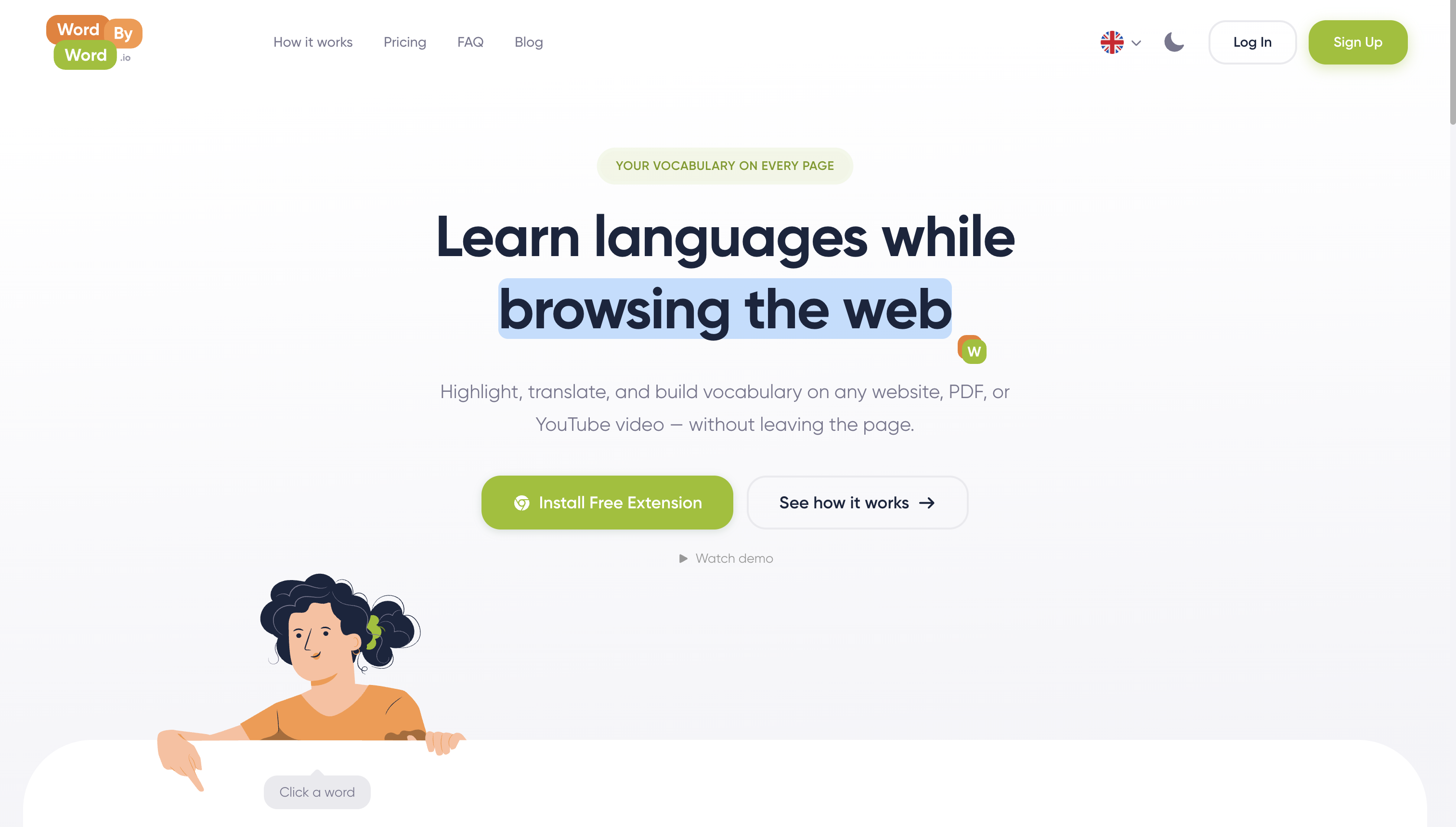
The free tier covers the core workflow with no credit card required. Premium unlocks unlimited collections, the AI trainer, enhanced voiceover, and CSV export for learners who want to push further. WordByWord releases regular updates and provides customer support through its website. Start with the free plan, run one 25-minute session, and see how many words you actually save.
Try WordByWord free and install it in under a minute.