Yes: well-designed gamified activities boost vocabulary retention, with research showing sizeable learning gains when the game mechanics, duration, and follow-through are right. The catch is that a leaderboard slapped onto a word list won’t do it. Start today by adding a 5 to 10 minute micro-game, a timed matching sprint or a quick retrieval quiz, to whatever vocabulary practice you’re already doing.
TL;DR:
- Combining mechanics, dynamics, and esthetics in gamified vocabulary activities nearly doubles their effectiveness, especially over programs lasting a full semester.
- Short, daily micro-games like timed matches, scavenger hunts, and role-play quests effectively reinforce vocabulary and maintain learner engagement.
- Selecting tools that support word capture, immediate feedback, spaced repetition, and progress tracking ensures long-term vocabulary retention.
- A six to eight-week structured routine with regular review, production tasks, and checkpoints produces meaningful improvements in vocabulary knowledge.
- Aspiring to patience and consistent practice over flashy short-term projects is key to successful gamification in language learning.
Table of Contents
- What Does the Research Say About Gamifying Vocabulary Learning?
- What Are Some Fun Games to Teach Vocabulary?
- How Do You Design a Gamified Vocabulary Activity That Actually Works?
- Which Tools Actually Support Gamified Vocabulary Practice?
- How Long Should a Gamified Vocabulary Unit Run?
- Our Take on Gamifying Vocabulary Learning
- Where WordByWord Fits Into Your Gamified Vocabulary Routine
- Sources
- FAQ
What Does the Research Say About Gamifying Vocabulary Learning?
The evidence is stronger than most educators expect, and more specific than “games make learning fun.” A meta-analysis of 41 studies covering over 5,000 learners found a large overall effect (Hedges’ g = 0.822) for gamification on learning outcomes. That number moves a lot depending on how the gamification is built.
The same analysis found that combining three design layers, mechanics, dynamics, and esthetics, together produced the strongest results with a notably greater effect size when all three were present. Interventions running longer than a single semester also outperformed short ones by a wide margin. A quick weekend project with badges bolted on isn’t the same intervention as a semester-long system with narrative, choice, and feedback loops working together.
Classroom-level studies back this up with vocabulary-specific data. A 10-week quasi-experimental study found students in a gamified vocabulary program significantly outperformed a control group, with a large effect size on post-tests. Separately, an 8-week randomized controlled trial using a gamified educational app reported better attention and reading and writing outcomes than a non-gamified control group, and those gains held up at an 8-week follow-up.
What weakens the effect:
- Short, one-off gamified sessions with no follow-through
- Passive features like static point totals with no feedback loop
- Games that reward speed or luck over actual word recall
- No connection between the game mechanic and the vocabulary being tested
Key stat: Gamification’s effect on learning outcomes nearly doubles (from g = 0.822 to g = 1.285) when mechanics, dynamics, and esthetics work together instead of one design layer alone, according to the Frontiers in Psychology meta-analysis.
What Are Some Fun Games to Teach Vocabulary?
You don’t need a tech budget to start. Some of the best interactive vocabulary games use nothing but index cards, a timer, and a room full of restless students.
Low-tech classroom activities:
- Vocabulary relay. Split the class into teams of four. Each student runs to a whiteboard, writes a definition or synonym for a word called out by the teacher, then tags the next runner. Takes 10 minutes, works for any level, and doubles as a formative check on which words need reteaching.
- Word scavenger hunt. Hide vocabulary cards around the room or building, each tied to a clue that requires using the word correctly to find the next one. Fifteen to twenty minutes, best for concrete nouns and phrasal verbs, and it forces production, not just recognition.
- Role-play quests. Assign a scenario (ordering at a restaurant, negotiating a contract, a mystery to solve) where each vocabulary word acts as a “key” needed to move the story forward. Twenty to thirty minutes, ideal for intermediate and advanced learners building both vocabulary activities and speaking fluency together.
Digital quick games:
- Timed matching sprints (word to definition, word to image) run in under five minutes and work well as warmups.
- Story-missions where learners unlock the next scene by correctly using or identifying target words, which sustains attention better than repeated quiz drills according to a comparative study on story versus quiz formats.
- Formative quizzes with immediate feedback, right or wrong, shown instantly, rather than a delayed score at the end.
Self-study micro-routine: Capture an unknown word the moment you hit it in a real article, video, or book. Add it to a collection. Run a 5 to 10 minute spaced-review sprint before bed or during a commute. That loop, capture, collect, review, is the backbone of every effective self-study system, and it works because retrieval practice strengthens memory far more than passive rereading.
Pro Tip: Rotate between receptive games (matching, multiple choice) and productive ones (typing, sentence building) within the same week. Learners who only recognize words rarely can produce them in conversation.

How Do You Design a Gamified Vocabulary Activity That Actually Works?
Game designers talk about three layers, mechanics, dynamics, and esthetics, known together as the MDA framework, and each one does different work in a vocabulary lesson.

Mechanics are the rules and feedback systems: points for correct answers, a timer, an instant right or wrong signal. In vocabulary practice, this looks like awarding points for correct word matches or giving immediate feedback on a typed answer instead of a delayed grade.
Dynamics are what emerge from those rules during play: a sense of progress through levels, the ability to choose which words to review first, competing or collaborating with classmates. Letting learners pick their own vocabulary sets rather than working through someone else’s list improves retention, because choice increases the mental effort invested in each word.
Esthetics are the emotional pull, the theme, the story, the sense of stakes. A narrative wrapper (solving a mystery, building a city, surviving a scenario) helps, but an overly elaborate storyline can backfire if the plot distracts more than the vocabulary itself does.
Launch checklist:
- Does the activity give feedback within seconds, not minutes?
- Can the learner choose or influence which words appear?
- Is there a light narrative or goal, without needless complexity?
- Will this run daily in short bursts, or only once as a special event?
Short daily sessions (5 to 15 minutes) tend to build habits faster than a single elaborate project, but the meta-analysis found the biggest overall gains came from programs sustained across a full semester or longer.
Which Tools Actually Support Gamified Vocabulary Practice?
Different tools solve different problems, and picking the wrong category is the most common reason gamification stalls out after week two.
- Browser extensions work best for learners who read and watch content in their target language already; they capture unknown words at the moment of confusion instead of asking learners to build lists from scratch.
- Quiz platforms are strong for quick formative checks and classroom energy, but weak on long-term retention without a spaced-review layer behind them.
- Classroom response systems are good for group competition and instant feedback during a lesson, less useful for individual pacing.
- LMS-integrated modules fit institutions needing grade-book reporting, though they rarely adapt to what a specific learner already knows.
The feature checklist that matters most: word capture from real content, spaced repetition scheduling, immediate feedback, and some form of progress reporting. Applied research on tool design consistently points to these four as the difference between a novelty app and one that produces lasting vocabulary gains.
This is where WordByWord’s Spotlight mode fits into a daily micro-game routine. It highlights unknown words directly inside articles, PDFs, and YouTube subtitles by mastery level, so a learner’s next “quest” is whatever the highlights show is still unfamiliar. Captured words drop into a collection, and the flashcard trainer runs the spaced-repetition sprints, typing, sentence builder, and a 60-second speed round among them, that turn a five-minute break into a genuine review session.
Key stat: Interventions combining all three MDA design layers reached an effect size of g = 1.285, nearly double the overall average of g = 0.822 found across the full meta-analysis, reinforcing that tool choice matters less than whether the tool supports all three layers together.
How Long Should a Gamified Vocabulary Unit Run?
Plan for weeks, not days. A single class period of vocabulary bingo will not move the needle on retention, but a structured 6 to 8 week block will.
- Weeks 1 to 2: Introduce the routine. Daily 5 to 10 minute capture-and-review sprints, one themed activity per week (travel, business, emotions), and a baseline vocabulary test before you start.
- Weeks 3 to 5: Add production tasks. Weekly speaking or writing assignments that force learners to use captured words instead of just recognizing them, alongside continued daily micro-reviews.
- Weeks 6 to 8: Increase spacing between reviews for words learners already know well, and add a mid-unit checkpoint test to catch words that need reteaching.
- End of unit: Run a post-test covering both receptive knowledge (recognizing meaning) and productive use (using the word correctly in a sentence), then compare against the baseline.
Track three things along the way: pre and post-test scores, spaced recall checkpoint results every two weeks, and an engagement log (minutes practiced, streak length). If engagement is high but retention lags, the fix usually isn’t more games, it’s more spacing between reviews and more production tasks that force active recall rather than passive recognition.
Our Take on Gamifying Vocabulary Learning
Most of the skepticism around gamification comes from watching bad versions of it, a leaderboard here, a badge there, with no design behind either one. The research doesn’t support that skepticism once mechanics, dynamics, and esthetics work together over real time. What it does support is patience: a semester of steady, short daily practice will outperform a flashy one-week project every time. Expect setup time for teachers and a realistic ramp before students form the habit, not instant results from day one.
— WordByWord Team
Where WordByWord Fits Into Your Gamified Vocabulary Routine
WordByWord is built around the reading and watching people already do, so there’s no separate app to open or curriculum to follow before practice can start. Every recommendation in this guide, capturing words at the moment of confusion, reviewing in short spaced bursts, choosing what to study next, maps directly to a feature already built into the platform.
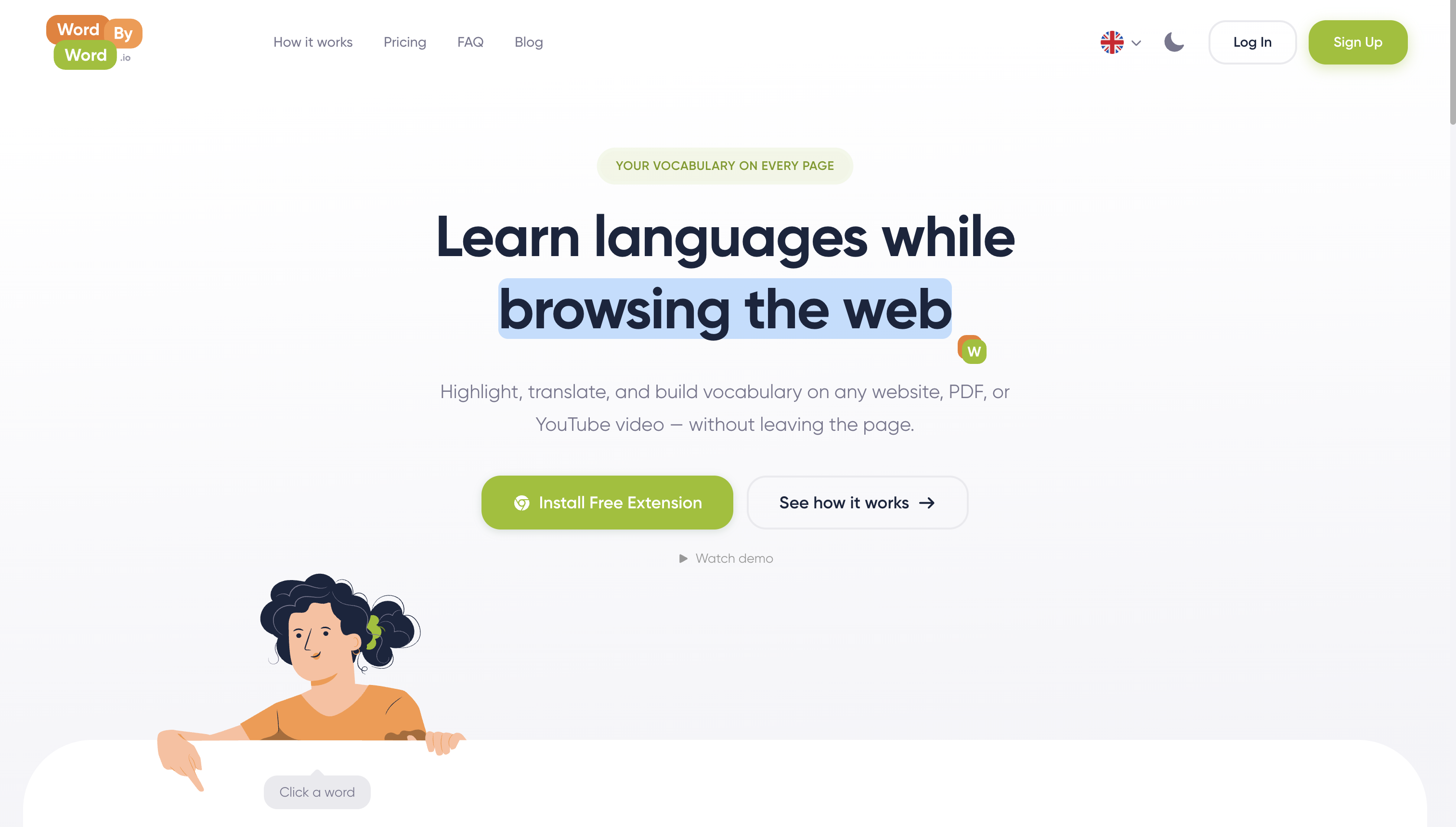
- Spotlight mode highlights unknown words right on the page by mastery level, turning any article or video into a ready-made word hunt.
- Comprehension level shows what share of a text you already know before you commit to reading it, so you can pick material that matches your level instead of guessing.
- Collections can be built by hand, generated by AI from a prompt, or imported from a spreadsheet, giving you the “choice” element that drives deeper encoding.
- Seven training modes, including typing, sentence builder, and a 60-second sprint, run the spaced-repetition reviews this guide’s research points to as essential.
A simple way to start: install the browser extension, read one article or watch one video in your target language, and let Spotlight show you what to capture. Then run a five-minute review sprint before you close the laptop. The Free Forever plan covers this entire loop with no time limit, and Premium removes usage caps for $5.99 per month if you want unlimited collections and exercises. Try the free plan today and see what your own comprehension level looks like on the next thing you read.
Sources
- Examining the effectiveness of gamification as a tool promoting teaching and learning in educational settings: a meta-analysis
- Gamification on English Vocabulary Acquisition: A Quasi-Experimental Study
FAQ
What are some fun games to teach vocabulary?
Vocabulary relays, scavenger hunts, and role-play quests work well in classrooms, while timed matching sprints and story-missions work well on screens. All of them succeed by pairing immediate feedback with a reason to actually use the word, not just recognize it.
Is gamification good for ADHD?
Yes, an 8-week randomized controlled trial found a gamified educational app improved attention and reading and writing outcomes in children with ADHD, with gains holding at an 8-week follow-up. Story-driven formats in particular sustain attention better than repetitive quiz drills for this group, according to comparative research on game formats.
How do you teach vocabulary words in a fun way?
Pair a clear game mechanic, points, a timer, instant feedback, with something that gives learners a reason to care, a story, a choice of words, a bit of competition. Short daily sessions of 5 to 15 minutes tend to build retention faster than occasional long sessions, and tools like WordByWord’s flashcard trainer can run those sprints automatically using spaced repetition.
Does Gen Z like gamification?
Gen Z learners generally respond well to game-based learning strategies, especially formats that mirror the apps and video games they already use daily, quick feedback loops, visible progress, and short session lengths. That preference lines up with what the research finds works best anyway: brief, frequent, well-designed practice beats long, infrequent study sessions.