
Pick a workplace topic, match it to your level, and practice for 20 minutes using active formats like gap-fill and role-play, then review with spaced repetition. This works because passive reading builds recognition, not recall, and recall is what you need in a live meeting or a client email. Your first 20 minutes should include:
- One topic pulled from your actual job (finance, sales, HR)
- One active exercise (gap-fill, matching, or a short role-play line)
- One review pass of terms you got wrong, scheduled for tomorrow
Key Takeaways
Business vocabulary sticks fastest when practice is organized by workplace topic, matched to your actual level, and reinforced through spaced, active recall rather than passive review.
| Point | Details |
|---|---|
| Match topic to role | Prioritize finance, sales, HR, or IT vocabulary based on what your job actually requires. |
| Test production, not recognition | Write a term in a sentence from memory instead of just recognizing its definition. |
| Use active formats | Gap-fill, role-play, and email rewrites build usable recall faster than flashcard lists alone. |
| Review on a schedule | Spaced intervals, not one-time study, are what convert new terms into lasting vocabulary. |
| Collect from real work | Tools like WordByWord let you save terms from reports, PDFs, and videos into collections for spaced review. |
Table of Contents
- Business Vocabulary Practice: Choosing Your Level and Weekly Plan
- A Practice Bank by Workplace Topic
- Exercise Formats That Actually Build Recall
- Turning Exposure Into Recall That Sticks
- Tracking Progress Without Guessing
- Common Mistakes That Stall Business Vocabulary Progress
- Making Vocabulary Practice Part of Your Actual Workday
- What Actually Moves the Needle
- A Faster Way to Collect and Review What You’re Already Reading
- Where to Find More Business Vocabulary Practice
- Frequently Asked Questions
- Sources
Business Vocabulary Practice: Choosing Your Level and Weekly Plan
Guessing your level wastes sessions on material that’s either too easy or too frustrating. Run this quick check first:
- Beginner: You can follow a slow, simple meeting but struggle to write more than two sentences in a work email.
- Intermediate: You can write a short email or report but hesitate on precise terms during negotiations or presentations.
- Advanced: You can read a one-page business report cold and respond in a meeting without translating in your head first.
Match your priority topic to your role: finance and reporting if you’re in accounting, negotiation and sales language if you’re client-facing, meetings and email phrasing if you’re in a generalist office role. The Cambridge English: Business Preliminary wordlist is a useful anchor here. It’s built from corpus data drawn from real learner writing and separates words you need to recognize from words you need to produce, which matters more than most word lists admit.
A workable weekly plan looks like this:
- Two 15-minute focused sessions on new terms in your priority topic
- One 20-minute session reading or listening to real content in that topic
- One 10-minute active recall review of everything flagged as shaky
If you’re preparing for TOEIC or BEC, map your weekly topic to the skills those exams test. TOEIC leans heavily on reading and listening comprehension in office scenarios, while BEC tests written production too, so intermediate and advanced learners should weight email and report writing accordingly.
A Practice Bank by Workplace Topic
Generic word lists get abandoned fast because they don’t map to what you actually do at work. A better approach: pick your topic, pick your level, and run one of the sample exercises below. The Cambridge Business Preliminary wordlist draws from corpora including the Cambridge Learner Corpus and the British National Corpus, so the terms below reflect language that actually shows up in workplace English, not textbook filler.
Finance: Beginner learners match terms like “invoice,” “revenue,” and “budget” to short definitions. Intermediate learners fill gaps in a sentence: “The company’s ___ grew despite rising costs” (margin). Advanced learners rewrite a paragraph of a quarterly report using more precise terms than “money” and “profit.”
Marketing: Beginners match “target market,” “campaign,” and “brand awareness” to icons or images. Intermediate learners complete a short multiple-choice quiz distinguishing “reach” from “engagement.” Advanced learners draft a two-line campaign pitch using at least four collocations correctly.
IT and tech: Beginners match basic terms (“deploy,” “bug,” “rollout”) to plain-English equivalents. Intermediate learners gap-fill a short incident report. Advanced learners role-play explaining a system outage to a non-technical manager, forcing them to translate jargon on the fly.
HR and recruiting: Beginners match “candidate,” “shortlist,” and “onboarding” to definitions. Intermediate learners complete a short job description with the right verb collocations (“conduct an interview,” not “make an interview”). Advanced learners write a two-sentence rejection email that’s polite but clear.
Sales and negotiation: Beginners match terms like “quote,” “discount,” and “close a deal.” Intermediate learners complete a short dialogue: “We’d be willing to ___ if you can commit to a longer contract” (negotiate / offer flexibility). Advanced learners role-play a counteroffer using hedging language (“I’m afraid that won’t work for us, but we could consider…”).
Meetings and presentations: Beginners match phrases for opening a meeting (“Let’s get started,” “Shall we begin?”). Intermediate learners complete gap-fills for transitions (“Moving on to the next point…”). Advanced learners practice handling interruptions politely, a skill most vocabulary lists ignore entirely.
Emails and telephoning: Beginners match greeting and closing phrases to formality level. Intermediate learners rewrite an overly casual email into professional register. Advanced learners draft a firm but courteous follow-up email chasing a late payment.
Operations, logistics, legal, and compliance: These deserve at least a short pass even outside your main role, since cross-department emails use this language constantly. A quick matching exercise on terms like “supply chain,” “liability,” and “compliance audit” builds enough passive recognition to follow along without stalling.
| Topic | Beginner exercise | Advanced exercise |
|---|---|---|
| Finance | Match term to definition | Rewrite report paragraph with precise terms |
| Marketing | Match term to image | Draft a 2-line campaign pitch |
| Meetings | Match opening phrases | Practice handling interruptions |
| Emails | Match greeting to formality | Draft a firm follow-up email |
Swapping vocabulary by industry is simple once you have the format: keep the exercise type, replace the word bank. A practical guide to essential business terms recommends this exact approach, testing terms in context rather than memorizing them as isolated flashcards.
Exercise Formats That Actually Build Recall
Not every format earns its place in a 20 minute session. These do:
- Active recall flashcards: See the definition, produce the term from memory, not the reverse.
- Gap-fill in context: “Our Q3 ___ exceeded projections by 8%” forces you to choose between similar words (revenue vs. income).
- Matching collocations: Pair “conduct,” “hold,” and “chair” with “a meeting” to learn which verb actually goes with which noun.
- Role-play scripts: A one-line prompt like “Politely decline a meeting time and suggest an alternative” beats passive review every time.
- Short listening cloze: Listen to 30 seconds of a business podcast and fill in five missing terms.
- Email rewrites: Take a casual sentence and rewrite it in professional register.
- Speed paraphrase: Restate a business phrase in your own words in under 10 seconds.
Use gap-fill and matching for quick warm-ups, and save role-play and email rewrites for when you have the full 20 minutes, since they take longer to think through.
Pro Tip: Grab a sentence from something you read at work today, blank out the key term, and you’ve got a gap-fill exercise in under a minute. No prep tools required.

Turning Exposure Into Recall That Sticks
Spaced repetition combined with active recall and contextual testing is the most reliable route to vocabulary you can actually use, not just recognize. Reading a term once and moving on rarely works. The British Council points out that developing specialized vocabulary in professional domains is what actually unlocks career opportunities, not general fluency alone.
The workflow is simple:
- Collect terms as you encounter them, from a report, an email thread, or a meeting.
- Write a short example sentence using the term the way you’d actually use it at work.
- Schedule the term for review at graduated intervals, not just once.
- Test it in a real task, like drafting an email, within the week.
Pro Tip: A testable example sentence needs a subject, a verb, and a real business context. “Margin” alone teaches nothing. “Our margin shrank after supplier costs rose” gives you something to recall later.
A step-by-step method for tracking vocabulary while reading walks through exactly this kind of collection habit, and it pairs naturally with tools that let you build collections and review with spaced repetition and active recall.
Tracking Progress Without Guessing
Self-assessment fails most learners because they judge progress by how a text feels, not by what they can actually produce. Fix that by testing production, not recognition: can you write the term in a sentence without checking a definition first? That’s the real test.
Keep a simple log. After each session, note which terms you got wrong twice in a row. Those are your priority list for the next review, not the new terms you just learned. This single habit does more for retention than any app feature, because it forces you to confront the words that keep tripping you up instead of coasting on the ones you already know.
Set a monthly checkpoint. Pick five terms from a month ago and see if you can use them in a fresh sentence without looking them up. If you can’t recall three out of five, your review intervals are too long, and you need to revisit that topic sooner.
Track streaks loosely, not obsessively. A missed day doesn’t erase progress, but a pattern of skipped weeks means your plan doesn’t fit your schedule and needs a shorter session length, not more willpower. Twelve minutes a day, done consistently, beats an hour once a week that you keep postponing.
Common Mistakes That Stall Business Vocabulary Progress
The biggest mistake is learning words in isolation instead of collocations. “Make a decision,” not “do a decision.” “Conduct a meeting,” not “make a meeting.” Vocabulary guides that separate words from their natural partners set learners up to sound almost right, which is often worse than sounding clearly wrong, because native listeners notice the mismatch without always flagging it.
A second mistake: confusing formality registers. Writing “Hey, just wanted to check” in a client email reads as careless, while writing “I would be most grateful if you could” in a Slack message to a colleague reads as stiff. Learn phrases in pairs, casual and formal, so you can switch deliberately.
Third, learners often memorize far more words than they can produce, chasing long lists instead of depth. MyEnglishPages’ top business word list recommends prioritizing role-relevant categories over sheer volume, and practicing collocations rather than single words, which matches what actually shows up in real workplace writing.
Fourth, learners avoid using new terms until they feel “ready,” which means the terms never get tested under real pressure. Force yourself to use three new terms in your next actual work email, even if it feels clumsy. Mistakes made in a low-stakes internal email cost you nothing and teach you more than another week of flashcard review.
Making Vocabulary Practice Part of Your Actual Workday
The fastest way to stop treating vocabulary practice as a separate chore is to fold it into work you’re already doing. Before you open a report in your target language, skim it for unfamiliar terms and note three. Before a meeting, glance at your agenda and think through the phrases you’ll need to disagree politely or ask for clarification.
Set a rule: every email you draft this week must include at least one term from your current practice topic. This turns passive vocabulary into tested, productive vocabulary almost immediately, because you’re not waiting for a quiz to force the recall, you’re forcing it yourself in a real message with real stakes.
Batch your review to the start or end of your workday rather than scattering it. A 10 minute review before you open your inbox primes the terms you’re likely to need that morning. A step-by-step reading tracking method works well here, since it turns whatever you’re already reading for work into your source material instead of a separate textbook.
Finally, talk through one work scenario out loud each day, even alone. Rehearsing a phrase for declining a deadline extension or pushing back on a budget cut builds the kind of fluency that a written quiz never quite reaches.
What Actually Moves the Needle
We’ve watched learners plateau for months on generic word lists, then jump forward in weeks once they switched to topic-specific practice tied to their own job. The pattern holds regardless of industry: narrow the topic, test production instead of recognition, and review on a schedule instead of randomly.
Pulling vocabulary straight from the reports, emails, and videos you already handle at work cuts out the gap between studying and using. Try one 20 minute session this week, built around a single work topic, and see what sticks by Friday.
A Faster Way to Collect and Review What You’re Already Reading
Building the workflow above by hand, collecting terms, writing example sentences, scheduling reviews, works, but it’s slower than it needs to be when you’re doing it in a separate notebook or app. WordByWord lets you translate any unfamiliar business term with one click directly inside a report, PDF, or YouTube video, then saves it straight into a collection without breaking your reading flow.
From there, review happens through customizable flashcards with voiceover, spaced-repetition scheduling, and seven training modes including typing and listening drills, so the terms you flagged in a real work document turn into recall you can use in your next meeting. If you already have vocabulary lists from Anki, Quizlet, or a spreadsheet, CSV import brings them in without starting over. The free plan works indefinitely with usage limits, so you can test the workflow on your next real work document before deciding if Premium’s unlimited collections fit your routine. Visit WordByWord to start your first collection today.
Where to Find More Business Vocabulary Practice
- The British Council’s Business English resources offer free exercises organized by workplace scenario.
- The Cambridge Business Preliminary wordlist is worth reviewing if you’re preparing for BEC exams specifically.
- A glossary of 500+ essential business terms gives you a categorized starting bank by topic.
- WordByWord’s blog covers active recall methods and tracking vocabulary while reading for readers who want the workflow explained step by step.
Frequently Asked Questions
How many business vocabulary words should I learn per week? Aim for 10 to 15 terms tied to one topic rather than a longer, scattered list. Depth in one area produces usable vocabulary faster than breadth across many.
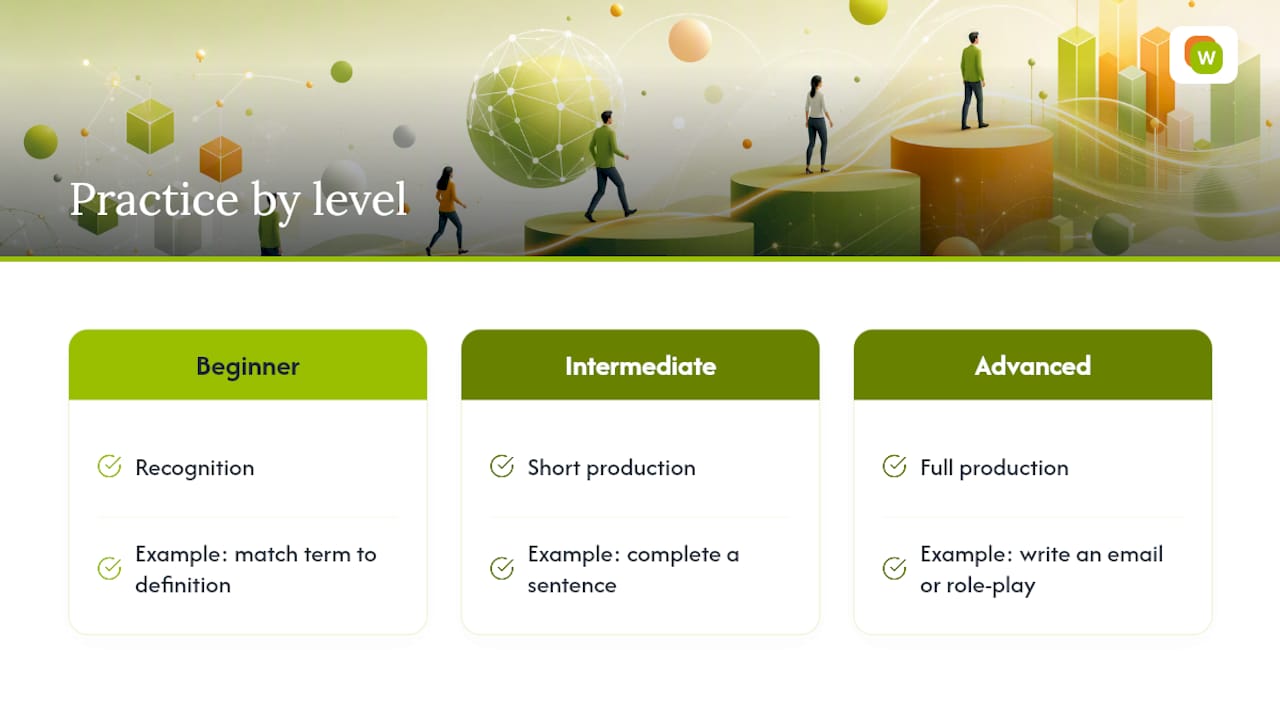
What’s the difference between Beginner, Intermediate, and Advanced business vocabulary practice? Beginner exercises test recognition, like matching a term to its definition. Intermediate exercises test short production, like completing a sentence. Advanced exercises test full production, like writing an email or handling a role-play under pressure.
Do these exercises align with TOEIC or BEC exams? Yes, broadly. TOEIC weights reading and listening comprehension in office scenarios, so gap-fill and listening cloze exercises map well. BEC also tests written production, so email rewrites and short reports matter more if you’re preparing for that exam specifically.
How long should a business vocabulary practice session be? Fifteen to 20 minutes, three to four times a week, works better than one long weekly session. Short, frequent sessions fit spaced repetition far more naturally than cramming.
Can I practice business vocabulary from content I’m already reading for work? Yes, and it’s often more effective than a separate textbook, since the vocabulary is already relevant to your role. Tools like WordByWord let you collect terms directly from reports, PDFs, and videos as you encounter them.
Sources
- Business English | LearnEnglish
- VOCABULARY LIST (Cambridge English: Business Preliminary)
- Business English Vocabulary: 500+ Essential Terms - italki
- Top 1000 Business English Vocabulary - My English Pages