Use short daily sessions that rotate input, output, and review, then reinforce the whole thing with a 15-minute weekly planning slot. That’s the workflow. It beats occasional marathon study sessions because it forces regular retrieval instead of one big cram, a pattern confirmed across multiple daily practice guides.
Your first move today: pick a session length (15, 30, or 60 minutes) and pick one content source you’ll return to all week. A news article, a YouTube channel, a novel. Anything you can revisit daily. Then set up a way to capture new words as you meet them, whether that’s a notebook or a tool like WordByWord that logs vocabulary right where you’re reading. Feed captured words into spaced repetition to aid retention, and build an input-output-review loop around them.
In several weeks, this typically looks like:
-
Developing a consistent streak of multiple sessions per week, even if short
-
Building a growing collection of tracked words with gradually improving retention
-
Noticeably faster recall when engaging with familiar topics
-
A recorded monologue that sounds more fluent than an initial attempt
Key Takeaways
A language learning workflow succeeds when short daily sessions rotate input, output, and review, backed by a weekly planning slot and a pre-decided survival mode for bad weeks.
| Point | Details |
|---|---|
| Rotate, don’t repeat | Alternate input, output, and review daily instead of drilling one skill for weeks at a time. |
| Match session length to your week | Use 15-minute, 30-minute, or 60-minute templates depending on available time, not motivation. |
| Never miss twice | One skipped day is normal; two in a row is how routines collapse, so pre-decide a survival mode. |
| Track production, not just streaks | A monthly 60-second monologue reveals recurring errors that daily flashcard counts miss. |
| Reduce capture friction | WordByWord highlights unknown words in real content and schedules them into spaced repetition automatically. |
Table of Contents
The Core Language Learning Workflow, Step by Step
Every sustainable routine has two layers: a weekly plan you set once, and a daily loop you repeat without thinking. Skip the weekly layer and you’ll drift. Skip the daily loop and the weekly plan stays theoretical.
Weekly planning (10 to 15 minutes, once a week):
-
Set one to three measurable goals (“finish this article series,” “hit 200 reviewed words,” “record three monologues”).
-
Choose your resources for the week: one input source, one output prompt, one review deck.
-
Block your session times on a calendar, treating them as fixed appointments rather than “whenever I have time.”
Daily session anatomy (repeat every session, any length):
-
Warm-up and input: read, watch, or listen to something at or slightly above your level.
-
Production: write, speak, or type using what you just absorbed.
-
Review: run a spaced repetition session on words due that day.
This structure mirrors what practitioner guides call a three-block routine, cycling vocabulary, listening, and speaking rather than drilling one skill in isolation. The order matters less than the rotation. What breaks routines is doing input every day and never circling back to output.
A few decision rules keep you from overthinking each session:
-
Pick your length before you sit down. Deciding “should I do 15 or 60 minutes” mid session burns willpower you need for the actual work.
-
Never miss twice. Missing one day is normal life. Missing two in a row is how habits die. If you skip Monday, Tuesday is non-negotiable, even if it’s just five minutes.
-
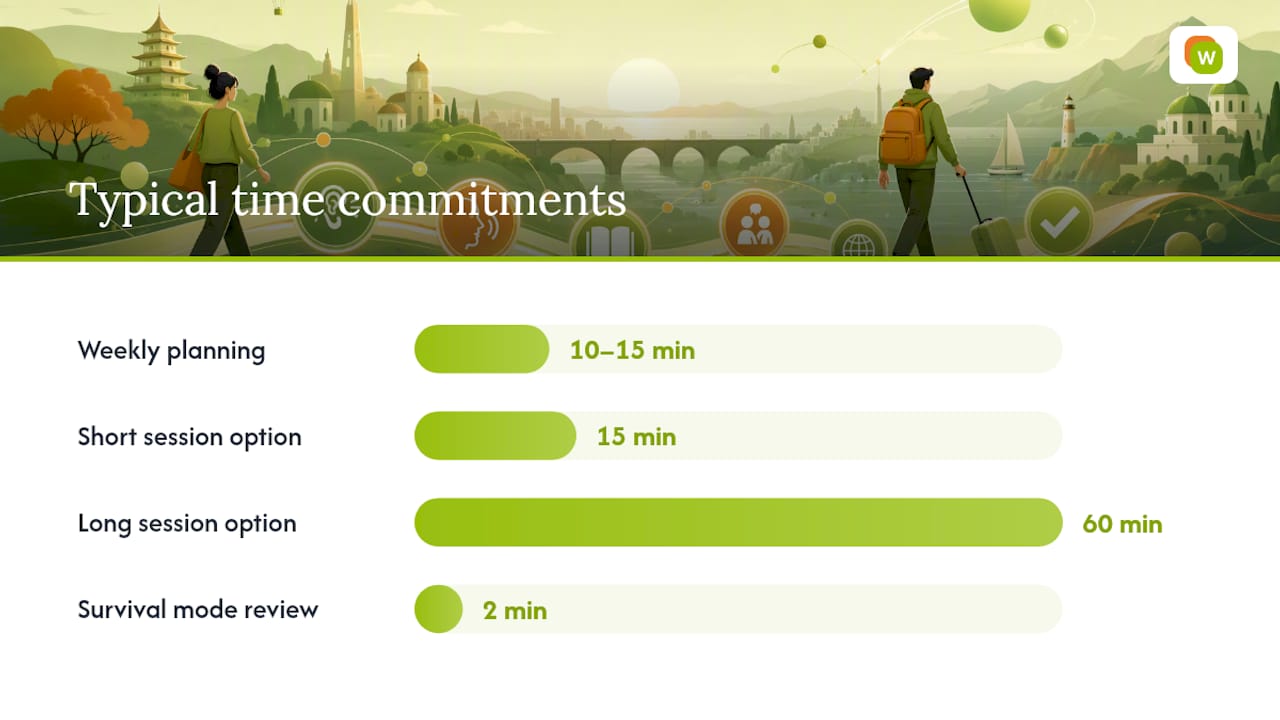
Run in Full, Maintenance, or Survival mode depending on your week. Full is your ideal session. Maintenance is a shortened version that still touches input, output, and review. Survival is a two-minute flashcard review when everything else is on fire. Pick your mode before you start, not after you’ve already failed to finish the full version.
The step people skip most is converting what they read into something they produce, a process enhanced by tools like the AI Accent Coach with Human-Based Instructions that support daily speaking practice. Take three words you just captured from an article and write two sentences using each one. This “stamps” vocabulary into retrievable memory rather than leaving it as passive recognition, a distinction that matters because recognizing a word on a page is a completely different skill from pulling it out of your own head during a conversation. Comprehensible input, the idea that exposure to material you mostly understand drives acquisition, remains a foundational piece of language acquisition theory. But input alone tends to stall out around the intermediate plateau unless you force retrieval through active production.
Pro Tip: End every session by writing down the single hardest word or phrase you encountered, before you close your laptop. That one item becomes tomorrow’s warm-up question to yourself, and it takes ten seconds.
Session Templates You Can Copy Into Your Calendar Today
You don’t need to invent a routine from scratch. Here are three templates scaled to how much time you actually have, plus a way to rotate them across a week so you’re not doing the identical thing every day.
15-minute template (the “I’m busy” version):
-
8 minutes of input: read a short article or watch a clip with subtitles.
-
4 minutes of micro-production: write two or three sentences using new words you just met.
-
3 minutes of spaced repetition review on due cards.
30-minute template (the workhorse version):
-
10 minutes of input: a longer article, podcast segment, or video.
-
10 minutes of output: a short recorded monologue about what you just consumed, or a written summary.
-
10 minutes of spaced repetition review.
This 10/10/10 split shows up repeatedly across practitioner routines because it keeps cognitive load balanced. Nobody burns out on any single skill.
60-minute template (the deep-work version):
-
20 minutes of expanded input: watch a video with a transcript, then reread the transcript for anything you missed the first time.
-
20 minutes of focused production: a session with a tutor or exchange partner, or, without one, a longer recorded monologue with self-correction.
-
20 minutes of spaced repetition plus deliberate practice on your three weakest recurring errors.
For a weekly rotation, don’t run the same template on repeat. Try 30 minutes on Monday, Wednesday, and Friday, a 60-minute deep session on Saturday, and 15-minute maintenance sessions on the remaining days. Vary your input topic too: news on Monday, a TV episode on Wednesday, a podcast on Friday. Repetition of structure builds the habit. Repetition of content kills your motivation by week three.
Capturing Words and Choosing Tools Without Overcomplicating It
The gap between people who build vocabulary and people who don’t usually isn’t talent. It’s capture discipline. If you meet a new word and don’t record it with enough context, you’ll forget it exists by tomorrow.

A word worth keeping needs four things attached to it: the word itself, the sentence it appeared in, the source (article title, video, page), and roughly when you found it. Skip the context and you’ll end up reviewing a flashcard with no memory of why that word mattered.
You need four tool categories, not four separate apps for each:
-
An in-browser highlighter or translator that lets you tap a word on any page, PDF, or video subtitle and get a definition without leaving the content.
-
A spaced repetition deck that supports export and import, so your vocabulary isn’t locked into one app forever.
-
An audio player or transcript tool for listening practice with rewind and subtitle support.
-
A simple habit tracker, even a paper calendar, to mark sessions completed.
A workable capture pipeline looks like this: highlight the word where you meet it, tag it by topic or difficulty, drop it into a collection, then let spaced repetition schedule your reviews automatically. This is the exact loop tools like WordByWord are built around, translating unmapped words on any webpage or PDF in one click and queuing them for review without a separate data-entry step.
Pro Tip: Pick one tool per category and commit to it for at least a month. Resource hopping, switching decks or apps every time you hit friction, resets your review streaks and scatters your vocabulary across five half-finished systems.
Designing Habits That Survive a Bad Week
Willpower is not a strategy. Attach your sessions to something you already do daily, and the decision to practice disappears.
-
Coffee brewing: 5 minutes of vocabulary review while it drips.
-
Commute: a podcast or audiobook chapter, hands-free.
-
Lunch break: 10 minutes of reading in your target language.
-
Evening wind-down: a short recorded monologue about your day.
Operational frameworks that build in emergency protocols and default modes tend to produce better adherence than routines that assume every week will go smoothly. Define three modes in advance:
-
Full mode: your complete 30 or 60-minute session, run on a normal week.
-
Maintenance mode: a 15-minute compressed version touching input, output, and review.
-
Survival mode: two minutes of flashcard review, nothing else, reserved for your worst days.
The rule that ties it together is simple: never miss twice in a row. One skipped day is noise. Two is the start of a new, worse habit. Pair that with a fixed 15-minute Sunday review of the week, where you glance at your streak and adjust next week’s goals. Visible progress, even something as basic as a streak counter or a running word count, tends to keep motivation higher than vague intentions to “get better eventually.”
How to Tell If Your Routine Is Actually Working
Three numbers tell you almost everything: minutes practiced, new words reviewed and retained, and a monthly production sample.
The production sample matters most and gets skipped most. Record a 60-second monologue on any topic today. Do it again in exactly a month. Comparing the two recordings surfaces recurring errors you’d never notice session by session, things like a grammar pattern you keep botching or a hesitation on the same type of sentence.
Watch for three warning signs that your workflow needs adjusting:
-
Recall on spaced repetition cards has stalled or is declining despite consistent review.
-
Speaking retrieval feels slower this month than last, not faster.
-
Comprehension gains on your usual input material have flattened out.
| Cadence | What to check |
|---|---|
| Weekly | Session count, minutes logged, cards reviewed |
| Monthly | New 60-second monologue compared against the last one |
| Quarterly | Full goal reset: are your original targets still the right ones |
A 30-Minute Session Using WordByWord, Start to Finish
Open an article and check its comprehension level, the percentage of words in that text you already know before reading a single line. If it reads too easy, pick something denser. If the comprehension level is very low, find something closer to your current range.
Spotlight mode highlights unfamiliar words directly on the page as you read, so you’re not hunting for what you don’t know. Add five to eight of them to a collection as you go.
-
Minutes 0 to 10: read with Spotlight active, tapping unfamiliar words for instant translation.
-
Minutes 10 to 20: write or speak two sentences using each of the five to eight words you just collected.
-
Minutes 20 to 30: run a spaced repetition review on that collection plus anything else due.
Collections export to CSV, so a week’s captured vocabulary maps directly onto your weekly goal count without extra copying. If your target was 50 new words this week, your collection totals tell you exactly where you stand.
The words you capture while reading something you actually wanted to read stick better than words copied from a vocabulary list you’ll never revisit.
Why We Built Around the Workflow, Not the Curriculum
Fixed curricula assume a learner who fits a mold. Real learners read, watch, and skim different things every day. Adopt a survival default this week, then adjust it once you see what actually breaks.
Try a 10-Minute Capture Session With WordByWord
The workflow above only works if capture is frictionless, and that’s the specific gap WordByWord closes. Instead of writing new words on a sticky note and losing them by dinner, you highlight a word inside whatever you’re already reading or watching, it drops into a collection, and spaced repetition schedules the review automatically. Capture, collection, review, production. Four steps, one browser extension, zero separate study app to open.
 Try a 10-minute workflow with WordByWord
Getting started takes less time than reading this section. Install the extension, open an article or a YouTube video with subtitles in your target language, and highlight five words you don’t know. That’s the whole first session. From there, Wordbyword handles the scheduling, and the free plan covers this entire loop with no cost to test it. If you want a running start on vocabulary, browse a ready-made collection like business English essentials and import it straight into your review queue.