
TL;DR:
- The best AI language learning apps in 2026 cater to different needs, including grammar, speaking, and vocabulary. Combining a conversational app with a vocabulary capture tool accelerates progress and retention.
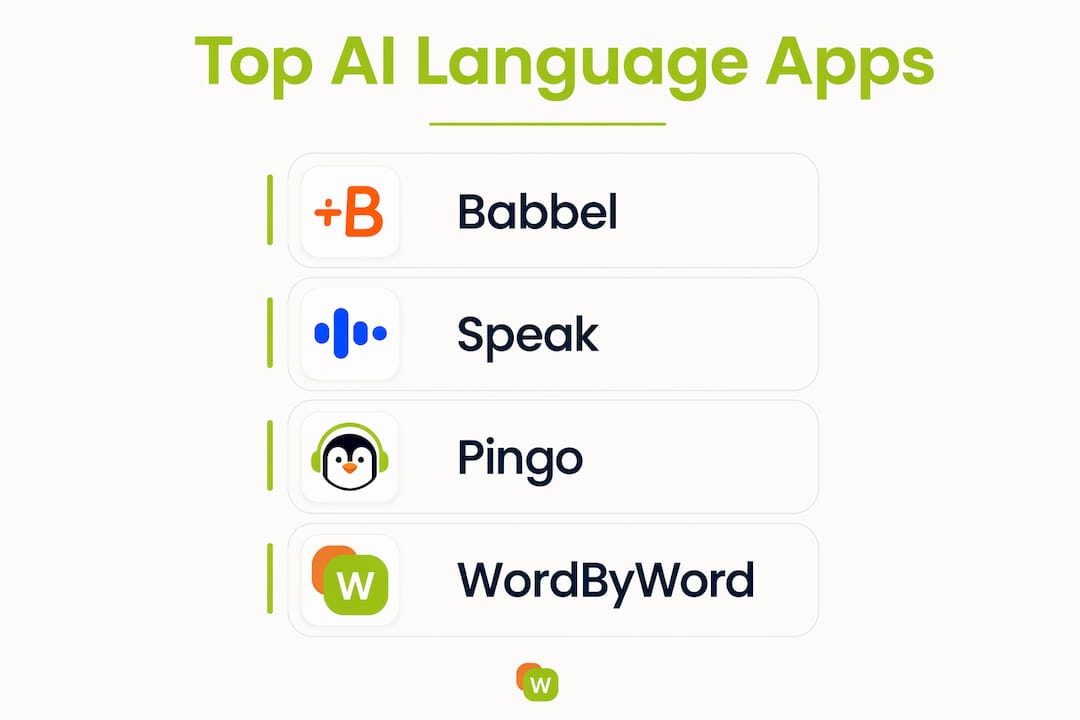
The best AI language learning apps right now are Babbel, Speak, Pingo, and WordByWord. Each one takes a genuinely different approach to fluency, and the right pick depends entirely on what you actually need: structured grammar, spoken conversation practice, or vocabulary you absorb while reading real content online.
Here’s what each one does best:
- Babbel delivers structured, expert-built lessons covering grammar, vocabulary, and pronunciation, with many users reporting proficiency improvement within a few months.
- Speak is built around getting you to talk from day one, using AI conversation practice and real-time pronunciation feedback backed by an OpenAI partnership.
- Pingo fills the gap between classroom drills and real conversation, letting you practice speaking in natural, goal-driven scenarios from the first session.
- WordByWord works differently from all three: it’s a browser extension that builds vocabulary as you browse, read PDFs, or watch YouTube, turning everyday content into a personalized learning environment.
No single app covers everything. The learners who make the fastest progress in 2026 tend to combine a conversational app with a tool that captures vocabulary from real-world content.
Table of Contents
- 1. Babbel: structured lessons built by language experts
- 2. Speak: AI conversation practice with real-time feedback
- 3. Pingo: conversational practice that adapts to your goals
- 4. WordByWord: vocabulary acquisition built into your browsing
- How to choose the right AI language learning app
- WordByWord turns your browser into a language classroom
- Key Takeaways
1. Babbel: structured lessons built by language experts
Babbel’s courses are developed by more than 200 language experts, which shows in how the content is sequenced. Grammar explanations connect directly to practical phrases, so you’re not just memorizing rules in isolation. Lessons run 10–15 minutes, making it easy to stay consistent without carving out a dedicated study block.
The platform covers 14 languages and uses spaced repetition to reinforce vocabulary at the right intervals. Speech recognition checks your pronunciation after each spoken exercise. It’s not the most conversational experience, but as a foundation for grammar and vocabulary, it’s hard to beat.
Pricing: Subscription-based with monthly, quarterly, and annual plans. A free trial is available.
Device compatibility: iOS, Android, and web browser.
2. Speak: AI conversation practice with real-time feedback
Speak is built around one idea: most apps teach you about a language; Speak makes you use it. The Speak Method follows a three-step loop: learn phrases native speakers actually use, practice until they’re automatic, then apply them in back-and-forth AI conversation.

The app has been downloaded more than 15 million times globally and holds a 4.8-star rating across the App Store and Google Play. Its OpenAI Startup Fund backing supports the conversational AI engine, which adjusts lessons based on your specific errors and learning history over time. That personalization is what separates it from a generic chatbot: the app tracks your weak spots and builds review sessions around them.
Speak supports Spanish, French, Korean, Japanese, Italian, and Simplified Chinese. For learners who freeze when it’s time to actually speak, this is the most direct fix available.
Pricing: 7-day free trial, then Premium or Premium Plus subscription. Premium Plus adds custom “Made for You” lessons generated from your mistake history.
Device compatibility: iOS and Android.
3. Pingo: conversational practice that adapts to your goals
Pingo takes a different angle on speaking practice. Instead of a fixed curriculum, you tell Pingo your level, your goals, and the situations you care about, and it builds a path around that. Conversations cover everyday moments, travel scenarios, job interviews, or whatever you’re actually preparing for.
More than 6 million learners use Pingo, and the app’s memory feature is one of its strongest points: it tracks your mistakes, vocabulary gaps, and progress across sessions so each conversation builds on the last. Learners who’ve hit a plateau with grammar-focused apps often find that Pingo’s open-ended conversation format pushes them past it.
AI conversation practice in a low-pressure environment also reduces speaking anxiety, which is one of the most common barriers to real fluency. There’s no embarrassment about a wrong answer when your conversation partner is an AI.
Pricing: Free tier available; premium subscription for full access.
Device compatibility: iOS and Android.
4. WordByWord: vocabulary acquisition built into your browsing
WordByWord operates on a different premise than the apps above. Rather than asking you to set aside study time, it integrates into what you’re already doing online. Highlight any word on a website, PDF, or YouTube subtitle, and WordByWord translates it instantly, adds it to your personal vocabulary collection, and queues it for review.
The Spotlight mode is the feature that makes this genuinely different: it overlays color-coded highlights on any webpage based on how well you know each word, from unknown to mastered. You can scan a page in seconds and know immediately whether the text is at your level. As your vocabulary grows, the highlights fade.
Smart flashcards and an AI trainer then convert those captured words into long-term retention. WordByWord supports over 50 languages, covers YouTube subtitles, and works across websites and PDFs without requiring a separate app session.
Pricing: Free tier with core translation and vocabulary features. Paid subscription unlocks unlimited collections, AI-powered exercises, enhanced voiceover, and advanced personalization.
Device compatibility: Browser extension (Chrome and compatible browsers).
Pro Tip: Pair WordByWord with a conversational app like Speak or Pingo. Use WordByWord to capture vocabulary from articles and videos you’re already reading, then practice those exact words in your next Speak or Pingo session. The combination of contextual exposure and active speaking practice accelerates retention faster than either tool alone.
How to choose the right AI language learning app
Wirecutter’s 2026 review makes a point worth taking seriously: the best AI app is the one that fits your actual goal, not the one with the most downloads. Before picking, answer three questions.
What’s your primary gap?
- If you struggle with grammar and vocabulary foundations, start with Babbel.
- If you can read the language but freeze when speaking, Speak or Pingo will move the needle faster.
- If you consume a lot of content in your target language but lose words you don’t know, WordByWord addresses that gap directly.
What’s your budget?
Most of these apps offer a free tier or trial. Babbel and Speak require a subscription for full access. WordByWord’s free tier covers the core features, which is enough for many learners to start. Premium unlocks AI-generated exercises and unlimited collections.
What devices do you use?
Speak and Pingo are mobile-first. Babbel works on mobile and web. WordByWord is a browser extension, so it’s desktop-focused but pairs naturally with any mobile app you use for speaking practice.
A few other factors matter too:
- Data privacy: Check each app’s privacy policy before connecting a microphone or syncing learning data. Speak’s privacy policy is publicly listed at speak.com; Pingo addresses voice data handling in its FAQ.
- Consistency over intensity: Fifteen minutes daily outperforms two-hour weekend sessions for language acquisition. Pick an app you’ll actually open every day.
- Active over passive: Passive listening or reading alone won’t build fluency. Apps that require you to produce language, speak out loud, or actively collect and review vocabulary, build skills that stick. Learners who use structured literacy approaches alongside AI tools often see stronger long-term retention because the combination reinforces both decoding and active recall.
Pro Tip: When you find an article or video in your target language that genuinely interests you, that’s your best study material. Use WordByWord to capture unknown words from it, then use a conversational app to practice sentences built around those words. Interest-driven content beats scripted exercises for motivation and retention.
WordByWord turns your browser into a language classroom
Every app on this list requires you to open it intentionally. WordByWord works the other way: it meets you where you already are. Whether you’re reading the news, watching a YouTube documentary, or working through a PDF, WordByWord is capturing vocabulary and building your personal word bank in the background.
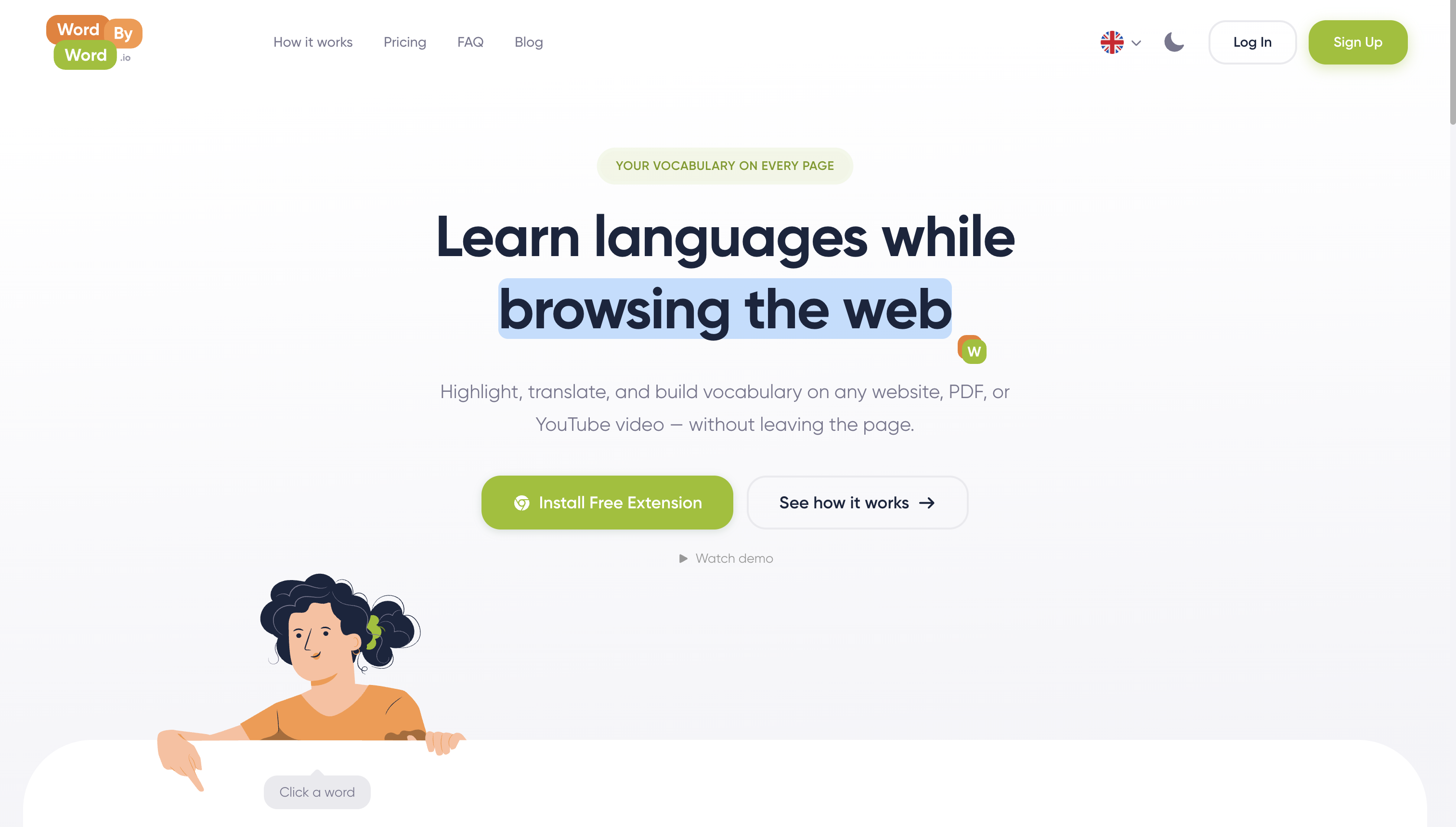
The Spotlight mode gives you an instant visual read on any page’s difficulty level, so you’re never wasting time on content that’s too easy or too frustrating. The AI trainer then takes the words you’ve collected and turns them into smart flashcard sessions timed for maximum retention. Over 50 languages are supported, including less common ones that most apps skip entirely.
The free tier is a real starting point, not a demo. Core translation and vocabulary tracking are available without a subscription. The paid plan adds unlimited collections, AI-generated exercises, voiceover, and advanced personalization for learners who want the full system. Start building vocabulary from the content you’re already reading today.
Key Takeaways
The most effective approach to AI language learning in 2026 combines a conversational practice app with a tool that captures vocabulary from real-world content you’re already consuming.
| Point | Details |
|---|---|
| Match app to your gap | Babbel for grammar foundations, Speak or Pingo for speaking confidence, WordByWord for vocabulary from real content. |
| Babbel’s proven results | 92% of Babbel users report improvement in language proficiency within two months. |
| Speak’s reach and AI backing | Speak has millions of downloads and a direct OpenAI partnership powering its conversational AI. |
| Hybrid learning wins | Combining a conversational app with a browser-based vocabulary tool produces stronger retention than either alone. |
| WordByWord’s approach | WordByWord’s Spotlight mode and smart flashcards build vocabulary passively during everyday browsing across 50+ languages. |