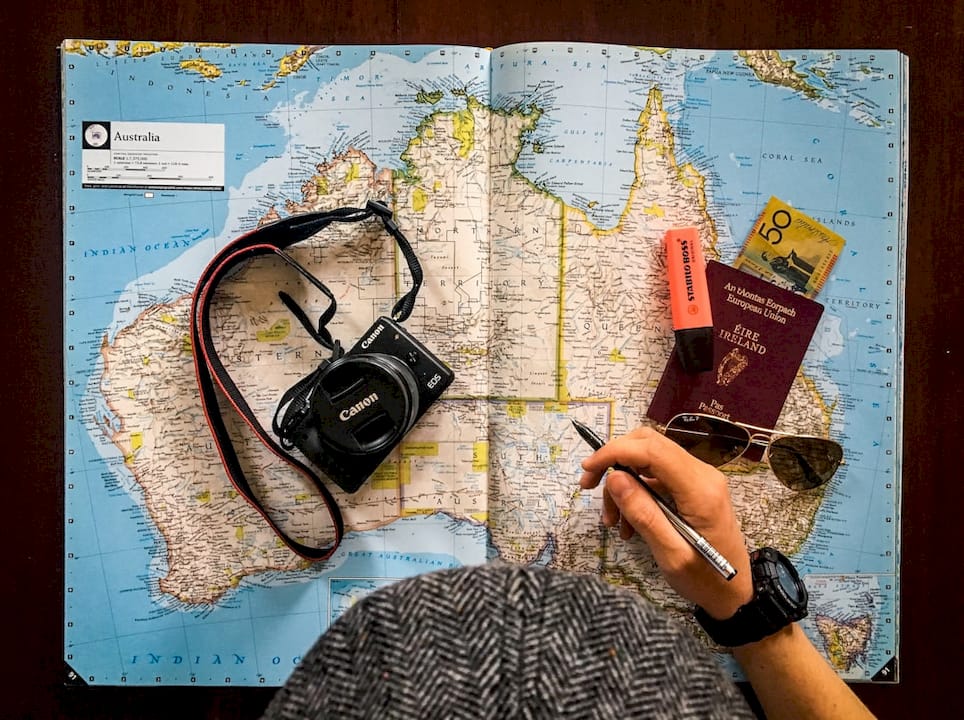
You don’t need fluency to travel. You need seven scenarios covered, cold, and a routine that keeps them fresh. Airport, hotel, local transport, directions, restaurants, payments, and emergencies: master short, reusable scripts for each and you can function almost anywhere English or the local language throws a curveball at you.
The routine is simpler than most learners expect. Short daily sessions of spaced repetition, adding new mini-scripts regularly, and periodic live roleplays improve readiness. That’s it. Structured, scenario-based preparation reduces travel anxiety and outperforms memorizing random word lists, because you’re rehearsing the exact exchange you’ll actually have, not studying vocabulary in the abstract.
Prioritize:
-
Airport check-in, security, and boarding
-
Getting from the airport to your hotel (trains, buses, taxis)
-
Asking for and understanding directions
-
Hotel check-in, requests, and problems
-
Ordering food and paying
-
Shopping and handling money
-
Emergencies and pharmacy needs
Key Takeaways
Scenario-based mini-scripts paired with short daily spaced repetition prepare travelers faster than general fluency study ever will.
| Point | Details |
|---|---|
| Prioritize seven core scenarios | Airport, transport, directions, hotel, food, shopping, and emergencies cover most travel interactions. |
| Use the three-line script format | Structure every phrase as greeting, request, and confirmation to aid recall under stress. |
| Match study time to trip length | A weekend trip needs five to seven scripts; a monthlong stay warrants the full four-week schedule. |
| Rehearse recovery phrases | “Repeat that?” and “Write it down?” belong in daily practice, not just as a last resort. |
| Build offline backups | Download language packs and screenshot key addresses before losing signal abroad. |
| Use WordByWord to collect and drill phrases | Save phrases from real travel pages and YouTube into a collection reviewed with spaced repetition. |
Table of Contents
-
Travel Vocabulary Preparation for Getting to Your Destination
-
Travel Vocabulary Preparation for Hotels, Food, and Everyday Life
-
How to Prepare: Building Your Travel Vocabulary Study Routine
Travel Vocabulary Preparation for Getting to Your Destination
Every trip starts the same way: you’re moving through systems designed by strangers, in a language you’re still catching up on. The airport, the plane, the taxi line. These are high-stress, low-flexibility environments, which is exactly why scripted phrases work better here than anywhere else. You’re not improvising a conversation. You’re executing a known sequence.
Airport check-in and security
Check-in counters run on a predictable pattern: booking reference, ID, bags, questions. Build your script around that order.
-
Opening line: “Good morning, I have a reservation under [name].” or “Here’s my booking reference: [number].”
-
The request: “Could I check this bag, please?” or “I’d like a window seat, if one’s available.”
-
Confirmation: “So that’s gate [number], boarding at [time]. Thank you.”
If your flight’s delayed or you’ve missed a connection, you need a fallback script too: “My connecting flight was delayed. Can you help me rebook?” Airlines expect this exact question dozens of times a day, so keep it short and direct.
Security and customs work differently. Officers ask closed questions, and you answer in fragments, not sentences. “Any liquids or electronics in your bag?” gets a “Yes, one laptop” or “No, nothing.” If you don’t follow a question, don’t guess: “Sorry, could you repeat that?” or “Could you speak a bit slower, please?” are two of the most useful lines in this entire article, and they work in almost every scenario below too.
Onboard phrases
Once you’re seated, the vocabulary shrinks again. You’ll mostly need: “Excuse me, could I get some water?”, “Is this seat taken?”, “Where’s the restroom?”, and “Sorry, what did the announcement say?” Flight attendants deal with confused passengers constantly, so a simple, polite question always lands better than an apologetic paragraph.
Trains, buses, and taxis
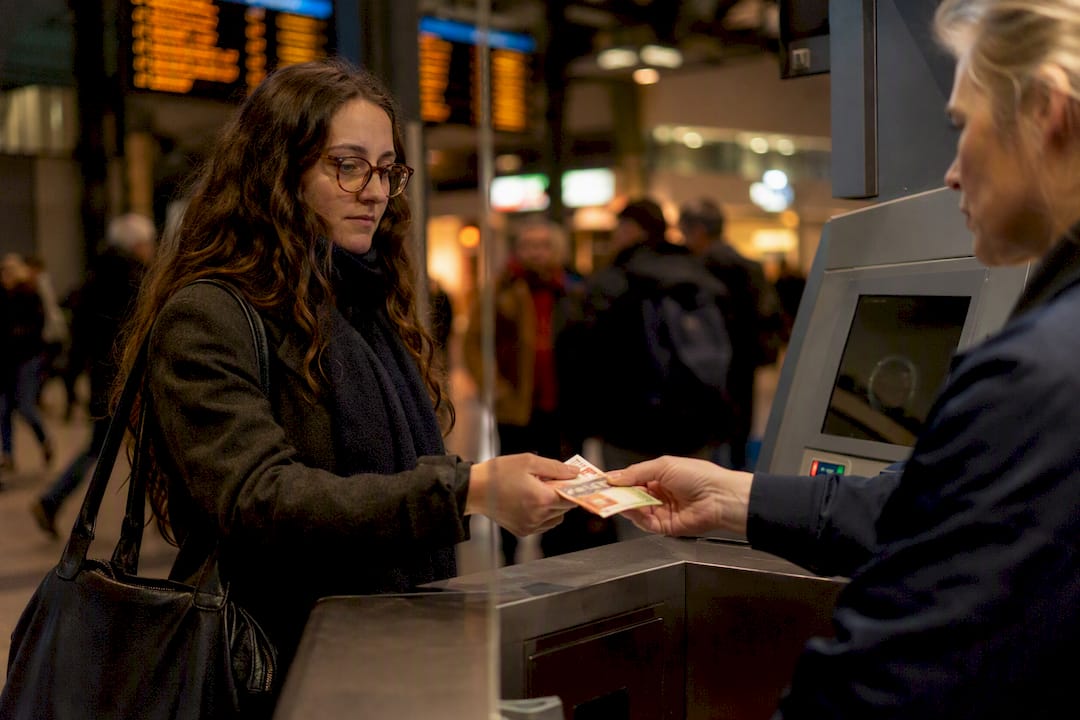
Ticket counters and machines follow their own script. “One ticket to [destination], please” or “Does this bus go to [place]?” covers most transactions. On board, “Could you tell me when we reach [stop]?” is worth memorizing word for word, because missing your stop in an unfamiliar city costs real time.
Taxis are more conversational. State your destination clearly, confirm the fare or meter, and have a backup: showing the driver a screenshot of the address on your phone. This isn’t cheating. It’s one of the most reliable recovery tactics available, especially for addresses with tricky pronunciation.
Directions
Asking for directions is a three-part script almost every time:
-
Ask: “Excuse me, how do I get to [landmark]?”
-
Clarify: “Is that on the left or the right?” or “Is it within walking distance?”
-
Confirm: “So I go straight, then turn left at the church. Got it, thank you.”
Pro Tip: Repeat the direction back to the person in your own words before you walk away. It forces you to process what you heard, and it gives them a chance to correct you if you got it wrong.
Recovery phrases for every scenario above
No matter which of these situations you’re in, the same five recovery lines apply:
-
“Could you say that again, please?”
-
“Could you speak a little slower?”
-
“Could you write that down for me?”
-
“Do you have a number I can call?”
-
“Here, let me show you on my phone.” (with the address or screenshot ready)
These aren’t backup phrases you hope to avoid using. They’re core vocabulary. Rehearsing recovery under mild stress bridges the gap between recognizing a phrase and actually producing it when you’re tired, jet lagged, and standing in a line that’s moving faster than you’d like.
Travel Vocabulary Preparation for Hotels, Food, and Everyday Life
Once you’ve arrived, the pace slows down, but the vocabulary gets more varied. You’re no longer moving through a fixed system. You’re negotiating, ordering, asking, and occasionally complaining. This is where a slightly wider phrase set pays off.
Hotels and accommodations
Check-in follows a familiar pattern: “I have a reservation under [name],” followed by whatever request you need. “Could I get an early check-in?” “Do you have any rooms with a view?” “Could you bring up an extra towel?” Each of these is a complete mini-script on its own: state the need, wait for the answer, confirm the arrangement.
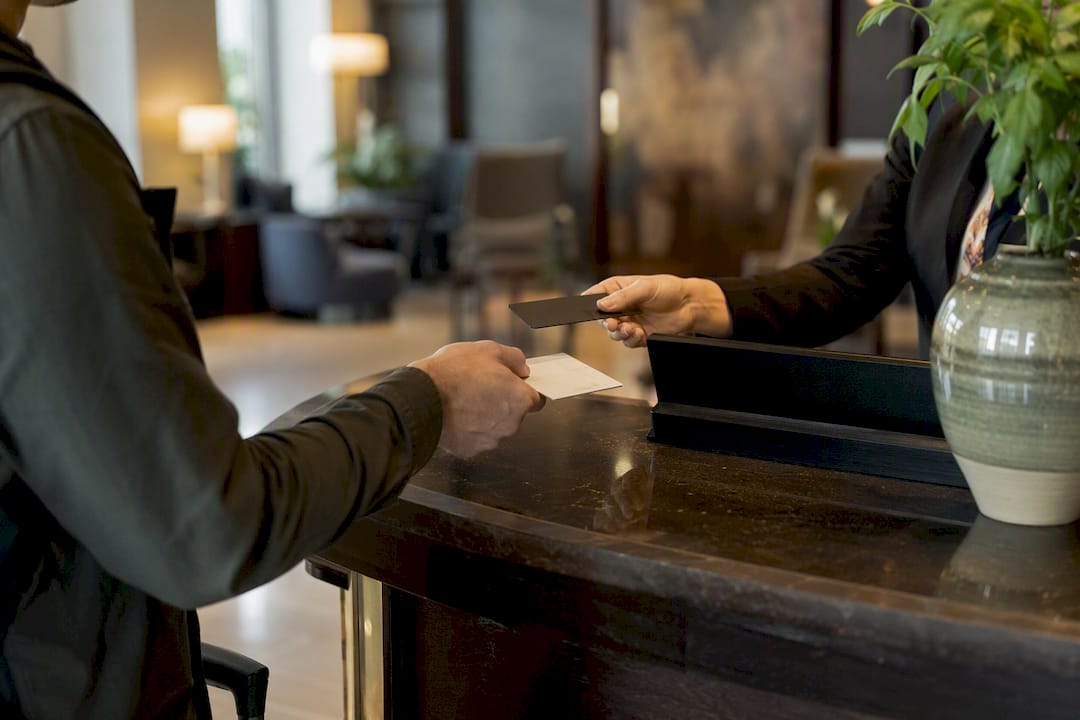
Problems require a slightly firmer version of the same structure. “There’s an issue with my room. The air conditioning isn’t working” states the fact plainly, then adds the ask: “Could someone come take a look?” Hotel staff are trained to solve problems quickly, so a clear, calm description gets faster results than an apologetic one.
Before checkout, two questions cover almost everything: “What time is checkout?” and “Could I get a receipt for my stay?” If breakfast or transport is included, ask directly: “Is breakfast included?” or “Can you help me arrange a taxi to the airport?”
Restaurants and food
Ordering food breaks down into four moves: greeting, question, order, and payment.
-
“Hi, could we get a table for two?”
-
“What do you recommend?” or “Does this dish contain nuts/dairy/gluten?”
-
“I’ll have the [dish], please.”
-
“Could we get the bill, please?” and, if needed, “Could we split this?”
Dietary restrictions deserve their own attention if they apply to you. Memorize the exact phrasing for your allergy or restriction in advance rather than improvising it at the table. “I’m allergic to [ingredient]” is a sentence you want to have said out loud twenty times before you actually need it under pressure. Tipping customs vary widely by country, so check the local norm before you go rather than guessing at the table.
Shopping and markets
Shopping vocabulary is short and transactional: “How much is this?”, “Do you have this in a smaller size?”, “Can I get a discount if I buy two?” In markets where bargaining is customary, a polite counteroffer works better than a flat refusal: “Could you do [lower price]?” said with a smile goes further than silence.
Always ask for a receipt, especially for larger purchases: “Could I get a receipt, please?” In countries where tourists can claim a tax refund on purchases, ask the shop directly: “Is this eligible for a tax refund?” Staff will usually walk you through the paperwork if you ask early, before you leave the store.
Sightseeing and attractions
Tickets, hours, and tours all follow the same short pattern. “Two tickets, please” or “Is there a discount for students?” covers admission. “What time do you close?” and “Is there a guided tour in English?” cover the logistics. If you’re lost inside a museum or site, “Where can I find [exhibit]?” is worth having ready, since layouts rarely match the map you were handed at the entrance.
Social phrases and everyday politeness
A short list of openers and closers rounds out your everyday vocabulary:
-
“Hi, how’s it going?” / “Good morning” / “Good evening”
-
“Nice to meet you, I’m [name].”
-
“Thank you so much, that’s really helpful.”
-
“Would it be okay if I took a photo?”
-
“That sounds great, thank you!” or “Thanks, but I think I’ll pass this time.”
Emergency and pharmacy vocabulary
Keep this list separate and memorized cold, because you’ll need it fast if the moment arrives: “I need a pharmacy” or “I need a doctor.” “I have a headache/fever/allergic reaction.” “Where’s the nearest hospital?” “Can you call an ambulance?” “I’ve lost my passport.” None of these need elaboration. Say the fact, then the need.
How to Prepare: Building Your Travel Vocabulary Study Routine
The mini-script structure holds for every scenario in this article: an opening line, a specific request or question, and a confirmation or closing. Three lines, trained as one unit. Structuring practice around this three-part pattern significantly improves recall under stress, which matters more for travel than almost any other kind of language use, since you’re often tired, distracted, or mildly anxious when you actually need the phrase.
Here’s what that looks like in practice:
-
Hotel: “I have a reservation under [name].” → “Could I get an early check-in?” → “Perfect, thank you, see you at [time].”
-
Restaurant: “Table for two, please.” → “Does this contain nuts?” → “Great, I’ll have that, thanks.”
-
Directions: “Excuse me, how do I get to [place]?” → “Is that on the left?” → “Got it, straight then left, thank you.”
A prep schedule that fits your trip length
Preparation time should scale with how long you’re going and how often you’ll need the language. Matching study time to trip duration keeps you from over-investing in phrases you’ll rarely use, so a weekend trip and a three-month stay call for genuinely different routines.
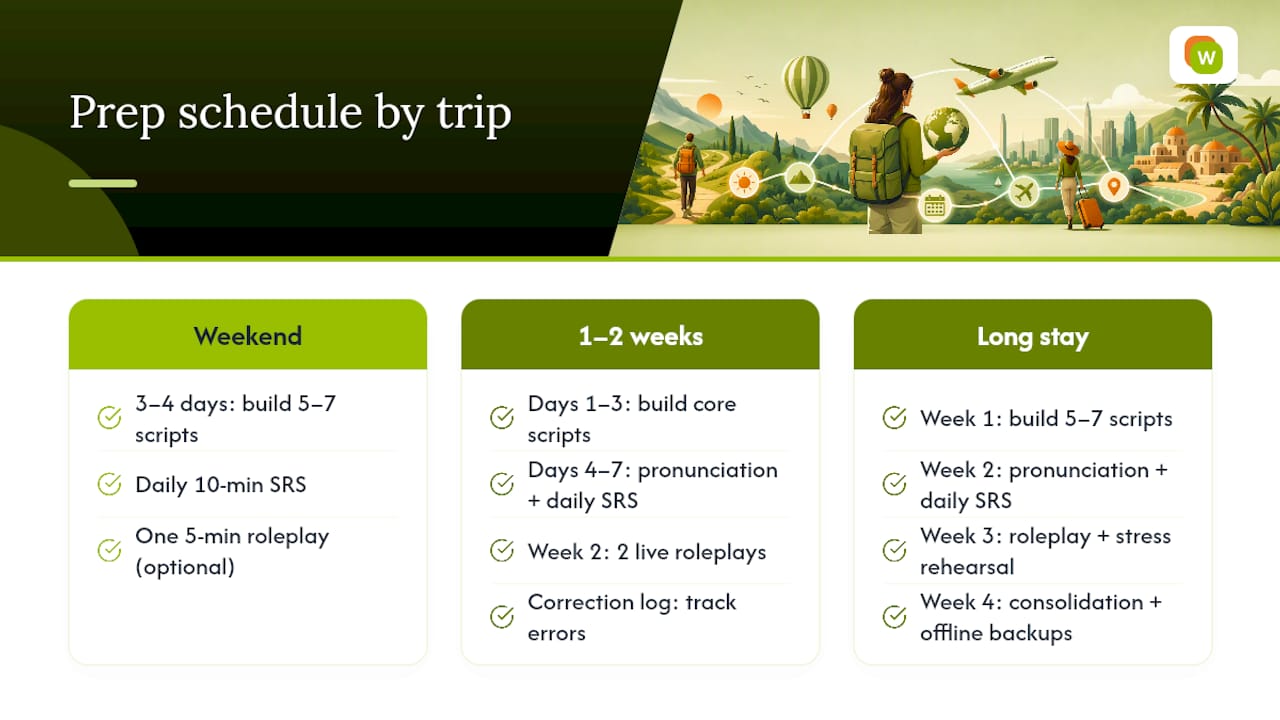
Weekend trip (under a week): Spend three or four days building five to seven mini-scripts covering your highest-priority scenarios, only. Ten minutes of spaced repetition daily, no roleplay required, though one five-minute practice run with a friend helps.
One to two weeks: Follow a fuller four-week arc compressed into two: days one to three build your core scripts, days four to seven add pronunciation drilling and daily SRS, the second week adds two live roleplays and a correction log where you track every phrase that tripped you up.
Longer stays (a month or more): Run the full four-week arc. Week one: pick scenarios, build five to seven mini-scripts. Week two: add pronunciation and daily SRS review. Week three: roleplay and stress rehearsal, including simulating background noise or a rushed exchange. Week four: consolidation and offline backups.
Setting up your flashcards
Each flashcard should carry four fields: the phrase itself, a literal translation (not just an idiomatic one, since the literal version often explains the grammar), a pronunciation note, and the context where you’d use it. Weight your review sessions toward the cards you keep getting wrong. That’s the entire point of spaced repetition: time gets spent where memory is weakest, not evenly across everything you’ve added.
-
Review your SRS deck for ten to fifteen minutes.
-
Add one new mini-script.
-
Say every phrase in the deck out loud, not just in your head.
-
Twice a week, run a full roleplay of one scenario, ideally with noise or a time constraint added.
Pro Tip: Rehearse your recovery phrases specifically under simulated pressure, like with a timer running or music playing. The version of you standing at a foreign train station is not as calm as the version of you studying flashcards on your couch, and your practice should reflect that.
Offline backups
Download an offline language pack before you leave, since airport WiFi and international data plans fail you more often than you’d like. Screenshot your hotel address, your itinerary, and any confirmation numbers, so you have them even with no signal. A one-page printed sheet with your top ten emergency phrases, in both English and the local language, costs nothing and solves a genuine problem when your phone dies at the worst possible moment.
Turning Travel Pages Into a Ready-to-Use Phrase Collection
The gap between reading a phrase list and actually recalling it at a foreign counter is where most travel prep quietly fails. WordByWord closes that gap by turning the article you just read into something you actually review.
Here’s the workflow: browse a travel guide, a menu, or a booking confirmation page, click any unfamiliar word or phrase to translate it instantly, and save it straight into a “travel phrases” collection. The same works inside YouTube subtitles, so a video on ordering coffee in Lisbon turns into flashcards without any manual typing.
-
Spotlight mode highlights which words on a page you already know versus which ones need work, so you’re not re-studying vocabulary you’ve already mastered.
-
Comprehension level tells you before you dive in whether a given menu or article matches your current level.
-
Collections can be built by hand, generated by AI from a prompt like “restaurant phrases for Italy,” or imported via CSV if you’ve already got a list.
-
Flashcards come with voiceover and seven training modes, including a 60-second sprint that fits neatly into the ten to fifteen minute daily routine this article recommends.
Preparation research is consistent on one point: phrases learned in context, from material you’ll actually encounter, stick better than phrases studied from an isolated list.
Offline access means your travel collection travels with you, no signal required.
Why the article underestimates how fast this actually works
Most travel-prep advice treats vocabulary building and scheduling as two separate problems: learn the phrases, then figure out how to review them. That split is where most people quit. The scenarios in this article work because the script structure, greeting, request, confirmation, gives you a container small enough to actually rehearse in a spare ten minutes, not a vague goal like “get better at Spanish.”
What we’d push back on is the assumption that longer trips need dramatically more vocabulary. They mostly need more repetition of the same core scripts, applied to more situations, not a bigger list. Scale your rehearsal frequency before you scale your phrase count.
Build Your Travel Collection Before You Board
You’ve got the scripts. Now you need somewhere to actually store and drill them, and that’s the part most travel phrase lists never solve, since a PDF you read once on a flight doesn’t survive contact with a real conversation three weeks later.
WordByWord turns any travel page, menu, or booking site into flashcards in one click, so your “airport phrases” and “restaurant phrases” collections build themselves as you read, instead of requiring a separate study session you’ll skip. Set your SRS reviews to ten minutes a day, download the offline pack before your flight, and you’ll land with scripts you’ve already rehearsed dozens of times, not just read once. Browse the English travel phrases library for a ready-made starting collection covering airports, hotels, and restaurants, or start from scratch with the free plan and build your own from the pages you’re already reading about your destination.